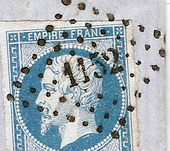
Numbered postmark is a type and collective name of postmarks that have a cancellation impression with numbers (digits), letters (letters) or their combination that allow identifying the post office from which the postal item was sent [1] .
Content
History and Description
On the number stamp, instead of the name of the post office and its location there is a conditional number assigned to this item [1] . Such stamps appeared in Great Britain in 1843, three years after the release of the first postage stamp . They were used throughout the entire XIX century [1] , but they were used a little bit until the XX century.
Postage stamps began to be extinguished on the letter using a special device to prevent their reuse, and also began to stamp or stamp the stamp with the date and the name of the post office in 1840, when postage stamps appeared in the UK.
Soon, in many countries, various systems were formed, where the cancellation stamp had a code (number) identifying the post office of the place of departure of correspondence. Most of these codes framed a pattern in the form of points, rays, strips [2] , concentric circles or ovals to ensure effective cancellation of the postage stamp. Stamps of similar images that do not contain any number codes are called dumb blanking stamps. Later, double stamps with a calendar stamp on the left and a cancellation stamp on the right came into use. Numbered blanking stamps were used throughout the nineteenth century, but only a few remained in use in the twentieth century.
Reprints of license plates are collected by philatelists , and rare specimens can be expensive.
Country Examples
The postal administrations that applied license cancellation stamps include the following.
Great Britain and its colonies
The first numeric cancellation stamps were license plates with numbers in the Maltese cross , used at the London Post Office since 1843. Since 1844, characteristic stamps of another strip pattern have been introduced in England, Scotland and Ireland. Codes corresponding to London postal districts, for example, “W21”, were also used [3] .
- British post offices abroad
Numbered blanking stamps were used in many British post offices that worked in foreign countries (mainly in Central and South America and the Ottoman Empire) and used British postage stamps . [4] These include:
- Argentina : "B32" ( Buenos Aires ).
- Bolivia : C39 (Cobicha).
- Brazil : C81 ( Bahia ) C82 ( Pernambuco ) and C83 ( Rio de Janeiro ).
- Venezuela : D22 (Ciudad Bolívar) and C60 (La Guaira).
- Haiti : C59 ( Jacmel ) and E53 ( Port-au-Prince ).
- Danish West Indies : “C51” or “D26” ( St. Thomas ).
- : “C86” ( Porto Plata ) and “C87” ( Santo Domingo ).
- Colombia : “C35” ( Panama ), “C56” or “C65” ( Cartagena ), “C62” ( Santa Marta ), “E88” ( Colon ) and “F69” ( Savanilla ).
- Cuba : C58 ( Havana ) and C88 ( Santiago de Cuba ).
- Mexico : C63 ( Tampico ).
- Nicaragua : C57 (Greytown).
- Peru : “C36” ( Arica ), “C38” ( Callao ), “D87” ( Iquique ), “C42” ( Islay ), “C43” ( Payta ), “D65” (Pisagua) and “D74” ( Pisco Islands and Chincha ).
- Puerto Rico : F84 (Aguadilla), F83 (Arroyo), F85 (Mayagues), 582 (Naguabo), F88 (Ponce) and C61 (San Juan).
- Ottoman Empire : "G06" ( Beirut ), "C" ( Constantinople ), "F87" ( Smyrna ) and "S" ( Istanbul ).
- Uruguay : C28 ( Montevideo ).
- : "247" ( Fernando Po ).
- Chile : C30 (Valparaiso), C37 ( Caldera ) and C40 ( Coquimbo ).
- Ecuador : "C41" ( Guayaquil ).
- Australian colonies
Prior to the formation of the federation in all Australian colonies, numbered cancellation stamps were used [5] [6] :
- in Victoria - up to 2100 (in various devices), earlier types of stamps included the letter "V" ;
- in Western Australia - with numbers up to 36 and with letter codes, for example, “GT” for Geraldton ;
- in Queensland - up to 747 and “BNG” - on postage stamps in circulation in Papua ;
- in New South Wales - with numbers up to 2094 (several types), as well as “LHI” - for Lord Howe ;
- in Tasmania - with numbers (in lanes) up to 390 and on Norfolk - with code 72, when it was part of Tasmania;
- in South Australia - up to 313.
- Antigua
Antigua used the banded postmarks [2] of the cancellations “A02” ( St. John's ) and “A18” ( ), initially on postage stamps of Great Britain.
- Bahamas
In the Bahamas , a stripe cancellation stamp “A05” ( Nassau ) was used, originally on UK postage stamps.
- Barbados
- Bermuda
- British Guiana
In , the banned cancellation stamps “A03” ( Georgetown ) and “A04” (New Amsterdam) were used, originally on UK postage stamps.
- British Virgin Islands
The British Virgin Islands used the A13 ( Tortola ) Damping Cancellation stamp, originally on UK postage stamps.
- British Bechuanaland
- British Honduras
In Honduras , the United Kingdom used the “A06” ( Belize City ) cancellation stamp stamp, originally on Great Britain postage stamps.
- Gibraltar
In Gibraltar , the banded postmarking stamps “G” and “A26” were used , originally on postage stamps of Great Britain.
- Hong Kong
In Hong Kong , the “B62” cancellation stamp was used. An additional 62B cancellation stamp was also used.
- Grenada
In Grenada, the A15 ( St. Georges ) cancellation postmark stamp was used, initially on UK postage stamps.
- Dominica
In Dominica, the “A07” ( Roseau ) cancellation stamp was used, originally on UK postage stamps.
- Egypt
In Egypt , the banned cancellation stamp “B01” ( Alexandria ) or “B02” ( Suez ) was used, originally on UK postage stamps.
- Zanzibar
- Golden shore
- India
- Canada
In Canada and in the provinces of Newfoundland, Prince Edward Island, and British Columbia, numeric cancellation stamps were used.
- Cyprus
Cyprus used the banned cancellation stamps “982” ( Famagusta ), “974” ( Kyrenia ), “942” ( Larnaca ), “975” ( Limassol ), “969” ( Nicosia ), “981” ( Paphos ), “D48 ” (HQ Camp, Nicosia) and “ D47 ” (Camp Polymedia, Limassol), originally on UK postage stamps.
- China and Japan
For contractual ports of China or Japan, where British administrations and consulates acting as local postmaster for traders working in China used Hong Kong postage stamps, their own blanking stamps were made [7] [8] .
- China
- Xiamen, 1844 - “A1” (1866–1885) and “D27” (1876–1885).
- Canton, 1844 - “C1” (1866-18585).
- Fuzhou, 1844 F1 (1866-1885).
- Hankow, 1872 “D29” (1879–1885).
- Cunchzhou (HOIHOW), 1873 "D28" (1876-18585).
- Ningbo, 1844 - “N1” (1866–1885).
- Shanghai, 1844 - “S1” (1866–1885).
- Svatou, 1861 - “S2” (1866–1885).
- Japan
- Kobi, 1869 - D30 (1876–1879).
- Nagasaki, 1860 - “N2” (1866–1879).
- Yokohama, 1859 - “Y1” (1867–1879).
- Mauritius
In Mauritius, at first, the blanking stamp “B53” was used , and then other codes with the prefix “B” and the strip number stamps.
- Malta
In Malta , the banded cancellation stamps “M” and “A25” were used (both in Valletta ), first on British, and later on Maltese postage stamps:
- The postmark "M" was put into use in 1857 and continued to be used until 1860. Imprints of this stamp are found only on British postage stamps and on the first print run of the first Malta postal stamp, a yellow penny penny.
- The postmark "A25" appeared in 1859 and continued to be used until 1904. There are several different types of this stamp, as it has been used for a long time. Postmarks "A25" are found mainly on British and Maltese postage stamps, as well as on some foreign stamps thanks to ship mail [9] .
- Monserrat
On Montserrat, the A08 ( Plymouth ) cancellation stamp stamp was used, originally on UK postage stamps.
- Nevis
Nevis A10 ( Charlestown ) cancellation stamp stamp was used on Nevis , originally on UK postage stamps.
- Seychelles
In the Seychelles, the B64 quenching stamp was used, originally on the stamps of Mauritius.
- St. Vincent
St. Vincent used the A10 ( Kingstown ) cancellation stamp stamp, originally on UK postage stamps.
- Saint christopher
At St. Christopher , the A12 ( Baster ) blanking postmark was used, originally on UK postage stamps.
- Saint Lucia
Saint Lucia used the A11 ( Castries ) cancellation stamp stamp, originally on UK postage stamps.
- Straits Sets
- Trinidad and Tobago
Trinidad and Tobago used the A14 quenching stamp ( Scarborough ) stamp, originally on UK postage stamps.
- Ceylon
- South African colonies
The British South Africa Company , the Cape Colony , Natal, the Orange Free State and the Transvaal used numeric cancellation stamps.
- Jamaica
In Jamaica , a blanking A01 cancellation stamp was used for the capital of Kingston , originally on the stamps of Great Britain. Cancellation stamps from “A27” to “A78” were used in various district post offices, again, also originally on UK postage stamps.
Belgium
Venezuela
In Venezuela , a number of strip numbered stamps were used.
Denmark
In Denmark , a series of numbered stamps (up to 286) in three concentric circles was used. Some duplex stamps were used. All of them were withdrawn from circulation in 1873.
Guatemala
In Guatemala, numbered stamps were used by both the country's postal administration and British mail .
German states
Before the merger, various German states had numbered cancellation stamps [10] :
- up to 177 - in Baden,
- to 920 - in Bavaria,
- up to 50 - in Braunschweig,
- up to 220 - in Saxony,
- up to 42 - in Schleswig,
- 424 - mail Thurn and Taxis ,
- in Prussia numbered stamps from 1987 were used.
Greece
Iceland
Spain
Italy
Colombia
Mexico
Netherlands and colonies
In Holland and its colonies Curaçao , Suriname, and the used a series of numbered stamps.
Nicaragua
Norway
Portugal
Russia
In Russia, numbered stamps have been used to extinguish postage stamps since 1858 [1] .
United States
Uruguay
France
The cancellation stamp was diamond-shaped or trapezoidal from dots about 20 mm in size on each side, with a number code in the center. The code consisted of a number that included from one to four digits and was unique to the post office that used it. For this reason, philatelists sometimes refer to such numbers as “town codes”.
Two main types of diamond-shaped stamps were used:
- ( fr. "losange à petits chiffres" - "rhombus with small numbers") - from 1852 [11] to 1862, and
- ( “losange à gros chiffres” - “rhombus with large numbers”) - from 1862 to 1876.
The differences between these two types are based largely on the size of the code digits and the size of points in the stamp. The points are noticeably smaller in a “rhombus with small numbers,” and the code numbers are about 4 mm high. City codes from 1 to 4494 are recorded. City codes from 3704 to 4018 and 4222 indicate use in French post offices abroad.
At the “big numbers diamond” stamp, the codes were twice as large, being almost 8 mm high. Since the overall size of the stamp remained the same, a larger part of the stamp with larger numbers was the area code. The list of codes used increased with the opening of new post offices, codes are known up to 6449. City codes 2387 and 5079-5156 were allocated to designate French post offices outside of continental France.
Chile
See also
- Postmark
Notes
- ↑ 1 2 3 4 Numbering stamp // Big philatelic dictionary / N. I. Vladinets, L. I. Illyev, I. Ya. Levitas ... [and others ] ; under total ed. N. I. Vladintsa and V. A. Jacobs. - M .: Radio and communication, 1988. - p. 302. - 40 000 copies. - ISBN 5-256-00175-2 . (Checked February 10, 2017) Archived copy . The date of circulation is February 10, 2017. Archived on March 13, 2016.
- ↑ 1 2 The Banner Stamp // Big Philatelic Dictionary / N. I. Vladinets, L. I. Il'ichev, I. Ya. Levitas ... [ and others ] ; under total ed. N. I. Vladintsa and V. A. Jacobs. - M .: Radio and communication, 1988. - p. 303-304. - 40 000 copies - ISBN 5-256-00175-2 . (Checked July 20, 2016) Archived copy . The date of circulation is July 20, 2016. Archived on October 13, 2012.
- ↑ Stanley Gibbons Commomwealth and British Empire Stamps 1840-1970. - Stanley Gibbons Ltd .. - ISBN 0-85259-683-9 .
- Ley Stanley Gibbons Stamp Catalog - Part 1: British Commonwealth 1985. - 87. - London : Stanley Gibbons Publications Ltd, 1984. - ISBN 0-85259-087-3 .
- ↑ Campbell, HM Australian Numeral Cancellations: A Compendium . - Royal Philatelic Society of Victoria, 1983. - ISBN 0-9592675-3-0 .
- ↑ Post Office References . Premier Postal Auctions . The appeal date is January 5, 2014.
- ↑ Webb, FW of China and Japan (1961)
- Ho Schoenfeld, H. Cancellations of the Treaty of Hong Kong, 1850. - 1930 (1998)
- Roud Proud EB The Postal History of Malta. - , East Sussex , UK: Proud-Bailey Co. Ltd., 1999. - p. 191-193. - 320 p. - ISBN 1-872465-31-5 . (eng.)
- ↑ Nummernstempel / Auswahl . Briefmarken-Tipps . The appeal date is January 5, 2014.
- Track How to track down your killers on your stamps . Linns.com . The date of circulation is July 12, 2016. Archived August 1, 2013.
Literature
- Numbering stamp // Philatelic Dictionary / V.Grallert, V.Grushke; Abbr. per. with him. Yu. M. Sokolov and E. P. Sashenkova. - M .: Communication, 1977. - p. 223. - 271 p. - 63 000 copies
- Y.Ya. Levitas, V.M. Basyuk , “Nіmi” i number stamps // All about the brands / Y.Ya. Levitas, V.M. Basyuk. - K .: Advertising, 1975. - p. 126. - 238 p. (in Ukrainian)