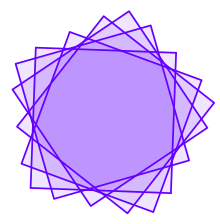
A counterexample of five squares, built by Kiss and Vidnyavsky.
Keleti's problem is the question of combinatorial geometry about an upper estimate for the ratio of the perimeter to the area of union of equal squares. Formulated by Tamas Keleti in 1998. [1] In 2014, a counterexample was found.
Content
- 1 Formulation
- 2 notes
- 3 History
- 4 Variations and generalizations
- 5 notes
- 6 References
Wording
Suppose - the union of a finite number of unit squares in the plane. Is it true that
Where denotes the perimeter, and area .
Remarks
- If all the centers of all the squares coincide, then equality holds.
History
- Tamas Keleti proved that the relation is bounded above by a constant.
- Genes [2] [3] proved that
- He also proved
- in three cases:
- if all the squares from the family are obtained from each other by parallel transfer,
- if the squares have a common center
- if the number of squares is 2.
- In 2014, Victor Kiss and Zolten Vindyanski built a counterexample of 5 squares. They also built an example with a ratio of about . [four]
Variations and generalizations
- By Keleti's theorem, for a given polygon K , the quotient of the perimeter to the area of an arbitrary union of polygons equal to K is bounded above.
- Similar problems for regular polygons also have counterexamples. That is, for a regular polygon K, there exists a finite set of equal polygons with a union F such that
Notes
- ↑ T. Keleti, A covering property of some classes of sets in , Acta Univ. Carolin. Math. Phys. 39 (1998), no. 1-2, 111–118.
- ↑ Z. Gyenes, The ratio of the perimeter and the area of unions of copies of a fixed set, Discrete Comput. Geom. 45 (2011), no. 3, 400–409.
- ↑ Z. Gyenes, The ratio of the surface-area and volume of finite un ion of copies of a fixed set in , MSc thesis, 2005.
- ↑ Viktor Kiss, Zoltán Vidnyánszky. Unions of regular polygons with large perimeter-to-area ratio // Discrete Comput. Geom .. - 2015. - Vol. 53 . - P. 878-889 .
Links
- Pálvölgyi Dömötör, Is the ratio Perimeter / Area for a finite union of unit squares at most 4? , MathOverflow .