Nikolai Vasilyevich Paliyenko ( Ukrainian Mikola Vasilovich Palіnko ; September 30, 1896 , Gazebo , Tarashchansky district, Kiev province - July 21, 1944, Brody , Lviv region ) - Russian and Ukrainian officer who served in the rank of Sturmbannfr during the Second World War SS Grenadier Division "Galicia" .
| Nikolai Vasilyevich Palienko | |||
|---|---|---|---|
| Ukrainian Mikola Vasilovich Palіnko | |||
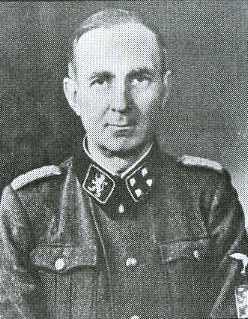 Palienko in SS uniform | |||
| Date of Birth | September 30, 1896 | ||
| Place of Birth | Arbor , Tarashchansky district , Kiev province , Russian Empire | ||
| Date of death | July 21, 1944 (47 years old) | ||
| Place of death | Brody , Lviv region , USSR | ||
| Affiliation |  Russian empire Russian empire UNR UNR Poland Poland Germany Germany | ||
| Type of army | artillery | ||
| Years of service | 1915-1944 | ||
| Rank |  lieutenant RIA lieutenant RIA centurion UPR  Major Troops of the Polish Second Republic of Poland Major Troops of the Polish Second Republic of Poland  Sturmbannfuhrer SS Sturmbannfuhrer SS | ||
| Part |
| ||
| Commanded | 4th Artillery Division of the 14th SS Waffen-Grenadier Division "Galicia" | ||
| Battles / wars |
| ||
| Awards and prizes |
| ||


Biography
Born on September 30, 1896 in the village of Besedka, Tarashchansky district, Kiev province (now the Stavishchensky district of the Kiev region ). The brother of the chieftain Alexander Palienko .
In 1907 he entered the 1st grade of the Belotserkovsky gymnasium. He graduated with a silver medal from the College named after Paul Galagan in Kiev in 1914, entered the Kiev University of St. Vladimir at the Faculty of Physics and Mathematics.
On November 1, 1915 he entered the cadet at the Nikolaev Artillery School , after which on April 1, 1916, with the rank of ensign, he was sent to the front of the First World War . He rose to lieutenant in the Russian Imperial Army .
After the overthrow of the autocracy in Russia and the proclamation of the Ukrainian People's Republic , Palienko joined the army of the UPR . First he served in the artillery division of Alexei Almazov , and then in the Dnieper artillery brigade of the Directory forces, which fought against the Polish forces on the Galician front, and from April 1919 against the Bolsheviks. December 29, 1919 promoted to centurion , but because of typhoid fever did not fight in the first months of 1920. He continued his service in the 1st Zaporozhye artillery brigade of the UPR Army. At the end of 1920 was interned by the Poles. In 1922 he was released from internment camps in Kalisz and went to Czechoslovakia.
In 1927, Palienko graduated from the Chemical Engineering Department of the Ukrainian Agricultural Academy as a process engineer. In 1928, under a contract, he went to serve in the Polish Army , studied in 1932-1934 at the Higher Military School in Warsaw. In 1938 he was promoted to major in the Polish Army. He led the guns of the 3rd division of the 26th light artillery regiment of the Polish Army during the battles in Poland against German troops , was wounded and captured. Through the efforts of the OUN emissaries, as a Ukrainian officer, he was released and demobilized. In 1940-1943 he worked as an engineer at a sugar factory in Perevorsk and director in Gorodenka .
In June 1943, Palienko volunteered to serve in the 14th SS Waffen-Grenadier Division of Galichina , having undergone retraining in Benesov. He was an instructor at undergraduate courses in Pozheche. From Waffen-SS he received the title of SS Sturmbannfuhrer , equivalent to the rank of Major Wehrmacht . He commanded the division of heavy artillery and artillery batteries of the battle group of Major Byersdorf. At the beginning of 1944 he participated in punitive operations against Soviet partisans in the Lyubashevsky district . He was seconded to the Quartermaster General Gerd von Rundstedt .
Since March 1944, Palienko took a three-month course of commanders of artillery divisions in Amsterdam . As the commander of the 4th artillery division, he participated in the battle of Brody against the Soviet troops.
He was killed on July 21, 1944 during the Battle of Brody near the Prince, while trying to escape from the environment.
Literature
- Encyclopedia of Ukrainian studies. - Lviv, 1996.- V. 5. - S. 1926.
- For Statehood. Materials to Іstorії Vіyska Ukrainsky. - Toronto, 1964. - Zbirnik 11. - S. 112 V.
- Ivanis V. Life stitches (guess). - Prince V. - Novy Ulm, 1962 .-- S. 20, 203, 250.
- TSDAVO Ukraine, f. 3795, op. 1, ref. 1689. Ark. 1 - 13.
- Tinchenko, Y. Yu. Ofitsersky Corps of the Army of the Ukrainian National People's Republic (1917-1921). Book I. - K.: Tempora, 2007. - ISBN 966-8201-26-4 .
- Tinchenko Y. Yu. Ofitsersky Corps of the Army of the Ukrainian National People's Republic (1917-1921). Book II. - K.: Tempora, 2011 .-- ISBN 978-617-569-041-3 .
Links
- Major Mikola Palіnko (Ukrainian)
- Historical club "Kholodny Yar" (Ukrainian)