Polyommatus eros polyommatus eros [1] - diurnal butterfly from the family Lycaenidae .
Polyommatus eros | ||||||||||||||
|---|---|---|---|---|---|---|---|---|---|---|---|---|---|---|
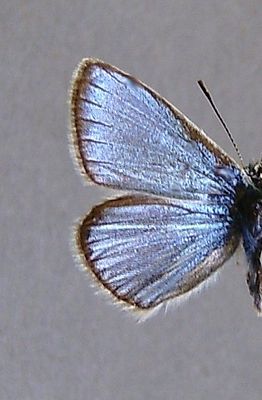 Male | ||||||||||||||
| Scientific classification | ||||||||||||||
| ||||||||||||||
| Latin name | ||||||||||||||
| Polyommatus eros (Ochsenheimer, 1808) |
Content
- 1 Etymology of the name
- 2 Description
- 3 Area
- 4 Biology
- 5 Security
- 6 References
- 7 notes
Name Etymology
Eros is the deity of love in Greek mythology [1] .
Description
Wingspan 23–28 mm. The wings of males on the upper side are blue with a narrow dark edge. On the hind wing, a number of blackish spots adjoin the dark edging. Veins to the top of the wing blacken. Female with brown coloring of the upper side of the wings and yellow-orange marginal spots on the wings. The underside of the wings of males is light gray with a pale pattern. A basal area with a bluish-blue dusting. Against the background of the hind wings, two whitish spots stand out - triangular in shape at the apex of the central cell and diffuse radiant at the marginal band. The underside of the female’s wings is darker.
The Buaduval subspecies Polyommatus eros boisduvalii (Herrich-Schäffer, 1844) differs noticeably from the rest by a lighter background of the upper side of the wings in males, a lighter brown background in females, which also have a more yellowish tint in the basal region. The subspecies also differs ecologically, inhabiting more xerophytic biotopes.
Range
It has a very torn range: the Pyrenees , Alps , Central Apennines , the mountains of the Balkan Peninsula, Asia Minor , Northwest and Central [1] .
According to recent studies, this taxon in Ukraine is represented by the subspecies of Buaduval polyommatus eros boisduvalii (Herrich-Schäffer, 1844) and the subspecies Polyommatus eros orientalis Krziwizky, 1983 [2] [3] [4] . The first is characteristic of the eastern forest-steppe regions of the country, where it is very rare and local. The second dwells dwells in Ukrainian Polesie. One of the rarest species of butterflies in the fauna of Ukraine. This always rare species over the past 30 years has been found in Ukraine in only a few copies. Probably disappeared in significant areas of the Ukrainian part of the range [5] .
It inhabits steppe and xerophytic meadows, dry edges of forests, valley meadows, edges of dry pine forests, steppe edges of pine forests and adjacent meadows, alpine stony meadows of high mountains, below - rocky meadow areas. In the mountains it is found at altitudes from 1700 to 3000 m above sea level. m
Biology
Develops in one generation throughout the year. The summer time of butterflies is from the beginning of June to the end of July, in the mountains - from the end of June to August. Feed plants of caterpillars: astragalus , Russian broom , broom . The female lays single eggs on leaves. The caterpillar passes in its development of 5 ages. Winters caterpillar of an early age. Upon reaching a length of up to 16 mm, the caterpillars stop feeding, seek shelter in the litter, hide under fallen leaves, which they attach with threads to the substrate. After 2-3 days - pupate. Pupa about 11 mm long.
Security
It is included in the Red Book of Ukraine under the name Buadyuval's polyommatus (Polyommatus boisduvalii) [5] .
It is included in the Red Book of European Day Butterflies with the category SPEC3 - a species that lives both in Europe and beyond, but is endangered in Europe.
Links
Notes
- ↑ 1 2 3 Lvov A.L., Morgun D.V. - Lepidoptera Lepidoptera in Eastern Europe (Guidelines for the Flora and Fauna of Russia), Moscow: KMK, 2007
- ↑ Vodolazhsky D.I., Wimers M., Stradomsky B.V. 2009. Comparative analysis of the mitochondrial and nuclear DNA sequences of polyommatus polyommatus (s. Str.) Latreille, 1804 (Lepidoptera: Lycaenidae: Polyommatus) // Caucasian Entomol. newsletter. 5 (1): 115-120.
- ↑ Stradomsky B.V., Polumordvinov O.A. 2007. Comparative analysis of the genitals of Polyommatus boisduvalii (Herrich-Schäffer, 1844), P. erotides erotides (Staudinger, 1892) and P. erotides krulikowskyi (Gorbunov, 2001) (Lepidoptera: Lycaenidaee ) // Caucasian Entomological Bulletin. Volume 3. Vol. 1. Rostov-on-Don - M .: KMK. S. 71 - 74.
- ↑ D.I. Vodolazhsky, B.V. Stradomsky, R.V. Yakovlev - Study of mitochondrial COI and nuclear ITS2 nucleotide DNA sequences of Mongolian representatives of the Polyommatus eros group (Lepidoptera: Lycaenidae). Caucasian entomol. Bulletin 8 (2): 264-266. 2012
- ↑ 1 2 Chervona book of Ukraine. Tvarinny svit / Pid tanned. ed. І. A. Akіmova. - K .: Globalconsulting, 2009 .-- 624 p.