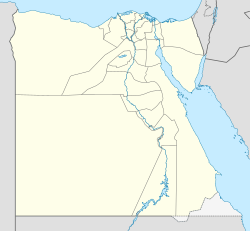
Hawara ( Arabic: هوارة DMG Hawāra ) is an ancient Egyptian necropolis located 6 km south of Fayyum .
| Hawara | |
|---|---|
| Arab. هوارة | |
| A country | Egypt |
| Region | Fayyum |
| Coordinates | |

Content
History
The first excavations in the area were carried out by Karl Lepsius in 1843. Flinders Pitri , who dug up the ruins of Hawara in 1888, discovered papyrus dating from the 1st and 2nd centuries in this place. n e., in these papyri were recorded the 1st and 2nd parts of the Iliad of Homer , which are called "Havara Homer" and are stored in the Bodleian library in Oxford .
In Havar there is an incomplete pyramid of Amenemkhet III , known as the " pyramid in Havar ." Built of unfired brick . The size of the base is 105 m, the height is 58 m. Currently, the pyramid is in a dilapidated state [1] . To the north of the pyramid in the large necropolis by Flinders Pitri, 146 portraits on sarcophagi dating from the Roman period , better known as Fayyum portraits, were found [2] .
In Hawara, the unbroken pyramid of Neferu Ptah, daughter of Amenemhet III [3] , and the tomb of Queen Nefrusebek were also found .
Gallery
Pyramid in havar
Pyramidal complex on the map of Lepsius
Fayyum portrait
See also
- List of Egyptian Pyramids
Notes
- ↑ Edwards, Dr. IES: The Pyramids of Egypt 1986/1947 p. 237-240
- ↑ FRANCESCO TIRADRITTI. Tesouros do Egito . - MANOLE. - S. 1. - 420 p. - ISBN 9788520410622 .
- ↑ Farag, Nagib. The Discovery of Neferwptah / Ministry of Culture. Antiquities Department of Egypt. - 1971.
Literature
- Mark Lehner: Geheimnis der Pyramiden. ECON, Düsseldorf 1997, ISBN 3-572-01039-X , S. 181-183.