Creeping mustard , or Pink mustard ( lat. Rhaponticum repens ) is a species of the genus Raponticum ( Rhaponticum ) of the family Asteraceae . Known as one of the most malicious and most difficult to eradicate perennials of this family.
| Gorchak creeping |
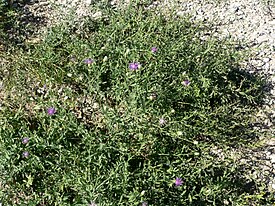
General view of a flowering plant |
| Scientific classification |
|---|
| Subtribe : | Cornflower blue |
|
| International scientific name |
|---|
Rhaponticum repens ( L. ) Hidalgo (2006) |
| Synonyms |
|---|
Acroptilon repens |
|
Due to its external resemblance to cornflower in European botanical literature, it is called "Russian cornflower".
Content
The plant has a well-developed root system with a powerful vertical stem [2] . The predominant type of reproduction is root shoot.
The adult plant reaches a height of 75 cm. It has branched stems with numerous oblong leaves.
Inflorescences are baskets. The flowers are dark pink. Flowering from July to the end of August [3] .
The native land of the plant is the steppes of Central Asia , from where it spread to the arid regions of the whole world, including Australia [4] .
Gorchak is thermophilic and sun-loving.
The northern border of its modern range in European Russia passes through the Kalacheevsky, Bogucharsky and Kantemirovsky districts of the Voronezh region [5] .
All parts of mustard are toxic in the budding phase, especially in dry years. Its toxicity does not decrease after drying.
It does not eat cattle, therefore, due to overgrazing, over time it fills the entire field with 50–80%, making it completely unsuitable for agricultural use.
