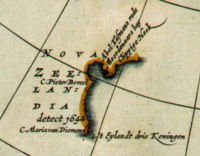
The official name of the country " New Zealand " [1] ( English New Zealand , Maori Aotearoa ) began to emerge in the middle of the XVII century - first it appeared in the records of Dutch cartographers as Nova Zeelandia , in honor of one of the provinces of the Netherlands - Zeeland ( n. Zeeland ) , then, in the Dutch script - Nieuw Zeeland [2] [3] [4] . Later, in the XVIII century, the British navigator James Cook in his notes used the English version of this name - New Zealand , and it became the official name of the country. The Russian name "New Zealand" is an exact translation of the historically formed name.
Content
Maori Names
The original name given to the Maori country before the first Europeans appeared here was not preserved, but it is known that the North Maori island was called Te Ika-a-Maui ( Maori Te Ika-a-Māui ), which can be translated as “ fish owned by Maui ” . Maui is in the Maori mythology a demigod who caught a huge fish in the ocean, which then became an island. South Island had two common names: Te Wai Pounamu ( Maori Te Wai Pounamu ) and Te Vaca-a-Maui ( Maori Te Waka a Māui ) [5] . The first name can be translated as “ jade water ”, and the second as “ boat owned by Maui ”. Until the beginning of the 20th century, the island of North was often called the indigenous people " Aotearoa " ( Aotearoa ), Which can be translated as "the country of a long white cloud " ( ao = cloud, tea = white, roa = long). According to the Maori legend, the outstanding navigator of antiquity, , saw a large white cloud on the horizon from Central Polynesia - a sign of the approaching land and, landing on this land, called it “ Aotearoa ” [6] . Later, this name became the generally accepted name in the Maori language for the whole country [7] [8] .
The third largest island of the archipelago - Stewart - in the Maori language has several names. One of them is “ Te Punga o Te Vaca a Maui ” ( Maori Te Punga o Te Waka a Maui ), translated as “anchor stone of a Maui canoe”, in accordance with the legend in which the South Island symbolizes the Maui canoe . But the most famous and used Maori name is “ Rakiura ” ( Maori Rakiura ), with respect to the etymology of which there are several versions. According to one of them, this is the abbreviation of “Te Rakyura and Te Rakitamau” (“the great and deep redness of Te Rakitamau”) - according to Maori legend, the leader Rakitamau blushed with embarrassment when he refused to marry with the two daughters of the island’s head. Another interpretation of the name " Rakiura " - "luminous skies", possibly refers to the aurora , which can be seen on the island [9] .
Names in European languages
The first Europeans, who reached New Zealand, arrived on the Dutchman’s expedition ship Abel Tasman in 1642 [10] . Expedition Tasman, examining the northern part of the west coast of the archipelago, suggested that landed on the ledge of a hypothetical continent - the Unknown South Land . Tasman gave the discovered territory the name of the Statesland (“State Land”, niderl. Staten Landt ) in honor of the General States of the Republic of the United Provinces (at that time the name of the Parliament of the Netherlands). Before Tasman, the name “ State Land ” was assigned to the land discovered in 1615 by the Dutch sailors Jacob Lemer and Willem Schouten near Tierra del Fuego , also adopted by them as a protrusion of the Unknown Southern Land. There is a view that Tasman used the same name as Schouten, believing that its land and that of Schouten represent the protrusions of the same continent, while in reality these islands are located at a distance of 8.5 thousand kilometers from each other. friend [6] . Tasman noted in his notes: “it is possible that this land [of Schouten] is connected to Staten Landt , but this is not known for certain” [11] . But already in 1643, another Dutch navigator, Hendrik Brouwer , proved that the Land of States , Schouten, was not part of the Unknown South Land, but only a small island . After that, in order to avoid confusion, the Dutch cartographers in 1645 renamed the land discovered by Tasman into Nova Zeelandia , in honor of the Netherlands province of Zeeland [3] [4] . The Latin form Nova Zeelandia in Dutch was assumed to be the Netherlands. Nieuw Zeeland , and in 1769-1770 the British explorer James Cook finally proved the insular position of the archipelago and called it in English - English. New Zealand [6] .
In 1840, Great Britain declared New Zealand its colony and approved the list of New Zealand’s main islands, with their names: North Island ( North Island ), Middle Island ( South Island ) and Stewart Island or South Island [ 12] [13] . After that, in 1841, the New Zealand administrative-territorial division was carried out: the North Island received the status of the province , the present South Island - the province of , and the island of Stewart - the province , by analogy with the eponymous provinces of Ireland [12] . These names of administrative-territorial formations did not take root: in 1846 the province of New Leinster was abolished, and in 1853 - New Ulster and New Munster. From the 1830s, the name “South Island” was used as an alternative for the Middle Island, and by 1907 it was fully established [14] .
In 2009, the Council on Geographical Names of New Zealand , the country's main body in the field of toponymic policy, found that the names of the main islands were not formally approved by any legal act. This omission was corrected in 2013, when the islands were officially called “Northern” ( Maori Te Ika-a-Maui) and “Southern” ( Maori Te Wa Vaypounamu) [15] . Maori and English names may be used interchangeably.
Informal titles
During its history, New Zealand and its various parts have received a number of unofficial names. At the end of the 19th century, New Zealand was informally referred to as “Maoriland” (from the Maoriland ), from the ethnonym of the indigenous population, and “God's country” ( God's Own Country ) [16] [17] . The first name was widely used in the labor movement , and one of the country's first working newspapers was named Maoriland Worker ( eng. Maoriland Worker ). Richard Seddon , the Prime Minister of New Zealand , who was in power the longest, popularized the name “Country of God”. Both of these nicknames of the country in the XX century have become obsolete, although the nickname “God's country” (or “Godzone”) is sometimes found [18] . Latin country names are Zealandia and Nova Zealandia [19] .
After the release of the film trilogy " The Lord of the Rings " by Peter Jackson , which was filmed in New Zealand for eight years, the country received the nickname " Middle-earth ." Wellington , the center of the local film industry, was often honored with this nickname, and the local newspaper The Evening Post was renamed The Middle Earth Post a week before the release of the first film. The city of Matamata , located near the place where many scenes were shot in the Hobbit , informally renamed itself “Hobbiton” [20] . The flourishing of the film industry in Wellington gave rise to the city’s nickname, “Wellywood”, but the proposal to install a Hollywood -style sign near Wellington Airport was rejected because of possible copyright infringements [21] .
See also
- Place Names of New Zealand
- Toponymy of New Zealand
Notes
- ↑ Dictionary of Geographic Names of Foreign Countries, 1986 , p. 255.
- ↑ A Note on the two 'New Zealands' (English) . Mapforum. The appeal date is December 12, 2008. Archived August 21, 2011.
- ↑ 1 2 Wilson, John Tasman's achievement . Te Ara - the Encyclopedia of New Zealand (September 2007). The appeal date is February 16, 2008.
- ↑ 1 2 Mackay, Duncan. The New Zealand Book Of Events. - Auckland: Reed Methuen , 1986. - p. 52–54.
- ↑ Mein Smith, 2005 , p. 6
- ↑ 1 2 3 Pospelov, 2002 , p. 293.
- ↑ Hay, Maclagan, Gordon, 2008 , p. 72.
- ↑ King, 2003 , p. 41
- ↑ History and naming of Stewart Island (English) . The appeal date is September 18, 2018.
- ↑ Mein Smith, 2005 , p. 23.
- ↑ Tasman, Abel JOURNAL or DESCRIPTION By me '' Abel Jansz Tasman '', Of a Voyage from '' Batavia '' for Making Discovery of the Unknown South Land '' in the year 1642. . Project Gutenberg Australia. The appeal date is March 26, 2018.
- ↑ 1 2 Paterson, Donald (April 2009), "New Leinster, New Munster, and New Ulster" , in McLintock, Alexander, from An Encyclopaedia of New Zealand , Te Ara: The Encyclopedia of New Zealand , < http: // www .TeAra.govt.nz / en / 1966 / provinces / 1 > . Retrieved January 7, 2011.
- ↑ Brunner, Thomas. The Great Journey: An Expedition to the Middle Island, New Zealand, 1846-8 . - Royal Geographical Society , 1851.
- K McKinnon, Malcolm Place names - Naming the country and the main islands . Te Ara - the Encyclopedia of New Zealand (November 2009). The appeal date is January 24, 2011.
- ↑ New Zealand Government (10 October 2013). Names of NZ's two main islands formalized . Press release .
- ↑ Phillips, Jock The New Zealanders - Maorilanders Neopr . Te Ara: The Encyclopedia of New Zealand (March 2009). The appeal date is February 27, 2011.
- ↑ Bracken, Thomas (1843–1898) . Dictionary of Australian Biography. The appeal date is February 27, 2011.
- ↑ Woodham, Kerre . Their spirit is strong (Feb 28, 2011).
- ↑ Orsman, HW The Dictionary of New Zealand English: a dictionary of New Zealand on the New Zealand. - Auckland: Oxford University Press, 1997. - p. 931–932.
- ↑ Lord of the Rings: Magic for New Zealand Tourism? National Geographic (Dec 19, 2001). The appeal date is February 23, 2011.
- ↑ Airport backs down over 'Wellywood' sign (March 31, 2010).
Literature
in Russian
- Pospelov EM. Geographic names of the world. Toponymic dictionary / resp. ed. R.Ageeva. - 2nd ed., Stereotype. - M .: Russian dictionaries, Astrel, AST, 2002. - 512 p. - 3 000 copies - ISBN 5-17-001389-2 .
- Dictionary of place names of foreign countries / A. M. Komkov. - M .: Nedra, 1986. - 459 p.
in English
- King, Michael. The Penguin History of New Zealand. - Penguin Books, 2003. - ISBN 978-0143018674 .
- Mein Smith, Philippa. A Concise History of New Zealand. - Australia: Cambridge University Press, 2005. - ISBN 0-521-54228-6 .
- Hay, Jennifer; Maclagan, Margaret; Gordon, Elizabeth, Jennifer. Dialects of English: New Zealand English. - Edinburgh University Press, 2008. - ISBN 978-0-7486-2529-1 .
Links
- Place Names & Street Names - information on the New Zealand Geographical Names Board , a database and official information from the
- New Zealand Gazetteer of Official Geographic Names - links to databases of all official geographic names in New Zealand