Damage ( lat. Contusio ) - closed damage to tissues and organs without significant violation of their structure. The surface tissues ( skin , subcutaneous tissue , muscles and periosteum ) are more often damaged. Soft tissue, which is pressed to the bones at the time of injury, is especially affected by strong impact.
| Injury | |
|---|---|
 Bruise of the upper leg caused by a blunt object | |
| ICD-10 | , , , , , , , , , , , , , , , , , , , , , , , , , , , , , , , , , , , , , , , , , , , , , , , , , , , , , , , , , , , , , , , , , , , , , , , , , , , , , , , , , , , , , , , , , , and |
| ICD-9 | xxx |
| Diseasesdb | |
| Medlineplus | |
| Mesh | D003288 |

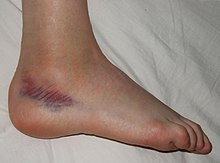
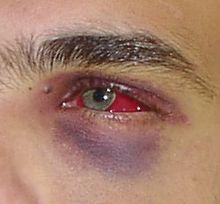
From the point of view of forensic medicine, “bruise” is an unfortunate term that does not determine the nature of the damage, but rather is a mechanism for the formation of any damage, for example, bruising. The concept of "bruise" reflects the mechanism of formation, that is, there was an impact with a blunt object, resulting in damage in the form of bruised wounds, bruises, abrasions, etc., as well as subarachnoid hemorrhages, ruptures of tissues and internal organs.
Also, "bruises" can occur during explosive and gunshot injuries, when in addition to local, local effects, there are signs of a "hydrodynamic shock", that is, damage to organs and tissues away from the "point of application of force."
As a rule, with a bruise, the victims experience more or less intense pain. Continued bleeding deep in the tissues often leads to additional trauma to neighboring tissues as a result of their compression, which is accompanied by a gradual increase in pain and impaired function. Hemorrhage at the site of the injury is usually manifested by bruising - a blue-purple spot, the color of which gradually changes to greenish and yellow.
Content
Reasons
It usually occurs as a result of a blow by a blunt object or when falling.
Bruising Effects
- As a result of a bruised shin in the area of the pre-inner surface, where the skin and subcutaneous tissue are adjacent to the bone, skin necrosis and its subsequent rejection are possible.
- When hitting bones with little protection by soft tissue, not only very painful bruises of the periosteum with its detachment occur, but also damage to the bones (cracks and fractures).
- A strike in the direction oblique to the surface of the skin can cause it to detach along with the subcutaneous tissue.
- When soft tissue is injured, a hemorrhage increases at the site of damage and a more or less pronounced swelling forms. Blood gradually impregnates the tissue, " hemarthrosis " may accumulate.
- With a bruised joint (for example, a knee), several hours after the injury, its volume increases, function is impaired, pain intensifies (especially with movements). The leg in this case is slightly bent, its extension is sharply painful.
- With a bruised head, only a slight swelling (“bump”) can occur, which does not cause much trouble. However, if the trauma was accompanied by loss of consciousness, weakness, nausea, vomiting, etc., then most likely there was a concussion or even a brain injury .
- With a bruised neck, in addition to damage to the soft tissues, blood flow in the vessels passing here can be disturbed a second time, which disrupts the blood supply to the brain.
- With a bruised back (spine), blood circulation of the spinal cord may be impaired (there is a decrease in sensitivity in the limbs, impaired muscle function, etc.).
- With a bruise of the chest, only local changes in the superficial soft tissues can be noted, but with a strong blow, for example as a result of a fall, breathing may be disturbed, with strokes in the region of the heart, it may stop.
- A contusion of the abdomen is sometimes accompanied by damage to internal organs (for example, rupture of the liver, spleen, accompanied by internal bleeding).
- Often at the site of application of traumatic force, especially when the skin is detached, abrasions and minor skin wounds are observed, which serve as the entrance gate to the causative agents of various infections.
Injury First Aid
The first few hours after a bruise, the affected area is treated with cold and peace. Cold reduces pain and relieves hemorrhage faster. You can attach a towel moistened with ice water to the area of the bruise, or an ice bubble, or a bottle of ice water. 3 hours after receiving the bruise, a pressure bandage (but not too tight so as not to disturb the blood flow) is applied to the bruise for the next day or two.
Veterinary
Clinical symptoms of a bruise include swelling, bruising, pain, and impaired function. The swelling is greater, the looser the subcutaneous tissue. The impaired function of a tissue or organ is the result of soaking them with blood and lymph and is most easily detected with bruises of the limbs, especially near the joint, the mobility of which is therefore limited. With large hematomas during the resorption period, an increase in body temperature can be observed. With extensive bruises, especially with damage to blood vessels and nerves, due to malnutrition, there may be necrosis of the skin and underlying soft tissues, compression of the nerves with a violation of their motor, sensory and trophic functions. [one]
- ↑ L.P. Troyanovskaya, A.N. Belogurov. Veterinary surgery, orthopedics and ophthalmology. - 2011 .-- 285 p.