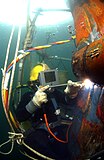
Hyperbaric welding is a welding process at elevated pressures , usually carried out under water. [1] [2] Hyperbaric welding can take place in water or be dry , that is, inside a specially constructed chamber in a dry environment. The use of hyperbaric welding is diverse - it is used to repair ships , offshore oil platforms and pipelines . Steel is the most common material for hyperbaric welding.
Content
History
Underwater hyperbaric welding was invented by the Soviet metallurgist Konstantin Khrenov in 1932. [3]
Application
Underwater welding is used to repair ships, offshore oil platforms and pipelines in river and marine environments. [four]
Dry Welding
Dry welding is carried out in a dry deep-sea chamber or in a mobile dry box at elevated pressure in a chamber filled with a gas mixture.
Most arc welding processes, such as manual arc welding (RDS), powder arc welding, non-consumable electrode welding (argon arc), shielded gas arc welding (MIG welding), plasma welding can take place at elevated pressure. [5] In this case, non-consumable electrode welding is more often used. Changes in the welding process at elevated pressure are associated with processes in the arc.
The increased pressure in the chamber affects the chemical composition of the deposited metal by reducing the diameter of the cathode and anode spots of the arc due to compression of the arc column.
Wet welding
Wet underwater welding is carried out directly in the water. [6] A waterproof electrode is used . [2] The welding process is limited to hydrogen embrittlement of the metal . [2]
An electric arc heats the workpiece and electrode, while the molten metal is transferred to the workpiece due to the gas bubble around the arc. A gas bubble is partially formed from the decay of the flux coating on the electrode. The current induces the transfer of metal droplets from the electrode to the work surface, which allows welding. Slags on the weld surface slow down the cooling rate, but rapid cooling is one of the biggest problems in producing high-quality underwater welding. [7]
When welding, conventional AC or DC power supplies are used. In this case, it is advisable to use a direct current, the strength of which varies between 180 A - 220 A with an arc voltage of up to 35 V.
Hazards and Risks
The dangers of underwater welding include the risk of electric shock . To prevent this, welding equipment must be adapted to the marine environment.
Diving operations should also take into account professional safety issues, in particular, the risk of decompression sickness due to increased respiratory gas pressure. [eight]
See also
- Oxy-fuel welding and cutting
Notes
- ↑ Keats, DJ. Underwater Wet Welding - A Welder's Mate . - Specialty Welds Ltd, 2005. - P. 300. - ISBN 1-899293-99-X .
- ↑ 1 2 3 Modern Welding Technology. - Upper Saddle River, New Jersey: Pearson Education, 2005 .-- P. 677–681. - ISBN 0-13-113029-3 .
- ↑ Carl W. Hall A biographical dictionary of people in engineering: from the earliest records until 2000 , Vol. 1, Purdue University Press, 2008 ISBN 1-55753-459-4 p. 120
- ↑ Underwater Welding Salary & Risk Factor . Water Welders . Matt Smith Date of treatment May 8, 2015.
- ↑ Properties of the constricted gas Tungsten (Plasma) Arc at Elevated Pressures. - Cranfield University, UK, 1991. - Vol. Ph.D. Thesis.
- ↑ Smith, Matt Dry or Wet Welding? Similarities, Differences and Objectives . Water Welders. Date of treatment April 8, 2014.
- ↑ Section 3.3 // The Professional Divers's Handbook / Bevan, John. - second. - 5 Nepean Close, Alverstoke, GOSPORT, Hampshire PO12 2BH: Submex Ltd, 2005. - P. 122–125. - ISBN 978-0950824260 .
- ↑ US Navy Diving Manual, 6th revision . - United States: US Naval Sea Systems Command, 2006.