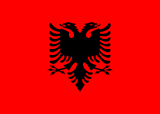
The Republic of Kosovo ( Alb. Republika e Kosovës ) is a self-proclaimed state formed in 1992 by a meeting of ethnic Albanian politicians in Kosovo and Metohija . It was recognized only by Albania [1] and tried to establish its own political institutions as opposed to the institutions of power of the Autonomous Region of Kosovo and Metohij, which is part of the Republic of Serbia .
| self-proclaimed state | |||||
| Republic of Kosovo | |||||
|---|---|---|---|---|---|
| Alb. Republika e Kosovës | |||||
| |||||
| Anthem : Anthem of Albania | |||||
 The Republic of Kosovo on the map of the FRY (1999) | |||||
←   → →1992 - 1999 | |||||
| Capital | Pristina | ||||
| Population | 2 million people | ||||
| Form of government | republic | ||||

Content
History
Background
The socialist autonomous region of Kosovo was formed in 1974 and had wide autonomy within the Socialist Republic of Serbia [2] . This autonomy was limited by constitutional amendments in 1989 . An anti-bureaucratic revolution swept the region, in which mass protests from Kosovo Albanians took place, starting with the 1989 strike of Kosovo miners. Many of the leaders of the strike movement were arrested by the Yugoslav authorities. This led to the declaration of a state of emergency in February 1990 and the resignation of the Regional Council of Ministers in May.
The Serbian federal government passed a series of laws that prohibited Albanians from buying or selling property, closed the Albanian media, and fired thousands of ethnic Albanians from government posts.
Proclamation
At the end of June, Albanian members of the regional council proposed a response - to vote on the advisability of declaring an independent republic. The Serbian chairman of the council immediately closed it and promised to resume the work of the council on July 2 , but this deadline was also postponed.
On July 2, the vast majority of Albanian regional council members returned to the council building, but the doors were locked. Then outside on the street they voted to declare Kosovo a republic as part of the Yugoslav Federation [3] . The Serbian government responded by dissolving the council and government of Kosovo, eliminating the remnants of autonomy, and then passed another law on labor relations, which left 80,000 Albanian workers unemployed.
The ethnic Albanian members of the now officially dissolved Council (Assembly of Kosovo) on September 7 secretly met in Kachanik and proclaimed the Republic of Kosovo, in which the laws of Yugoslavia would be valid only if they corresponded to the constitution of the republic that was not yet drafted. On September 22, 1992, the Council declared the Republic of Kosovo an independent state. This declaration was approved by an informal referendum held a few days later. The Serbian authorities took this step extremely painfully and tried to arrest and bring to justice the voters [4] .
Parallel authorities
Kosovo Albanians organized a separatist movement, creating a number of parallel authorities in the fields of education, medical care, and taxation [5] .
NATO Intervention
Since 1995 , tensions in Kosovo have been increasing and ultimately led to the Kosovo War , which began in 1998 between the Federal Republic of Yugoslavia and the Kosovo Liberation Army (KLA). The world community learned about the conflict in the region in January 1999 after the Racak massacre - a very controversial story of the massacre of Albanians by Serbian security forces. An international conference was held in Rambouillet at which a peace agreement was agreed in Rambouillet , adopted by ethnic Albanians, but rejected by the Yugoslav government.
The failure of the negotiations in Rambouillet led to the bombing of the NATO Air Force of the Federal Republic of Yugoslavia from March 24 to June 10 , as a result of which the Yugoslav authorities signed a military-technical agreement allowing NATO peacekeepers ( KFOR ) and the international civil mission (UNMIK) to enter Kosovo.
UNMIK took control of Kosovo. The Kosovo Transitional Council was created in order to unite the political and social leaders of the region to make compromise decisions. The KLA was disbanded and replaced by the Kosovo Defense Corps, a paramilitary emergency response organization. Kosovo re-declared independence in 2008 .
Leaders
President
- Rugova, Ibrahim
Prime Ministers
- Bukoshi, Buyar (1991 - 1999)
- Zeynulahu, Yusuf [6] (1990 - 1991)
Notes
- ↑ Statement of Albanian PM Sali Berisha during the recognition of the Republic of Kosovo, stating that this is based on an 1991 Albanian law, which recognized the Republic of Kosovo Archived April 20, 2012 on Wayback Machine
- ↑ Independent International Commission on Kosovo. The Kosovo report: conflict, international response, lessons learned . New York, New York, USA: Oxford University Press, 2000. Pp. 35–36.
- ↑ Noel Malcolm, A Short History of Kosovo , p. 346.
- ↑ Noel Malcolm, A Short History of Kosovo , p. 347
- ↑ Clark, Howard. Civil Resistance in Kosovo . London: Pluto Press, 2000. ISBN 0-7453-1569-0
- ↑ Ben Cahoon. Serbia . Worldstatesmen.org. Date of treatment June 19, 2010.