The Stumpf functions c k ( x ) were introduced into the celestial mechanics by the German astronomer Karl Stumpf in his theory of the universal solution for Keplerian motion . [1] [2] They are described by the following decomposition in a Taylor series :

for This series absolutely converges for any valid x .

Close to trigonometric functions . Comparing the expansion in the Taylor series for c 0 ( x ) and c 1 ( x ) with the decomposition in the Taylor series for the trigonometric functions sin and cos, we can find the following relations:
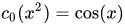
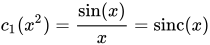
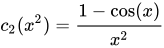
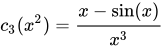
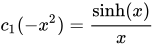
Similarly, for the hyperbolic functions sinh and cosh, we find:

For non-negative k , {\ displaystyle c_ {k} (0) = {\ frac {1} {k!}}} .
 .
.Stumpf functions satisfy the following recursive expression:

The Stumpf functions allow one to uniformly describe the motion of a body in a central field for any value of “Keplerian energy” (the sum of kinetic and potential energy) corresponding to movement along elliptical (Kepler energy is negative), parabolic (Keplerian energy is exactly zero) and hyperbolic (Kepler energy is positive a) trajectories .
Links
- ↑ Stumpff K. (1956,1965,1974), Himmelsmechanik , Deutscher Verlag der Wissenschaften, Berlin
- ↑ Stiefel E., Sheifel G. (1975), Linear and regular celestial mechanics. The perturbed two-body problem. Numerical methods. Canonical theory. , "The science"