Buchis - in Egyptian mythology, a sacred white bull with black markings, revered as the embodiment of the god of war Montu .
| Buchis | |
|---|---|
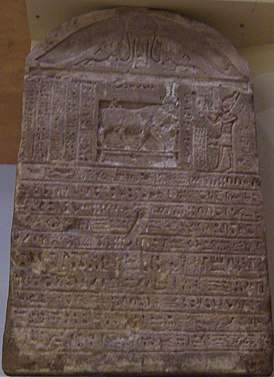 A stele in honor of the death of Bukhis with the image of Hathor | |
| the embodiment of the god of war Montu | |
| Mythology | Ancient egyptian |
| Type of | sacred bull |
| Latin spelling | Buchis |
| Cult Center | Germontis |
Mythology
He was depicted with a solar disk on his head and two high sultans between the horns.
Initially, the Buchis cult was inferior in popularity to the cults of the bulls Apis and Mnevis (with the latter, associated with Ra , Buhis was identified). The bull cult Bukhisa gained strength and reached its peak in the Hellenistic and Roman periods - under the Ptolemies (305-30 BC) and the Roman emperors of the dynasties Yuliev-Klavdiev and Flaviev (27 BC - 96 BC) .
According to legend, retold by the late Roman grammar Macrobius, Buchis’s hair did not grow like in ordinary animals, but in the opposite direction, while changing color hourly.
The center of the Montoux cult was the city of Germontis (now Armant ) in Upper Egypt . In Hermont, with the death of the previous Buchis, a special bull was chosen for this role, during his life he was surrounded by honors corresponding to his divine nature. The deceased Bukhis mummified and was solemnly buried in a sarcophagus in the local necropolis of Buheum. Since Bukhis was considered the son of a heavenly cow (respectively, the brother of the sun, Ra ), mothers of Bukhis also received honors.