Dipturus gudgeri (lat.) Is a species of cartilaginous fish of the rhombic family of rays of the order of stingrays. They live in the temperate waters of the eastern Indian and southwestern Pacific oceans between 28 ° S. w. and 44 ° S w. They are found at a depth of up to 700 m. Their large, flattened pectoral fins form a rhombic disk with an elongated and pointed snout. The maximum recorded length is 140 cm. Eggs are laid [1] [2] [3] .
| Dipturus gudgeri |
| Scientific classification |
|---|
| No rank : | Bilateral symmetrical |
|
| International scientific name |
|---|
Dipturus gudgeri ( Whitley , 1940) |
| Synonyms |
|---|
- Raja gudgeri (Whitley, 1940)
- Zearaja gudgeri whitley , 1940
|
| Security status |
|---|
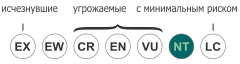
Close to vulnerableIUCN 3.1 Near Threatened : 161535 |
|
Content
The species was first scientifically described in 1940 [4] . The holotype is an individual caught off the coast of Western Australia at a depth of 365 m in 1913 [5] . The view is named after Eugene Willis Gajer (1866-1856) from the American Museum of Natural History .
These bathydemersal ramps are endemic to the waters of Australia (Western Australia, New South Wales ). They are found on the outer edge of the continental shelf and in the upper part of the continental slope at a depth of 160 to 700 m, the most common in the range of 400-550 m [3] .
The wide and flat pectoral fins of these rays form a rhombic disk with a rounded snout and rounded edges. On the ventral side of the disc are 5 gill slits, nostrils and mouth. On the long tail there are lateral folds. These skates have 2 reduced dorsal fins and a reduced caudal fin [1] .
The maximum recorded length is 185 cm [3] .
Like other rhombic, these stingrays lay eggs enclosed in a rigid horn capsule with protrusions at the ends. Embryos feed exclusively on yolk . Males reach puberty with a length of 127 cm. Life expectancy is estimated at 16 years [3] .
Not subject to target fishing. May be caught as by- catch . Meat of large individuals arrives at local markets. The International Union for Conservation of Nature has assigned the species a conservation status of “Close to Vulnerability” [3] .
- ↑ 1 2 Froese, Rainer, and Daniel Pauly, eds. Family Rajidae - Skates (Neopr.) . FishBase
- ↑ Dipturus gudgeri (English) in the FishBase database.
- ↑ 1 2 3 4 5 Dipturus gudgeri (English) . The IUCN Red List of Threatened Species .
- ↑ Whitley GP The fishes of Australia. Part 1. The sharks, rays, devil fishes and other primitive fishes of Australia and New Zealand. - Sydney: Royal Zoological Society of New South Wales, 1940 .-- S. 230.
- ↑ Dipturus gudgeri (neopr.) . Shark-References. Date of treatment May 26, 2016.