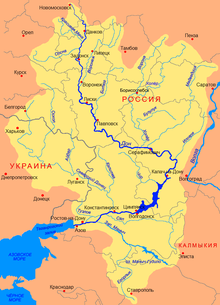
Lipetsk Region is a Russian region in the Upper Don Region.
The Upper Paleolithic on the territory of the Lipetsk region includes the station of the Gravett culture of Gagarino [1] , the epigravettsky culture is the site of Zamyatino 14 in the Zadonsk region [2] .
Traces of the settlement of the Abashevsky culture of the Bronze Age were found in the area of the village Verbilovo . In the area of the villages of Ssielki and Fomino-Negachevka there were found settlements of the Repinskaya , Abashevskaya, Srubnaya and Gorodetsky cultures of the Bronze Age - the early Iron Age (III — I millennium BC) [3] .
In the Lipetsk region, between the Don and Voronezh rivers, mounds with burials of notable Sarmatians were discovered [4] .
The monuments of the Kolochin culture include finds on the river. Voronezh and on r. Matyre (settlements Krivets and Yarlukovo on the river Matyra) [5] .
Content
Slavic period
In the VIII century, the territory of the region was settled by the agricultural Slavic tribes of the Romensko-Borschiv culture [6] . These Slavs are identified with Vyatichi chronicles [7] .
Old Russian period
In the ancient Russian period, the territory of the Lipetsk region initially (from 1024) belonged to the Chernigov principality , but then (1129) became part of the newly formed Ryazan principality .
In 1156, the Polovtsi raided the Fast Pine in the Ryazan principality : "The Polovtsian came to Rezan to the Fast Pine, and captivated many, went back." Ryazan squads went after the Polovtsy in pursuit, defeated them and freed the prisoners: “Leap up with the pursuit of them ... And full of otpoloni, and their beating” [8] . The invasions of nomads led to the desolation of the region and its transformation into a part of the Wild Field , although legally the lands were listed as the Ryazan principality .
During the period of civil strife and fragmentation, a separate Principality of Lipetsk was formed (first mentioned in chronicles in 1283). Elets principality with the center in Yelets known since the end of the XIV century.
Belgorod line
In the XVI-XVII centuries, the region turns into the southern defensive region of the Russian (Moscow) state from the Crimean Tatars and Nogai , who were in vassal dependence on the Ottoman Empire and carried out predatory raids through Muravsky Way . For a relatively short time (the end of the XVI - the beginning of the XVII centuries) the fortress cities were rebuilt: Dankov (1568), Yelets fortress (1591), Talitsky jail (1592), Lebedyan (1605). Under fortresses sloboda [9] and repairs are created . The settlement of the land came from Moscow [10] and Ryazan [11] . Cossacks settled here, which was reflected in toponymy ( Peskovatka-Cossack ). Monastic colonization was also carried out. In 1592, the Yeletsky Trinity Monastery appears. In 1610 Moscow monks from Sretensky Monastery create the Zadonsky Nativity of the Virgin Mary Monastery .
In 1618, the Lipetsk land was ravaged by the troops of Hetman Sagaidachny . In 1635, the construction of a powerful fortified line began - the Belgorod intersection line , on which fortresses stood out within the limits of the modern Lipetsk region: Usman (1645), Dobry (1647), and Sokolsk (1647). The monastic [12] [13] [14] and landownership (boyars Efanov , Romanovs ) is developing.
Peter's Age
Owing to the Azov campaigns of Peter I (1695-1696), the Russian border moves south to the Sea of Azov and the territory of the Lipetsk region becomes part of Central Russia. In 1700, the Lipsky Iron Plants were built , and in 1703 the Kuzminsky anchor plant was built . From this moment begins the history of the city of Lipetsk . At that time, the need for flax, hemp and wool increased due to the creation of the navy and the regular army. Therefore, agriculture is actively beginning to develop.
According to the first division of Russia in the province in 1708, most of the Lipetsk region was assigned to the Azov province , but after the Prut disaster and the loss of Azov, the center of the province moved to Voronezh (1586). When provinces were divided into provinces in 1719, approximately the future Usman district was sent to the Voronezh province , and the future Lebedyansky and Lipetsk districts to the Yelets province .
Region within gubernias
On September 16, 1779, by the decree of Catherine II, the Lipsky Zavody settlement officially received the status of the district city of the Tambov governorship (from 1796 - the Tambov province) with the name Lipetsk . Lipetsk , Lebedyansky and Usman districts became part of the Tambov province, Yelets district - in the Oryol province , Zadonsky district - in the Voronezh province , and Dankovsky and Ranenburg districts - in the Ryazan province .
In the 18th century, the growth of large landowner land tenure continued. Lipetsk region, rich in black soil, became the breadbasket of the state. Subsequently, he gained fame and as a resort of mineral waters . C 1769 here is the residence of Bishop Tikhon of Zadonsk (1783+). In 1871, the Elets classical male gymnasium was opened. In 1873, Russian writer Prishvin was born in the land of Lipetsk in a merchant family.
During the February Revolution , the October Revolution of 1917, and the civil war many cultural treasures perished. In August 1919, the cities of Lebedyan and Yelets were captured by the Cossacks of General Mamantov during the march of Denikin on Moscow.
After the establishment of Soviet power in the land of Lipetsk, collectivization took on tragic forms. In 1930, the teacher Skorokhodov died at the hands of the fists .
In December 1941, the Yelets operation was launched on the territory of the region. In general, the Germans failed to gain a foothold on the Lipetsk land, which was in the rear of the Red Army .
Lipetsk Region
As a subject of the Federation, the Lipetsk Region was formed by a decree of the Presidium of the Supreme Soviet of the USSR dated January 6, 1954 from areas of four neighboring areas. The region included: from the Voronezh region : the city of Lipetsk , Borinsky, Vodopyanovsky, Grachevsky, Gryazinsky, Dmitryashevsky, Dobrinsky, Lipetsk, Molotovsky, Talitsky, Usmansky, Khvorostyansky and Khlevensky districts; from the Oryol region - the city of Yelets , Volynsky, Dolgorukovsky, Yeletsky, Zadonsky, Izmalkovsky, Krasninsky, Stanovlyansky, Chernavsky and Chibisovsky districts; from the Ryazan region - Berezovsky, Voskresensky, Dankovsky, Dobrovsky, Kolybelsky, Lebedyansky, Lev-Tolstovsky, Troekurovsky, Trubetchinsky and Chaplygin districts; from the Kursk region - Bolshe-Polyansky, Volovsky and Terbunsky districts.
On April 26, 1954, the USSR Supreme Soviet approved the creation of the Lipetsk region [15] .
On July 4, 1967, for success in the development of the national economic complex, the Lipetsk Region was awarded the Order of Lenin [16] .
Notes
- ↑ Gagarin Upper Paleolithic parking
- ↑ A. Bessudnov. The Late Paleolithic Site of Zamyatino 14 on the Upper Don.
- ↑ Lipetsk archaeologists have found eight settlements of the "Bronze Age"
- ↑ Where will the Farn bird land
- ↑ Migration of the early Slavic population in the territory of the Tambov region // Bulletin of the Tambov University. 2013
- Archaeological cultures: Romensko-Borshevskaya
- ↑ Excavations of the burial site of Vyatichi in the Lipetsk region
- ↑ Ryazan and Polovtsy
- ↑ Church of Dimitry of Thessalonius (Elec)
- ↑ Borisovka (Lipetsk region)
- ↑ Korenevshchino
- ↑ Ratchino (Lipetsk region)
- ↑ Big Khomutets
- ↑ Kalikino (Lipetsk region)
- ↑ s: USSR Law of 04/26/1954 on the approval of decrees of the Presidium of the Supreme Soviet of the USSR
- ↑ Description of the coat of arms of the Lipetsk region . Union of heraldry of Russia (2008). The appeal date is February 16, 2010. Archived on August 22, 2011.