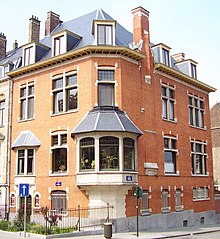
The Quaker Council for European Affairs (QCEA) was founded in 1979 to promote the values of the Religious Society of Friends (Quakers) in a European context. The office of the Quaker Council for European Affairs is located in Brussels . [1] This is an international non-profit organization operating in accordance with Belgian law.
Content
- 1 What QCEA does
- 2 Recognition as a consulting organization
- 3 Partnership and interaction
- 4 Programs
- 5 Achievements
- 6 References
- 7 notes
What QCEA does
The Quaker Council on European Affairs organizes socially significant public campaigns and lobbying. The Council publishes reference materials, reports and studies on European and Quaker topics. The publications are intended for politicians and public figures, as well as for Quakers.
The organization publishes an information publication Around Europe (“Around Europe”) [2] , intended both to convey to the authorities the position of the Quaker Council on European Affairs, and to provide other readers with information about European events that they would not otherwise have to find. Ten times a year, the publication is distributed to recipients worldwide.
The Quaker Council on European Affairs also collaborates with other non-governmental and church organizations with similar fundamental values. Among them are the European Peacebuilding Liaison Office, the European Bureau for Conscientious Refusal of Military Service , Kairos Europe, the Mennonite Center in Brussels, the Ecumenical Center, the Center for European Security and Defense.
The Quaker Council for European Affairs interacts with members of the European Parliament and takes part in the activities of the Council of Europe . To achieve its goals, QCEA sends representatives to various seminars and conferences, as well as organizes its own seminars and conferences and conducts a training tour every year to help Quakers and non-Quakers learn more about what is happening in Europe.
Recognition as a consulting organization
The Quaker Council on European Affairs often provides evidence and comments at Council of Europe consultations. The QCEA is a member of the Association of Non-Governmental Organizations for Civil Society and Democracy in Europe, recognized by the Council of Europe and authorized to file complaints about violations of the European Social Charter with the European Committee of Social Rights.
Partnership and Interaction
QCEA collaborates with a number of other Quaker organizations, including the Quaker United Nations Office, the Council of Friends in the Service of Society in Britain, and the related and European Friends of the World Advisory Committee (EMES-FWCC) and affiliates organizations.
QCEA is one of more than 30 partner organizations in the European Peacebuilding Liaison Office. [3]
QCEA is a member of the International Human Rights and Democracy Network.
The QCEA office also houses the secretariat of the Quaker Youth Organization of European and Middle Eastern Young Friends.
Programs
QCEA works in six main program areas:
Peacekeeping
The QCEA peacekeeping program is based on the fundamental idea of creating the European Union and the Council of Europe as peaceful projects, as well as the idea that this idea should remain the guiding principle of all their activities. Today, it finds concrete application in political spheres that influence relations between countries and regions in the world.
Human rights
Quakers believe in the presence of what is from God, in every person. Therefore, throughout their history, human rights have remained the focus of Quaker care. QCEA's activities focus on a number of specific issues on which the Council of Europe and the European Union formulate policies and make decisions.
Economic justice
Quakers believe in the equality of all people. As a result of this, Friends have long been dealing with issues of economic justice, reconciliation and the equal distribution of world resources. The details of QCEA's work change over time, as the political agenda of the European Union and the Council of Europe changes, so as to voice and support the Quaker position on the most pressing issues.
Democratic governance
The European Union is often criticized for its so-called insufficiently democratic legitimacy. Since 2001, QCEA has been involved in the development of numerous aspects of the organization and decision-making procedures of the EU, following the belief that real democracy requires active interaction with citizens.
Sustainable energy security
The Sustainable Energy Security Program aims to rethink energy security in the 21st century, so that it includes human security, equitable energy distribution and true environmental friendliness , and also strengthens the movement for the use of renewable energy sources at all levels throughout Europe.
Palestine and Israel
QCEA recognizes the importance of the EU's role in ongoing peacekeeping in Palestine and Israel . Therefore, QCEA devotes one of its programs to this area, which is designed to influence the EU and its associated organizations in relation to this conflict and the parties involved.
Achievements
The following are some of the policy changes that have taken place with the participation of QCEA. This does not deny participation in them and other organizations. The list below is limited only to those points where it is possible to determine specific consequences in the sense of adopting texts, creating structures, discovering mechanisms, or taking action. Much of QCEA's work involves decision-making at a less explicit level and is aimed at profound changes in public opinion.
In 2007, the QCEA published a report on the situation of women prisoners in the Council of Europe member states; [4] In 2009, the Parliamentary Assembly of the Council of Europe adopted resolution 1663, which included most of our recommendations.
In 2008, the European Parliament approved its own report on the situation of women in prisons and the impact of parental sentences on society and the family, many of our recommendations were also included in this report.
QCEA has become the founder of the European Peacebuilding Liaison Office, which now unites 31 organizations.
Other initiatives and work programs in which I participated and some of which were led by QCEA:
- The “Stability Instrument” provides funding for peacekeeping and conflict prevention, and in particular dialogue in this area between government agencies and civil society.
- Conflict prevention and peacekeeping play a key role in the European Foreign Service
- The social and environmental standards of the European Investment Bank include a reference to the likelihood of conflict.
“The Greek government had to report to the Council of Europe about how alternative service is being treated in this country. Why? ”Because the QCEA participating in Council of Europe meetings had the right to refer collective complaints under the European Social Charter . QCEA used this right to successfully file a complaint against Greece.
“The anti-discrimination clause is included in the Amsterdam Treaty. Why? ”Because it was facilitated by non-governmental organizations in Brussels, including the QCEA.
“The Council of Europe requested reports from all its member states on the conditions created in these countries for conscientious objectors to military service. Why? ”Because the QCEA raised this issue in September 1996. In 2002, a brochure on the rules for organizing alternative service and non-military duty was prepared and distributed in the EU member states.
Links
Notes
- ↑ Council of Europe. Database of international NGOs
- ↑ EMES-FWCC // QCEA Activity (inaccessible link) . Date of treatment June 8, 2016. Archived July 1, 2016.
- ↑ EPLO // MEMBER ORGANIZATIONS
- ↑ QCEA // Women in Prison, 2007