
Nubian pyramids are ancient pyramidal structures located in Sudan . The pyramids were built by the rulers of the Meroite kingdom 800 years after the Egyptians stopped building their pyramids.
Pyramids
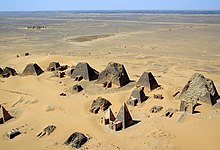
Today, there are about 255 pyramids [1] built in three different areas of Nubia . These pyramids were tombs for the kings and queens of Napata and Meroe . The very first pyramids were built in El Curra , they served as tombs for the rulers of Kashta , his son Pianha , as well as their successors Shabaki , Shabataki and Tanutamon . Fourteen pyramids were built for their wives, some of whom were illustrious warrior queens. The later Napata pyramids are located near the Nuri settlement, on the west bank of the Nile in Upper Nubia.
In this necropolis are the burials of 21 rulers, 52 queens and princesses, including the rulers of Anlamani and Aspeltu . The bodies of the kings were buried in large sarcophagi. The weight of the Aspelt sarcophagus reaches 15.5 tons [2] , 4 of which weighs the lid. The most ancient and largest pyramid of Nuri belongs to the pharaoh of the XXV dynasty Taharka .
The most extensive cluster of pyramids is located in Meroe, between the fifth and sixth rapids of the Nile, about 100 km north of Khartoum . During the Meroite period, more than forty kings and queens were buried in these places. The proportions of the Nubian pyramids differ from the Egyptian ones: the height of the pyramids varies from 6 to 30 meters, the base rarely exceeds 8 meters, the side faces are stepped or covered with white stucco, sharply extending upwards, with an angle of inclination of about 70 °. Along the perimeter, along the base of the entire pyramid there is a characteristic ledge in the form of a step. Also, protrusions can be on the edges of some pyramids. The tops of the pyramids are crowned with the top in the form of a truncated pyramid on top of which a cylinder is located. Most of them have temple outbuildings adjacent to the base in which they made offerings. The temple outbuildings were decorated with bas-reliefs. Around the pyramids was a low fence. Unlike Nubian Egyptian pyramids have a smaller angle of inclination of the side surface - from 40 ° to 50 °, they have more extensive and branched temple extensions, there is no step along the perimeter of the base of the pyramid, and the top was crowned with a pyramidion .
All the pyramids were looted in ancient times. Some chapels preserved murals telling about the owners of the mummy who are buried in this tomb. Mummies with decorations were located in wooden sarcophagi . At the time of the discovery of the pyramids by archaeologists of the XIX-XX centuries, in some pyramids were found the remains of bows, quivers for arrows, archer rings , horse harness , wooden boxes, furniture, pots, stained glass, metal vessels and much more, which testified to intensive trade between Meroe, Egypt and Greece .
In the 1830s, many pyramids were greatly damaged by the Italian doctor-researcher, treasure hunter Giuseppe Ferlini , who, not wanting to dig out the entrance deep in the sand, blew up the tops of the pyramids to get inside. In such a barbaric way he destroyed about 40 pyramids.
The surface of the side face of one of the pyramids in Meroe.
Mural in the tomb of Tanutamon.
The location of the main complexes.
Burials
- Imperial burial complex in El ( ).
- Pyramids at Meroe ( ). Pyramids dated 720-300 years BC. e. located in the southern burial complex. Pyramids dated from 300 BC e. 350 BC e. located in the Northern burial complex.
- The royal funerary complex in Nuri ( ).
- Pyramids at Jebel Barkal ( ).
See also
- Nubian architecture
- Pyramids in Siding
- Egyptian pyramids
Notes
- ↑ Cluster of 35 Ancient Pyramids and Graves Discovered in Sudan
- ↑ Lehner, Mark. The Complete Pyramids . - Thames and Hudson, 1997. - P. 196–197. - ISBN 978-0-500-05084-2 .
Links
- Pyramids of Nubia - A site detailing the three major pyramid sites of ancient Nubia
- Aerial Photographs of Sudan - A site featuring spectacular aerial photographs of the pyramids and temples at el-Kurru, Nuri, and Meroë
- Voyage au pays des pharaons noirs Travel in Sudan and notes on Nubian history (French)
Literature
- Dows Dunham: El Kurru: Dows Dunham (The Royal Cemeteries of Kush. Band 1). Harvard University Press, Boston 1950.
- Dows Dunham: Nuri (Royal cemeteries of Kush. Band 2). Museum of Fine Arts / Harvard University Press, Boston 1955.
- Dows Dunham: Royal Cemeteries of Kush: Royal Tombs of Meroe and Barkal. Museum of Fine Arts / Harvard University Press, Boston 1957 (Nachdruck: Museum of Fine Arts, Boston 1980, ISBN 0-87846-050-0 ).
- Dows Dunham: The West and South Cemeteries at Meroe. (Royal cemeteries of Kush. Band 5). Museum of Fine Arts / Harvard University Press, Boston 1963.