"Udzuki" ( Jap. 睦月 Month Unohana (poetic name of the fourth month of the lunar calendar) - Japanese destroyer type "Mutsuki" .. The fourth ship in a series of 12 ships took an active part in the war against China and the battles in the Pacific sunk by American torpedo boats. during the battles for the Philippines on December 12, 1944.
| Uzuki (Uzuki) | |
|---|---|
| jap. 卯 月 | |
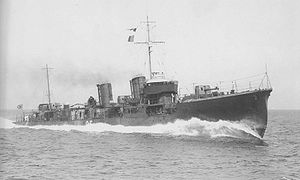 The destroyer Uzuki . 1925 year | |
| Service | |
 Japan Japan | |
| Named after | |
| Class and type of vessel | Destroyer destroyer type "Mutsuki" |
| Organization | Japanese imperial fleet |
| Manufacturer | Ishikwajima Shipyard , Tokyo |
| Ordered to build | 1923 year |
| Construction started | January 11, 1924 |
| Launched | October 15, 1925 |
| Commissioned | September 1, 1926 |
| Withdrawn from the fleet | January 10, 1945 |
| Status | Sunk by torpedo boats December 12, 1944 |
| Main characteristics | |
| Displacement | 1315 tons (standard) 1445 tons (full) |
| Length | 102 m |
| Width | 9.2 m |
| Draft | 3m |
| Engines | 4 steam boilers "Ro-Go" 2 Kampon turbines |
| Power | 38 500 l. with. (28.7 Mw ) |
| Speed | 37.25 knots (69 km / h ) |
| Sailing range | 7400 km at 15 knots |
| Crew | 150 people |
| Armament | |
| Artillery | 1925 year : 4 × 120 mm guns 2 × 7.7 mm machine gun 1938 year 4 × 120 mm guns 2 × 25 mm guns 2 × 13 mm machine gun 1942 year 3 × 120 mm guns, 10 × 25 mm guns (2 × 3, 2 × 2), 4 × 13 mm machine gun (2 × 2) |
| Anti-submarine weapons | 1938 : 2 bombers type 3 2 type 94 bombers 36 depth charges |
| Mine torpedo armament | 1925 year : 2 × 3 TA type 12 12 610 mm torpedoes type 8 |
Content
Design and Construction
Ordered in accordance with the "New Shipbuilding Program for the replacement of ships under the terms of the Washington Treaty of 1923." Ships of this type were the development of destroyers of the Kamikaze type . More powerful torpedo tubes (built) were installed on destroyers of the Mutsuki type. To increase the stability of the ship, the hull dimensions and displacement were increased.
Built on the basis of the experience of the First World War, the destroyers were designed to attack the enemy’s linear forces and protect their heavy artillery ships from destroyer attacks, set active minefields and mine sweeping. However, by the end of the 1930s, ships were significantly inferior in basic parameters to new destroyers, both Japanese and future opponents. Uzuki was built at the Ishikwajima Shipyard in Tokin in 1924-26. It went into operation under the name "No. 25" on August 1, 1928, it received its main name.
Armament
Artillery weapons included four single-gun shield installations of 120-mm type 3 guns (length 45 calibers, range - 5500 m, stock of 180 shells per gun, rate of fire - 9 rounds per minute). One gun was placed on the forecastle, the second between two pipes in the central part of the ship, two more - in the cow part in front and behind the main mast. The ships had practically no anti-aircraft weapons, which was limited to two type 92.7.7 mm machine guns. The increased role of aviation required the strengthening of anti-aircraft weapons, which was carried out during the modernization of the ship in February 1938. Two single 25-mm type 96 anti-aircraft guns were installed (length - 60 calibers, rate of fire up to 110 rounds per minute, effective firing height up to 1500 m, range up to 3000 m, stock of shells - 2000 per gun). 7.7 mm machine guns were replaced by 13.2 mm type 93.
In September 1943, the next re-equipment of the ship was carried out. One 120-mm gun was dismantled, the number of 25-mm anti-aircraft guns increased to 10, and 13-mm machine guns to four. a year later, another 120 mm gun and 13 mm machine guns were dismantled and two 25 mm guns added.
Torpedo armament was strengthened due to the fact that new three-tube 610-mm torpedo tubes of type 12 were first installed on destroyers of this type, which made it possible to reduce their number. The first device was traditionally for Japanese destroyers placed in front of the bow superstructure. However, on subsequent types, designers refused such a placement. The second apparatus was located in the stern between the chimney and mainmast. Upon entry into service, the ship did not have any anti-submarine weapons. In 1932, this gap was corrected and the ship received two Type 88 bombers and two Type 3 bomb throwers with a stock of 36 depth charges. During the modernization of 1938, bombers were replaced on the destroyer (new type 94 bombers were installed) and a sonar type 93 and a type 92 hydrophone were deployed. In March 1944, one three-pipe torpedo launcher was dismantled, and in September 1944 the destroyer received a radar for detecting air targets and control type 13 fire and radar detection of surface targets type 22 mod. four.
Service History
Pre-War Service
After commissioning, the ship was included in the 30th division of the destroyers of the Second Flotilla of the Second Fleet. In October 1927, participated in the maneuvers of the United Fleet in the area between the Ryukyu and Bonin Islands (part of the “blue” compound). From December 1927 to September 1931, Uzuki was in reserve and was in Sasebo at the fleet shipyard. In September-December 1931, the ship was undergoing current repairs of the hull and mechanisms. In December 1931, the 30th division was included in the First Flotilla of the First Fleet. From January 26 to March 22, 1932, the ship participated in the First Shanghai Battle as part of the Third Fleet under the command of Vice Admiral Kitisaburo Nomura . Uzuki acted near the mouth of the Yangtze River, providing fire support to the army units that fought for Shanghai .
March 22, 1932 the destroyer returned to Sasebo , where until September 1932 they carried out current repairs, installed anti-submarine weapons. At the end of September 1932, the destroyer returned to the operating fleet and until July 1933 was engaged in combat training in the area south of the island of Formosa . On August 21-25, 1933, Uzuki took part in the naval parade at Yokohama . From December 1934 to January 1936 the ship was listed in the reserve at Sasebo on the basis of the fleet. The outbreak of war with China required the strengthening of the fleet and the destroyer was again returned to service
From April 13 to 22, 1936, Mutsuki patrolled at Qingdao , and in August 1936 he embarked on a long training trip to Amoy with the development of receiving fuel from the tanker on the move. From January 1937 to February 1938, the next repair and modernization was carried out at the fleet shipyard in Yokosuka : hull structures were strengthened, anti-aircraft weapons were installed, equipment for detecting submarines, new bombs. After the repair, Uzuki became part of the 29th division of the Fifth Flotilla of the Third (Chinese) Fleet. In March 1938 - November 1940, the destroyer was based on Mako and participated in the blockade of the coast of China. In January 1941, the ship returned to the Metropolis, and in November 1941 it was relocated to Truk Atoll. [1] .
The initial period of the Pacific War
By the beginning of the war, the destroyer under the command of the captain of the 3rd wound Masao Nishimura in the 23rd division was included in the composition of Rear Admiral Goto . In December 1941, as part of a compound of heavy cruisers (the heavy cruisers Kako, Furutaka , Aoba, Kinugasa, and the destroyers Yuzuki and Kikuzuki of the same type) took part in the capture of the islands of Guam and Wake . In January-February 1942, as part of the compound, Marumo ensured the occupation of Kavieng and Surumi (on the coast of New Ireland ), after which he returned to the base in Truk . In mid-April 1942, Uzuki included Rear Admiral Kajioka into the Port Moresby Invasion Force. After the battle in the Coral Sea , the formation of Rear Admiral Kajiok moved to Rabaul . In May-June he participated in escort operations
Solomon Islands Campaign
On May 25, 1942, the 23rd destroyer division was disbanded and the Uzuki was included in the 30th division. Hitoshi Takiyuchi was appointed the new captain. Since the end of June 1942, Uzuki has been actively used, accompanied by transports in the Solomon Islands . In early July, together with the light cruiser "Yubari" escorted three vehicles with building parts to the island of Guadalcanal . On July 14, 1942, the 29th destroyer division was placed at the disposal of the commander of the Sixth Flotilla of the Eighth Fleet. On July 20-22, 1942, the destroyer, along with the cruisers Tenryu , Tatsuta, the mine sweeper Tsugaru, destroyers Asanagi and Yuzuki escorted three vehicles with units of the South Sea Detachment that successfully landed in Buna. On the return trip, during a raid on American base aviation, Uzuki received minor damage to the hull and superstructures due to close bomb explosions, 16 crew members were killed. From July 25 to August 9, 1942 he accompanied the convoys to Buna three times. August 11, 1942 took part in the rescue of sailors from the sunken heavy cruiser "Kako".
In August 1942, in Truk was included in the Transport Connection Rear Admiral Tanaka . On August 23-27, 1942, he took part in an attempt to conduct three transports with army units to Guadalcanal during the battle of the Eastern Solomon Islands . During the operation to rescue the downed pilots from the Ryukho aircraft carrier , he received minor injuries from close bomb explosions dropped by a B-17 bomber . In September-October 1942, the ship was undergoing current repairs of the hull and mechanisms. After the repair, Uzuki until May 1943 provided military transport or escorted heavy ships between the islands of the Metropolis, the Truk Atoll and the Bismarck Archipelago. On December 25, the destroyer was damaged as a result of a collision with the Nankai Maru transport ship and was towed to Rabaul, where it was again damaged on January 5, 1942 during an air raid, and then towed to Truk. On April 21-25, 1943 he was accompanied by the damaged heavy cruiser Aoba during the transition from Kavieng to Truk Atoll. In May 1943 he arrived in Yokosuku, where from the end of May to August 1943, the fleet’s shipyard underwent ongoing repairs of the hull and mechanisms and the replacement of weapons.
After completion of the repair, the destroyer escorted convoys between the Metropolis and the Bismarck archipelago. He took part in the operations of the final stage of the fighting in the Solomon Islands : on the night of October 23-24, he was engaged in the rescue of the crew of the destroyer "Motizuki" . On November 14-16 he escorted a convoy from Rabaul to Shortland Island . On November 24-25, 1943, as part of the Transport Connection of Captain 1st Rank Kagawa, the destroyer delivered reinforcements to Buka Island and removed about 100 people from the flight personnel of the Bougainville Island garrison. During the operation, the ship took part in the battle at Cape St. George with the connection of Captain 1st Rank Burke, happily avoiding death. The battle was the end of the battles in the Solomon Islands and the destroyer moved first to the base in Truk, and then escorting the connection of large ships (the heavy cruiser Maya, aircraft carriers Zuyho and Unye) moved to Yokosuka. [one]
In January-March 1944, the fleet’s shipyard in Yokosuk carried out ongoing repairs of the hull and mechanisms, dismantled the stern 610-mm torpedo tube, and another 120-mm gun No. 2 machine guns. After the repair was completed, Uzuki was included in the First Compound of escort ships, where he provided transportation between the Dutch East Indies and the Metropolis. In early June 1944, the ship was placed at the disposal of the commander of the First Mobile Fleet and was appointed the flagship of the Second Supply Compound. On June 19-21, 1944, the destroyer took part in the battle of the Mariana Islands . During the battle, he took on board the crew of the heavily damaged tanker Tenye Maru and finished it off with torpedoes.
At the end of June 1944, the ship arrived in Yokosuku, where radars were installed at the fleet shipyard (radars type 22 mod. 4 and type 13). In mid-July 1944, Uzuki provided transportation between the coast of China and the Philippines. On December 11, 1944, to the north-east of the island of Cebu , during the escort of a convoy of self-propelled barges with army units, the ship, together with the destroyer Yuzuki, went into battle with the American destroyer Kohlan. During the shootout, a Japanese convoy attacked the torpedo boats of the enemy RT-492 and RT-490. One of the torpedoes they launched hit Uzuki . The destroyer broke into two parts and sank 50 miles northeast of the island of Cebu ( ). [1] 170 crew members, including Captain Watanabe, died, 59 managed to escape. January 10, 1945 the ship was removed from the lists of the Navy.
Literature
- Apalkov, Yu.V. Vasiliev P.P. Warships of the Japanese fleet: destroyers and destroyers 10.1918 - 8.1945 Part I. Reference. - St. Petersburg, Galeia Print, 1998.
- Dashyan, V. Ships of the Second World War. Japanese Navy. Part 2. - Marine collection No. 2004-07 (064), 2004.
- Ivanov, Yu.V. Japanese destroyers 1920-1945. - Vladivostok, 1996.
- Patyanin, S.V. Destroyers and destroyers of Japan 1879-1945 .. - Art of Russia, 1998.
- Brown, David. Warship Losses of World War Two. - Naval Institute Press, 1990. - ISBN 1-55750-914-X .
- Howarth, Stephen. The Fighting Ships of the Rising Sun: The Drama of the Imperial Japanese Navy, 1895–1945. - Atheneum, 1983. - ISBN 0-689-11402-8 .
- Jentsura, Hansgeorg. Warships of the Imperial Japanese Navy, 1869–1945. - US Naval Institute Press, 1976. - ISBN 0-87021-893-X .
- Watts, Anthony J. Japanese Warships of World War II. - Doubleday, 1967. - ISBN ASIN B000KEV3J8.
- Whitley, M J. Destroyers of World War Two: An International Encyclopedia. - London: Arms and Armor Press, 2000 .-- ISBN 1-85409-521-8 .
Notes
- ↑ 1 2 3 Apalkov Yu. V. Vasiliev P.P.Warships of the Japanese fleet: destroyers and destroyers 10.1918 - 8.1945. Part I. Reference. - SPb. Galeia Print, 1998.
Links
- Apalkov Yu. V. Vasiliev P.P.Warships of the Japanese fleet: destroyers and destroyers 10.1918 - 8.1945 Part I. Handbook
- Dashyan V. Ships of the Second World War. Japanese Navy. Part 2
- Patyanin S.V. Squadron destroyers and destroyers of Japan 1879-1945.
- Nevitt, Allyn D. IJN Uzuki : Tabular Record of Movement . Long Lancers . Combinedfleet.com (1997).
- Nishidah, Hiroshi Mutsuki class destroyers (inaccessible link) . Materials of the Imperial Japanese Navy (2002). Archived August 30, 2011.
- Jones, Daniel H. IJN Minekaze, Kamikaze and Mutsuki class Destroyers . Ship Modeler's Mailing List (SMML) (2003). Archived on August 28, 2008.
- Japan 4.7 "/ 45 (12 cm) 3rd Year Type 12 cm / 45 (4.7") 3rd Year Type 12 cm / 45 (4.7 ") 11th Year Type