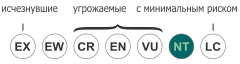
Dipturus cerva (lat.) - a type of cartilaginous fish of the family of rhombic rays of the order of the sloped . They live in temperate waters in the temperate waters of the eastern Indian and southwestern Pacific Oceans between 32 ° S. sh. and 44 ° S. sh. They are found at a depth of up to 470 m. Their large, flattened pectoral fins form a diamond-shaped disk with an elongated and pointed snout. The maximum recorded length is 60 cm. Lay eggs. Not subject to target fishing [1] [2] [3] .
| Dipturus cerva |
 |
| Scientific classification |
|---|
| No rank : | Bilateral symmetric |
|
| International Scientific Name |
|---|
Dipturus cerva ( Whitley , 1939) |
| Synonyms |
|---|
|
| Security status |
|---|
Close to VulnerabilityIUCN 3.1 Near Threatened : 161329 |
|
Content
The species was first scientifically described in 1939 as Raja cerva [4] . The specific epithet comes from the Latin. cerva . - “doe”. The holotype is an individual 11.9 cm long, caught in the waters of Tasmania ( ) at a depth of 183 m [5] .
These demersal rays are endemic to Australian waters ( New South Wales , South Australia , Tasmania, Western Australia ). Found on the continental shelf and continental slope at a depth of 20 to 470 m on soft ground [2] [3] .
The wide and flat pectoral fins of these rays form a rhombic disk with a rounded snout and rounded edges. On the ventral side of the disc are 5 gill slits, nostrils and mouth. On the long tail there are lateral folds. These rays have 2 reduced dorsal fins and a reduced tail fin [1] .
The maximum recorded length is 60 cm [3] .
Like other rhombic, these stingrays lay eggs enclosed in a hard horn capsule with protrusions at the ends. The capsule is 7 cm long and 3.8 cm wide. The embryos feed exclusively on yolk [3] . Males and females reach sexual maturity at a length of 47 cm and 49 cm at the age of about 4 and 5 years, respectively. The length of newborns is about 15 cm. Life expectancy is estimated at 9 years. Duration of generation is 5 years. The diet consists mainly of invertebrates , including cephalopods and crustaceans . Juveniles feed mainly on shrimp, while adults prey on octopuses and fish [2] .
These stingrays are not targeted. Caught as by- catch . Meat is eaten. Over the past 20 years, the number of skates in catches has decreased by 83%. In some part of the range, fishing is not conducted. In 2002, 43 tons of stingray wings were sold on the Australian market, which corresponds to a mass of 134 tons of stingrays. Species affiliation is not installed. The International Union for Conservation of Nature has granted the species the protection status “Close to a vulnerable position” [2] .
- ↑ 1 2 Froese, Rainer, and Daniel Pauly, eds. Family Rajidae - Skates (Unsolved) . FishBase.
- ↑ 1 2 3 4 Dipturus cerva (English) . The IUCN Red List of Threatened Species .
- ↑ 1 2 3 4 Dipturus cerva (Eng.) In the FishBase database.
- ↑ Whitley GP Taxonomic notes on sharks and rays // Australian Zoologist. - 1939. - Vol. 9, no. (3) . - P. 227-262, fig. 18, pl. 20-22.
- ↑ Dipturus cerva "' (Neopr.) . Shark-References. Circulation date 2 June 2016.
- View Dipturus cerva (Eng.) In the World Register of Marine Species ( World Register of Marine Species ).