
In graph theory, the Hadwiger number of an undirected graph G is the size of the largest complete graph that can be obtained by tightening the edges of the graph G. Equivalently, the Hadwiger number h ( G ) is the largest number k for which the complete graph K k is a minor of the graph G , the smaller graph obtained from G by contracting edges and removing vertices and edges. The Hadwiger number is also known as the number of clique contractions of the graph G [1] or the degree of homomorphism of the graph G [2] . The number is named after Hugo Hadwiger , who introduced the number in 1943 and made a hypothesis that the Hadwiger number is always no less than the chromatic number of the graph G.
Graphs with a Hadwiger number of 4 or less are described by Wagner [3] . Graphs with any finite Hadwiger number are sparse and have a small chromatic number. Determining the Hadwiger number for a graph is an NP-hard problem, but the problem is .
Counts with a small Hadwiger number
A graph G has a Hadwiger number no more than 2 if and only if it is a forest , and a three-vertex full minor can be formed by tightening the cycle in G.
A graph has a Hadwiger number of three or less if and only if its tree width does not exceed two, which is true if and only if any of its hinges is a parallel-serial graph .
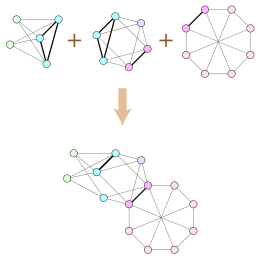
From the Wagner theorem describing planar graphs by their forbidden subgraphs , it follows that the planar graphs have a Hadwiger number not exceeding 4. In some articles containing a proof of the theorem, Wagner [3] describes graphs with the Hadwiger number four or less precisely - these are graphs which can be formed with the help of sum-on-click operations of planar graphs with a Wagner graph having 8 vertices.
The graphs with the Hadwiger number of less than 5 include the top graphs and the embeddable graphs , both families have the full K 6 graph among the forbidden minors [4]
Sparseness
Any graph with n vertices and a Hadwiger number k has O ( nk √ log k ) edges. This boundary is exact - for any k there exists a graph with Hadwiger number k having Ω ( nk √ log k ) edges [5] [6] [7] . If a graph G has a Hadwiger number k , then all its subgraphs also have a Hadwiger number not exceeding k , and this implies that the graph G must have degeneration O ( k √ log k ). Thus, graphs with a limited Hadwiger number are sparse graphs .
Coloring
The Hadwiger hypothesis states that the Hadwiger number is always no less than the chromatic number of the graph G. That is, any graph with Hadwiger number k should have a coloring of maximum k colors. The case k = 4 is equivalent (according to Wagner’s characterization of graphs with this Hadwiger number) to the four -coloring problem on coloring planar graphs . The hypothesis was also proved for k ≤ 5, but remains unproved for large values of k [8]
Due to the low density, graphs with a Hadwiger number not exceeding k can be colored using the greedy coloring algorithm in O ( k √ log k ) colors.
Computational complexity
Checking whether the Hadwiger number of a given graph does not exceed a certain value of k is an NP-complete problem [9] , whence it follows that determining the Hadwiger number is an NP-hard problem . However, the problem is - there is an algorithm for determining the largest click minor in a time that depends only polynomially on the size of the graph, but exponentially on h ( G ) [10] . In addition, polynomial time algorithms can approximate the Hadwiger number substantially more accurately than the best polynomial time approximation (assuming that P ≠ NP) is the size of the largest full subgraphs [10] .
Related Concepts
The achromatic number of a graph G is the size of the largest clique that can be formed by tightening a family of independent sets in G.
Uncountable click minors in infinite graphs can be characterized in terms of shelters that formalize avoidance strategies for some games — if the Hadwiger number is uncountable, it is equal to the order of greatest shelter in the graph [11] .
Any graph with Hadwiger number k has a maximum of n 2 O ( k log log k ) clicks (full subgraphs) [12] .
Khalin [2] defined a class of graph parameters, which he called S -functions. Among them is the number of Hadwiger. These functions, which map graphs to integers, are required to take a zero value on , to be minor monotonous , an increase of one is required when adding a new vertex adjacent to all previous vertices, and from two values for subgraphs along both to the sides of the click separator, the function should be more The set of such functions forms a complete lattice for the operations of taking the minimum or maximum elements. The bottom element in such a grid is the Hadwiger number, and the top element is the wood width .
Notes
- ↑ Bollobás, Catlin, Erdős, 1980 .
- ↑ 1 2 Halin, 1976 .
- ↑ 1 2 Wagner, 1937 .
- ↑ Robertson, Seymour, Thomas, 1993b .
- ↑ Kostochka, 1984 .
- ↑ Thomason, 2001 .
- ↑ The letters O and Ω in these expressions mean O large .
- ↑ Robertson, Seymour, Thomas, 1993a .
- ↑ Eppstein, 2009 .
- ↑ 1 2 Alon, Lingas, Wahlen, 2007 .
- ↑ Robertson, Seymour, Thomas, 1991 .
- ↑ Fomin, Oum, Thilikos, 2010 .
Literature
- Noga Alon, Andrzej Lingas, Martin Wahlen. Approximating the subomorphism problems // Theoretical Computer Science. - 2007. - V. 374 , no. 1–3 . - p . 149–158 . - DOI : 10.1016 / j.tcs.2006.12.021 . .
- B. Bollobás, PA Catlin, Paul Erdős. Hadwiger's conjecture is true for almost every graph // European Journal of Combinatorics . - 1980. - T. 1 . - p . 195–199 . - DOI : 10.1016 / s0195-6698 (80) 80001-1 . .
- David Eppstein. Finding large clique minors is hard // Journal of Graph Algorithms and Applications . - 2009. - Vol. 13 , no. 2 - p . 197–204 . - DOI : 10.7155 / jgaa.00183 . - arXiv : 0807.0007 . .
- Fedor V. Fomin, Sang-il Oum, Dimitrios M. Thilikos. Rank-width and tree-width of H- minor-free graphs // European Journal of Combinatorics. - 2010. - V. 31 , no. 7 - pp . 1617–1628 . - DOI : 10.1016 / j.ejc.2010.05.003 . - arXiv : 0910.0079 . .
- Hugo Hadwiger. Über eine Klassifikation der Streckenkomplexe // Vierteljschr. Naturforsch. Ges. Zürich. - 1943. - T. 88 . - pp . 133–143 . .
- Rudolf Halin. S -functions for graphs // J. Geometry. - 1976. - Vol. 8 , no. 1-2 . - p . 171–186 . - DOI : 10.1007 / BF01917434 . .
- AV Kostochka. Number of graphs by their average degree // Combinatorica. - 1984. - V. 4 , no. 4 - p . 307–316 . - DOI : 10.1007 / BF02579141 . .
- Neil Robertson, Paul Seymour, Robin Thomas. Excluding infinite minors // Discrete Mathematics . - 1991. - V. 95 , no. 1-3 . - p . 303–319 . - DOI : 10.1016 / 0012-365X (91) 90343-Z . .
- Neil Robertson, Paul Seymour, Robin Thomas. Hadwiger's conjecture for K 6 -free graphs // Combinatorica . - 1993a. - V. 13 , vol. 3 - p . 279–361 . - DOI : 10.1007 / BF01202354 . .
- Neil Robertson, PD Seymour, Robin Thomas. Linkless embeddings of graphs in 3-space // Bulletin of the American Mathematical Society. - 1993b. - V. 28 , issue. 1 . - p . 84–89 . - DOI : 10.1090 / S0273-0979-1993-00335-5 . - arXiv : math / 9301216 . .
- Andrew Thomason. The extremal function for complete minors // Journal of Combinatorial Theory . - 2001. - V. 81 , no. 2 - p . 318–338 . - DOI : 10.1006 / jctb.2000.2013 . .
- K. Wagner. Über eine Eigenschaft der ebenen Komplexe // Math. Ann .. - 1937. - T. 114 . - p . 570–590 . - DOI : 10.1007 / BF01594196 . .