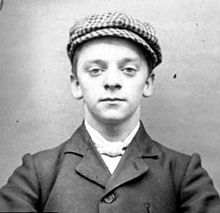
Peaky Blinders - A family from Birmingham , England . It was active at the end of the XIX and, to a lesser extent, at the beginning of the XX century, before the outbreak of the First World War . The Sharp Peaks was one of many urban youth gangs in this era. The gang consisted mainly of young unemployed men. They affirmed their social significance by robbery, violence, political influence and gambling control. Members of this gang wore a signature suit that included custom-made jackets, lapel coats, button down vests, silk scarves, flared trousers, leather boots and pointed flat hats. The gang was highly organized, with its own hierarchical systems.
They held power for nearly twenty years, until in 1910 they were overtaken by a larger gang - the Birmingham Boys, led by Billy Kimber. However, despite the fact that they disappeared by the 1930s, their name "Sharp Visors" has become the slang synonym for any street gang in Birmingham.
Content
Title
According to the historian of the West Midlands Police Museum David Cross, the name “Sharp Visors” has become popular because of the practice of stitching razor blades into the visors of their caps, which could then be used as weapons [1] . Carl Chinn, a professor of history at the University of Birmingham, describes this as an unrealistic scenario and says that the simpler explanation is that peakys was a common nickname for then-popular low-top caps. [2] [3] Gangs are known to have a distinctive clothing style. Wearing caps , neckerchiefs, flared trousers, jackets distinguished them from each other. [four]
British writer John Douglas of Birmingham claimed that hats were used as weapons in his novel Summer Walk. Members of the gang with razor blades sewn into their hats hit the enemies with their heads to blind them. As an alternative, the visors were used to cut the foreheads, causing blood pouring into the eyes of their enemies, causing temporary blindness.
History
There are two debatable questions: were the Sharp Peaks a single gang, or is it the local Birmingham term for a form of violent youth subculture? Politician Eric Moonman claims that youth street gangs in Birmingham were known as the "Sharp Peaks", or as the "Hard Workers" ( born Sloggers ). [5] Historian Paul Thompson writes: “These gangs will attack rapists, drunkards, and perhaps they will not kill them, but they will leave them to die in a ditch. If they cannot “knock out” a person or knock him down, they kick him or use belt buckles, like the Scuttlers from Manchester. ... They will use a knife, poker, fork or something else. ” [6]
Philip Guderson, author of The Birmingham Gang , claims that the Sharp Peaks arose as one gang, but later the term became universal. Previously, there was a gang known as the Chipside Workers ( Cheapside Sloggers ), which operated in the 1870s, and the term "Workers" (that is, "militants") already became an eponym for street gangs when the "Sharp Peaks" appeared in end of the century in Edderley Street, Bordesley, and Small Heath , the extremely poor slums of Birmingham. “Sharp Peaks” was distinguished by a special style in clothes, unlike earlier gangs. [ specify ] Famous gang members were David Taylor (imprisoned for killing a man, and for carrying a gun at 13 years old), “Baby Face” by Harry Fowles, Ernest Hines and Stephen McNickle. [7]
The girls of the gang members also had a characteristic style of clothing: “A lot of pearls, a fringe that obscured the entire forehead and almost reached the eyes, and a characteristic mottled colored silk scarf covering her neck.” [7] The gang members were allegedly often cruel to their girlfriends , one of which noted: “He will pinch and beat you every time he goes out with you somewhere. And if you talk to another guy, he can beat you without hesitation. ” [7]
In Culture
On BBC Two in October 2013, a drama series titled Sharp Visors starring Cillian Murphy was aired. The series tells about one gang from Small Heath, born in Birmingham after the First World War . The second season aired in 2014 [1] [8] [9] . The third began in 2016. The fourth - in October 2017. The fifth will be released on August 25, 2019.
Notes
- ↑ 1 2 Bradley, Michael . Birmingham's real Peaky Blinders , BBC News (September 12, 2013).
- ↑ Carl Chinn. Birmingham's Peaky blinders - fact and fiction . Birmingham Mail (September 12, 2013). Date of treatment September 29, 2013.
- ↑ Chamberlain, Zoe . The TRUTH Behind the Peaky Blinders , Birmingham Mail (October 15, 2014).
- ↑ Ugolini, Laura. Men and Menswear: Sartorial Consumption in Britain 1880–1939. - Ashgate, 2007 .-- P. 42.
- ↑ Moonman, Eric. The Violent Society. - F. Cass, 1987 .-- P. 36.
- ↑ Thompson, Paul. Edwardians: The Remaking of British Society. - Routledge, 1992 .-- P. 50.
- ↑ 1 2 3 Larner, Tony . When Peaky Blinders Ruled Streets with Fear, Sunday Mercury (August 1, 2010), p. 14.
- ↑ BBC Two - Peaky Blinders, Series 1 . BBC Date of treatment October 7, 2014.
- ↑ BBC Two - Peaky Blinders, Series 2 . BBC Date of treatment October 7, 2014.