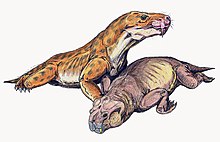
Presumably, it had poisonous glands that connected with grooves in the upper canines . The skull is high, there are no posterior teeth, five incisors and one canine on each side. There is no parietal opening. There is also (probably) a complete zygomatic and postorbital arch. The palatine openings are small. Behind the upper canines there are deep notches, possibly containing a poisonous gland, a hollow goes from this cavity to the canine. The tenderloin is connected to two large holes under the orbit (the exit of blood vessels and nerves?). On the canine itself there is a groove and a crest, for the drain of the secretion of the poisonous gland, and the groove goes along the front surface of the canine. The secondary sky is not developed. The skull is 10 cm long. The skeleton and lower jaw are unknown.
Found in the Upper Permian sediments (Cistecephalus zone) of Karoo in South Africa . Probably ate relatively small prey, which she could swallow whole. However, nutrition of relatively large animals such as dicynodonts is also possible. In this case, euchambers probably inflicted a bite on the prey, and then expected its death, pursuing the dying animal. Such tactics, however, could not be very successful in competition with other predators (some gorgonops or other terocephalus could intercept weakened prey).
In the BBC series Walking with Monsters (2005), a terocephalus (its role is played by the cynodont from the series Walking with Monsters ) attacks the leafosaurus and kills it with poisonous fangs. The prototype of poisonous terocephalus was euchambersia (however, the action takes place in the Upper Triassic era).