
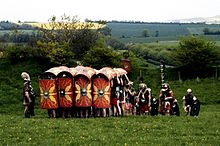


Skutum ( Latin scutum , plural scuta ) - a growth (tower) shield with a central handle and umber .
History
This type of shield comes from Italy , where it was distributed, probably, back in the Bronze Age . In particular, in Etruria , near Vetulonia , in one of the graves of the necropolis of Poggio alla Tuardia , which belongs to the VIII century. BC e. , a sculptural image of a shield was found, practically no different from the later Roman scutum. Later it was widely used by the Celts , Iberians and Illyrians .
Around the beginning of the 4th century BC e. began to be used by Roman legionnaires instead of the Argive hoplite shield (around the same time, the Romans abandoned the Greek phalanx ). By the time of the civil wars in Rome, the scutum took the form of an oval with a straightened top and base and gradually became completely rectangular. This last type of scutum is widely known from monuments from the time of the Empire . In the III century. n e. the scutum is gradually replaced by a flat oval shield (the so-called Auxilian shield), to which the old name was extended. Later heavy Byzantine infantrymen armed with a large oval shield were called scooters (shield bearers).
Design and manufacture
In ancient times, it had an oval or quadrangular convex (covering the body) shape. The so-called Samnite gladiators are depicted with an oval scutum with a cut top. Often strengthened by a vertical edge made of wood and in this case might not have a umber. Umbon was made of iron or bronze and could have various forms (metal strip, oval, “winged”, “butterfly”, etc.).
The Roman Scootum of the time of the Republic was about 75 cm wide, about 1.2 m high and weighs 8-10 kg. According to Polybius , it was made of two wooden plates glued together, which were first wrapped in coarse cloth and then calfskin. A scutum of this type, found in the Fayum oasis, whose height is 1.28 m and a width of 63.5 cm, is made of birch plates. Nine to ten such thin plates 6-10 cm wide were laid out longitudinally and laid on both sides with a layer of narrower plates laid perpendicularly to the first. Then all three layers were glued together. So the wooden base of the shield was formed. At the edge, its thickness was a little less than a centimeter, increasing to the center to 1.2 cm. Such shields were covered with felt, which was folded at the edge twice and stitched through a tree. The handle of the shield was horizontal and held in full grip. This type of pen is clearly visible on many Roman monuments. Polybius adds that such a shield had an iron umbon and iron upholstery along the upper and lower edges.
Considering the rounded shape of the shield, the only handle on the inside of the umbon and the swords that the Roman legionnaires wore not on the left, but on the right side, it should be assumed that the shield was not held in front of the chest, but along the left side, and the Roman legionary pressed the enemy, leaning on shield with your shoulder and helping yourself with a short sword, which with such use of the shield is more convenient to wear on the right.