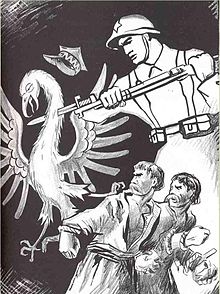
Soviet poster (1939)
The reunification of Western Belarus with the BSSR ( Belarusian. Uz'yadnanne Zakhodnyay Belarusі BSSR ) - the entry of Western Belarus into the BSSR after the Polish campaign of the Red Army in 1939 .
Content
History
During the First World War, the Russian Empire collapsed, in the North-Western Territory of which Belarusians lived. During the Civil War in Russia , Polish statehood was restored in the form of the Second Polish-Lithuanian Commonwealth . The Polish state began to restore the borders of the First Polish-Lithuanian Commonwealth , seizing the lands of Ukraine, Belarus and Lithuania, as well as pursuing an active predatory policy west of the lands of the former Kingdom of Poland . After the Soviet-Polish war , according to the Riga Treaty of March 18, 1921, Western Belarus became part of the Polish state and, together with Western Ukraine , became part of its "eastern outskirts" (kresy wschodnie). During the policy of " pacification ", the Polish authorities managed to defeat the national liberation movement of Belarusians, the backbone of which was left-wing parties and organizations, some of which (for example, the Communist Party of Western Belarus - KPZB) were closely connected with the party organs of the BSSR. By 1939, in Western Belarus, the Polish authorities had liquidated the last educational institution in the Belarusian language , and before that they had finished with many legal publications and organizations.
On the eve of World War II, the Polish authorities tried to enter into an anti-Soviet alliance with Nazi Germany, rejecting the peace initiatives of the USSR . The Soviet government, trying to postpone the attack of the Third Reich , concluded a series of treaties with the German side, similar to those concluded by Berlin with its other foreign policy partners. One such treaty was the Non-Aggression Treaty between Germany and the Soviet Union, signed on August 23, 1939, better known as the Molotov-Ribbentrop Pact . It is believed that in accordance with the secret protocol to it, the "eastern margins" of Poland became part of the " sphere of influence " of the USSR.
In September 1939, the Second World War and the Soviet Union began, waiting for the defeat of the Polish troops by Germany and the flight of the Polish government, on September 17 brought to the Polish ambassador Vaclav Grzybowski a note in which he informed:
“The Soviet government also cannot be indifferent to the fact that half-Ukrainians and Belarusians living in Poland, left to their own devices, remain defenseless. In view of this situation, the Soviet government ordered the Red Army High Command to order the troops to cross the border and take protection of the life and property of the population of Western Ukraine and Western Belarus. "
Having informed Poland and other countries about the note, on September 17, the Soviet government ordered the Red Army to cross the Polish border and occupy the territory of the Polish "Kresy" - Western Belarus and Western Ukraine. These events are known as the Liberation Campaign of the Red Army or the Polish Campaign of 1939. As a result of the campaign, in September 1939, Western Belarus was completely occupied by the Red Army, and both parts of Belarus - Eastern (BSSR) and Western (Polish "emergent armchairs") were practically united. In Western Belarus, formally still separate, Soviets began to form and public meetings were held, the result of which was the preparation of the legal registration of the reunion.
On October 14, 1939, the Supreme Council of the BSSR decided to accept Western Belarus into the BSSR. Thus, the territory of the BSSR and its population almost doubled.
On December 4, 1939, the Presidium of the Supreme Soviet of the USSR issued a decree on a new administrative-territorial division of the former Western Belarus, the territory of which has since been represented by the Baranavichy, Bialystok, Brest, Vileyka and Pinsk Regions. Of these, only the Brest region has survived to date.
As a result of the Yalta Conference, most of Western Belarus was assigned to the USSR; only a small part of the Bialystok region was returned to the Polish People's Republic. In 1991, the BSSR was renamed and since then in the official documents of the post-Soviet republic it is called the Republic of Belarus . Today, the territories of the former Western Ukraine and Western Belarus, which were part of the Ukrainian SSR and BSSR, are the territories of the post-Soviet Ukraine and Belarus.
Ratings
In Soviet and Belarusian historiography until the 1980s, the reunification of Western Belarus with the BSSR was unequivocally assessed as an act of liberation from social and national Polish oppression, as well as an act of historical justice, liquidation of the consequences of the division of Belarus under the terms of the Riga Peace Treaty of 1921 [1] [2] [3] [4] .
Today, the public perception and official historiography of Belarus is dominated by a positive perception of reunification [5] [6] [7] [8] [9] . On the eve of the 70th anniversary of the reunification, representatives of the Belarusian public suggested that the authorities recognize September 17 as the “Day of Reunification of the Belarusian People”, add the date to the calendar of official holidays, as well as to the calendar of memorable dates of the Union State of Belarus and Russia [10] [11] . According to the results of dozens of such appeals to various state bodies of Belarus and Russia, no positive decision was made to the leadership of the Union State and to the presidents.
The authorities of Belarus try not to notice the connection of September 17 with the events of the autumn of 1939. Only once, on September 17, 2009, did the presidential press service publish an official congratulation of Alexander Lukashenko on the 70th anniversary of the reunification of Western Belarus with the Belarusian Soviet Socialist Republic [12] . The congratulation said:
“On September 17, 1939 the liberation campaign of the Red Army began, the purpose of which was to protect the Belarusian and Ukrainian population left to their fate in Poland under the conditions of the German invasion and the outbreak of World War II. This not only strengthened the security of the USSR, but also became an important contribution to the struggle against fascist aggression. Despite various opinions and assessments of the events associated with this date, the fact is indisputable: as a result of the military operation, the artificially divided Belarusian people reunited, which was an act of historical justice. On the liberated lands, conditions were created for the construction of a new life. Belarusians got an opportunity to develop statehood within the framework of a single national-territorial entity. ”
Before and after the anniversary of 2009, the authorities of the Republic of Belarus did not congratulate citizens on the reunification of the Belarusian people and their lands [13] [14] . A typical example was the behavior of the authorities in 2016: state media did not pay attention to the 77th anniversary of the event, at the local level (in Grodno and Brest, for example), official events were held on other occasions [15] .
On the 77th anniversary of the beginning of the Red Army campaign of liberation, September 17, 2016 on the street. An international meeting of the Belarusian public was held in Minsk, according to the results of which it was announced the creation of the civil initiative “Committee of September 17”. The committee issued a statement saying [16] :
“We, Belarusians, representatives of different generations and political convictions, are united in one thing: it is necessary to seek the restoration of the memorial date of September 17 and seek recognition of it as a state holiday in the Republic of Belarus, as well as a memorable date for the Union State as the Day of the Reunification of the Belarusian People.”
See also
- National Assembly of Western Belarus
- Joining of Western Ukraine and Western Belarus to the USSR
- Polish Wehrmacht Campaign (1939)
Sources
- ↑ Klokov V. Ya. The Great Liberation Campaign of the Red Army. (Liberation of Western Ukraine and Western Belarus). - Voronezh, 1940.
- ↑ Minaev V. Western Belarus and Western Ukraine under the yoke of Panski Poland. - M., 1939.
- ↑ Trainin I. National and social liberation of Western Ukraine and Western Belarus. - M., 1939. - 80 p.
- ↑ Professor Eugene Novik: “Both Western Belarus and Western Ukraine are original Russian lands.” Information and journalistic. Together with Russia, Minsk . ross-bel.ru. Date of treatment September 18, 2016.
- ↑ September 17 - Day of reunification of the Belarusian people - Bykhov | News Bykhova. Lighthouse of the Dnieper. Lighthouse of Prydnyaproўya. District newspaper. . www.bykhov.by. Date of treatment September 18, 2016.
- ↑ Anniversary of the reunification of Belarus: why does Belarusian propaganda hush up its significance? - IA REGNUM . Date of treatment September 18, 2016.
- ↑ NOD BELARUS. Belarus COMMITTEE SEPTEMBER 17 part 2 GCD Belarus (November 18, 2015). Date of treatment September 18, 2016.
- ↑ “The reunion of Belarus in 1939 is the greatest historical event” - IA REGNUM . Date of treatment September 18, 2016.
- ↑ Day of reunification of the Belarusian people . kprf.ru. Date of treatment September 18, 2016.
- ↑ Belarusian public: September 17 should be a memorable date - IA REGNUM . Date of treatment September 18, 2016.
- ↑ The public has proposed the establishment of the Day of Reunification of the Belarusian People (September 16, 2008). Date of treatment September 18, 2016.
- ↑ News | The official Internet portal of the President of the Republic of Belarus . president.gov.by. Date of treatment September 18, 2016.
- ↑ Baranchik Yuri. September 17: Day of Reunification and Separation / Empire - information and analytical portal . www.imperiyanews.ru. Date of treatment September 18, 2016.
- ↑ The Belarusian historian did not find an explanation for hushing up the anniversary of the reunification of Belarus - IA REGNUM . Date of treatment September 18, 2016.
- ↑ Sergey Shiptenko: Day of the reunification of the Belarusian people and the head of cheese. Information and journalistic. Together with Russia, Minsk . ross-bel.ru. Date of treatment September 18, 2016.
- ↑ In Belarus, the “Committee of September 17” was created - IA REGNUM . Date of treatment September 18, 2016.
- Anna M. Cienciala (2004). The Coming of the War and Eastern Europe in World War II (lecture notes, University of Kansas). (eng.)
- Donўar, T. І. Uz'yadnanne Visit Belarus from the Belarusian SSR / T. І. Donўar // Yustytsyya Belarusі. - 2009. - No 4. (Belarusian)
- Ales Chaychits. Chamu Sovetsky acupatsya Belarusі was acupatsyyay (bel.)