Natalya Sergeevna Goncharova ( June 21 [ July 3 ] 1881 , the village of Ladyzhino (according to other sources, the village of Nagaevo), Tula Province - October 17, 1962 , Paris ) - Russian avant-garde artist , graphic artist , stage designer . The representative of luchism . Wife of Mikhail Larionov [6] .
| Natalya Sergeevna Goncharova | |
|---|---|
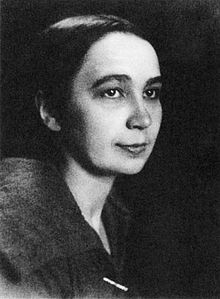 | |
| Date of Birth | or |
| Place of Birth | village Ladyzhino , Tula province , Russia |
| Date of death | |
| Place of death | |
| A country | |
| Study | |
| Style | avant-garde , rayism , pointlessness |
Origin
Belonged to the noble family of the Goncharovs (descendants of the Kaluga merchant Afanasy Abramovich - founder of the Linen Factory ). Born in the family of Moscow architect Sergei Mikhailovich Goncharov (1862-1935) and his wife Ekaterina Ilyinichna (nee Belyaeva), daughter of a professor at the Moscow Theological Academy [7] .
Grandfather - Volokolamsk police officer collegiate secretary Mikhail Sergeyevich Goncharov (1837-1867) - nephew of Natalia Goncharova-Pushkina . His wife - the grandmother of Natalya Sergeevna - Olga Lvovna (nee Chebyshev; 1836-1908), the sister of the famous mathematician P. L. Chebyshev .
Biography
Russian years
Education, early years
Goncharova’s childhood passed in the Tula province , where her father owned several villages and estates: Ladyzhino, Nagaevo, the village of Luzhny [8] . After living for the first ten years in the estates of her father, Goncharova later regretted having to live and work in large cities, while she would prefer rural life. Traveling around Russia, she also showed a greater interest in the study of villages than cities [9] .
In 1891 (according to other sources in 1892) he moved to Moscow with his family [8] [10] [11] .
In 1898 she graduated from the IV female gymnasium [8] with a silver medal. In 1900, he tried himself in medical courses [8] , but throws them after three days [9] . Later, in conversations with Goncharova, M. Tsvetaeva writes: “I could not bear the masculine appearance of female medical students.” In the same year, following a close friend, she studied for six months at the history department of the Higher Women's Courses [9] .
In 1901, as a free listener, he entered the Moscow School of Painting, Sculpture and Architecture in the sculpture department, in the class of the sculptor-impressionist P. P. Trubetskoy [8] . Her other teacher is S. M. Volnukhin [11] .
According to one version, in the same year he meets his future husband M.F. Larionov . However, according to another version, their acquaintance could have happened a year earlier: in the lists of Larionov’s works his portraits painted by Goncharova in 1900 are mentioned [8] .
In 1903 he made a trip to the Crimea and Tiraspol [10] . In Tiraspol, Goncharova draws posters for an agricultural exhibition, which takes place in a building constructed by her father [9] . From the trip, Goncharova returns with watercolors and pastels made in the impressionist technique, which she is fond of under the influence of Larionov [8] . The brought paintings are acquired by collectors of contemporary art A. I. Morozov , N. P. Ryabushinsky [11] . In the same year, interrupts his studies due to health conditions.
Returns to the school in 1904 and goes to the painting workshop, where K. A. Korovin becomes her teacher [8] [12] . The preference for painting sculpture is often associated with the influence of Larionov. In conversations with M. Tsvetaeva, Goncharova mentions his words spoken during his studies:
You have eyes for color, and you are busy with form. Open your eyes to your own eyes!
However, Goncharova continues to engage in sculpture. Twice her works are marked with medals: in 1904 she received a small silver medal for animalistic sculptural sketches, she was awarded the second medal for sculpture in 1907 [8] .
In 1909, Goncharova stopped paying tuition, and she was expelled from school [8] [10] .
Creative activity
Since 1906, Goncharova has been more and more involved in painting. In Paris, she visits a retrospective of Paul Gauguin and is fond of Fauvism , moving away from impressionism . Soon she tries herself in many other areas of painting: she is fond of cubism and primitivism [8] . At the same time, Goncharova actively exhibited her works, taking part in all significant exhibitions of contemporary art in Russia, as well as in some European exhibitions [12] :
- Exhibitions of the Moscow Association of Artists (1905, 1907),
- Autumn Salon in Paris (1906),
- "Russian Art Exhibition", organized by S. P. Diaghilev ,
- "Stefanos" (1907-1908, Moscow),
- The Link (1908, Kiev),
- Salons of the magazine " Golden Fleece " (1908-1909, Moscow).
Since 1908, Goncharova has been living in a house designed by her father ( Trekhprudny Lane , 2a) [8] .
From 1908 to 1911 he gave private lessons at the I. I. Mashkov Studio of Painting and Drawing [8] .
The first experience of theatrical work dates back to 1909: Goncharova prepares sketches of sets and costumes for the production of “The Weddings of Zobeide” by Hugo von Hoffmannsthal , carried out in the private studio of Konstantin Kracht [10] . He also tries himself in arts and crafts, designing the sculptural friezes of some Moscow mansions and developing wallpaper designs [13] .
On March 24, 1910, at the premises of the literary and artistic circle of the Society of Free Aesthetics, Goncharova organized his first solo exhibition [11] , which presented 22 paintings [14] . The exhibition lasted only one day: because of the painting “The Model (on a blue background)” Goncharova was accused of pornography, several works were confiscated. Soon, the court acquitted the artist [8] .
In 1912 he took part in futuristic walks organized by Larionov with painted faces around Moscow [8] . Starts to illustrate the books of futurists [8] [15] :
- A. Kruchenykh and V. Khlebnikov - “Mirskontsa”, “The Game in Hell” (1912),
- A. Kruchenykh - “Blast”, “Two poems. The desert The Desert "(1913),
- The collection of “Zadok judges” No. 2 (1913),
- K. Bolshakov - “Le futur”, “Heart with gloves” (1913), etc.
On the initiative of A. Kruchenyh, lithographed postcards with drawings by Goncharova are published.
Together with Larionov, he organizes and participates in exhibitions “ Jack of Diamonds ” (1910), “ Donkey's Tail ” (1912), “Target” (1914), “No. 4”. It is part of the Blue Horseman association in Munich and participates in the exhibition of the same name in 1912.
He takes part in the exhibitions "World of Art" (1911-1913, Moscow, St. Petersburg), " Youth Union ", "Moscow Salon", exhibitions of futurists in Rome , post-impressionists in London (1912), the gallery " Storm " in Berlin , First German autumn salon (1913, Berlin ), an exhibition of modern painting (1912, Ekaterinodar ) [8] [16] .
The largest solo exhibitions of Goncharova took place in Moscow, on Bolshaya Dmitrovka (autumn 1913 ), and in St. Petersburg (spring 1914 ), more than 700 works created from 1900 to 1913 [8] [17] [18] were presented at them. The Moscow exhibition ends with the release of the first monograph catalog dedicated to Goncharova and Larionov edited by I. M. Zdanevich . The catalog's foreword contains a frequently quoted statement attributed to Goncharova [19] :
I have gone through everything that the West could give up to now - as well as everything that, coming from the West, my homeland created. Now I shake off the dust from my feet and move away from the West, considering its leveling value to be very small and insignificant, my path to the source of all arts is to the East. The art of my country is incomparably deeper and more significant than everything that I know in the West.
Among art historians, there is a debate about the true authorship of these words. There is an assumption that the author was I. Zdanevich himself. However, the statement of similar theses in the earlier texts by Goncharova and Larionov allows other researchers to argue that the quote was consistent with the ideas of Goncharova and her close circle [19] . Later, when she was forced to emigrate to Paris, Goncharova said: “I wanted to go to the East, but I went to the West” [9] .
In 1913, he participated in the filming of the film “ Drama in the Cabaret of Futurists No. 13” . The only surviving shot of this film captures the half-naked Goncharova in the arms of Larionov. The premiere took place in January 1914, when the group "Donkey's Tail" had already broken up.
In 1914, on the recommendation of Alexandre Benois , Diaghilev invited Goncharov to Paris to work on the Golden Cockerel [12] . In Paris, in addition to theatrical work, Goncharov and Larionov arrange a personal exhibition in the gallery of Paul Guillaume in the spring of 1914, which received favorable reviews in the French press [20] .
"Mystical images of war"
With the outbreak of World War I, Larionov and Goncharova returned to Russia. In 1914, Goncharova published a lithographic series "Mystical Images of War" - large lithographs on a patriotic theme.
In 1915 he worked on the set design for the theatrical production of “Fans” by K. Goldoni at the A. Ya. Tairov Chamber Theater . This work of Goncharova was highly appreciated by V. Meyerhold [21] . The book by T. Churilin, “Spring after Death,” is published with lithographs by Goncharova.
In April 1915, the last lifetime exhibition of Goncharova in Russia took place ("Exhibition of Painting 1915"). In June 1915, Diaghilev invited Goncharov and Larionov to work continuously in his "Russian Seasons", they left Russia [8] .
Censorship
After Goncharova’s first solo exhibition in the Society for Free Aesthetics, the Voice of Moscow newspaper publishes an anonymous review in which two paintings (“The Model with Hands Arched” and “The Model with Hands on the Waist”) are called pornographic [22] . The next day, the police arrests these works and the painting “God,” which, according to the author of the newspaper article, “is worse than pornography of secret cards” [14] [23] . Goncharova is charged with disseminating pornography (“obviously seductive paintings”). The same charges are brought against the organizers of the exhibition: V. Ya. Bryusov , I. I. Troyanovsky , V. O. Girshman , K. I. Igumenov, V. A. Serov , and even Andrei Bely , who had no relation to the exhibition, however who wrote the text that was discussed on it [14] .
This case of harassment of an artist in pre-revolutionary Russia is not typical for historians. The very persecution of artists who do not occupy a political position cannot be called widespread at that time, and before Goncharova, an article on pornography was not applied to works of artistic value [14] .
Police attention to the exhibition may be due to a reform of the law, which since 1906 has expanded the possibilities of censorship. The sexist context of Goncharova’s accusations is also noted. Already in a note published by The Voice of Moscow, the author is especially outraged that a woman allows herself to violate moral standards [14] . Until the beginning of the 20th century, the very possibility of female artists to work on nudity was significantly limited [14] . Thus, the genre of nudity performed by the artist was unusual and provocative for the Moscow public. Goncharova herself did not have much experience writing nudity until 1908 , when she became a teacher at the Mashkov school - it was in the classroom at this school that the arrested “Models” were created [14] .
Finally, the cause of the trial could be the place where the exhibition took place. The main issue facing the court was the question of the publicity of the exhibition. Goncharova, her lawyer V. Khodasevich and defense witnesses pointed out that the one-day exhibition was a closed event, not intended for the general public. The court agreed with this version and, on this basis, acquitted Goncharov [22] . However, researchers note that the exhibition in the "Society of Free Aesthetics", one of the most visible venues in the capital, can only partially be called a closed event [14] [24] . Traditionally, nude paintings were shown in salons for an even more limited number of viewers.
According to the catalog of the 1913 exhibition, Goncharova painted nude paintings from 1906 to 1910, but after the trial she stopped her studies in this genre [14] .
But clashes with censorship did not end there. In 1911, the police demanded that the painting “God of fertility” be removed from the Jack of Diamonds exhibition. In 1912, the church opposed the display of the four-part cycle “Evangelists” at the exhibition “Donkey's Tail” [15] : the religious plot of the painting contradicted, according to the censor, the name and spirit of the exhibition [25] .
In 1914, under the sanction of the Chief Prosecutor of the Synod, 22 paintings from the personal exhibition of Goncharova in the St. Petersburg "Art Bureau" of Nadezhda Dobychina [23] were arrested - despite the fact that the paintings were previously approved by the spiritual censor [26] . The arrest was preceded by a press article criticizing the use of avant-garde techniques in portraying religious subjects [23] :
Exposed blasphemous works should be immediately removed from the exhibition: it is impossible to really allow deliberate disfiguration of the saints in the form of a laughing stock among green dogs, "radiant" landscapes and similar "cubist" rubbish.
Goncharova is interceded by former Minister of Education, Count I. I. Tolstoy , vice-president of the Academy of Arts Nikolai Wrangel and artist Mstislav Dobuzhinsky [23] . Under their pressure, the paintings were returned [26] .
Estimates of the works of Goncharova regarding the traditions of religious painting diverge. Later researchers note that neither before Goncharova, nor for a long time after “none of the Russian artists deviated in their work from the traditions of depicting sacred images so much that their creations could be called fundamentally new and modern interpretations” [27] . They note the inheritance of the Goncharova tradition of Lubok and peasant ideas about religion, mixing Christian and pagan images [23] . At the same time, a contemporary of Goncharova, archimandrite of the Alexander Nevsky Lavra , appreciated the artist’s work precisely for the revival of a style close to ancient icon painting. This position is also found in later studies [26] .
It is also known about the proposal of A. Schusev Goncharova to paint the Trinity Church, designed by him, built in 1912 in the village of Kugureshty (Bessarabia). The civil war and the separation of Bessarabia did not allow the plan to be realized, but the sketches made by Goncharova for the temple were preserved [26] .
There is an assessment of Goncharova as “the least radical artist of the Russian avant-garde,” for whom provoking the public did not matter as much as for a number of other avant-garde artists [28] .
Goncharova herself saw special value in combining artistic, religious and patriotic plots in painting [26] :
Religious art that the state can glorify is a beautiful and magical manifestation of art itself.
She commented on her encounters with censorship in this way [7] :
If I have clashes with society, it’s only because the latter does not understand the fundamentals of art in general, and not because of my individual characteristics, which no one is obliged to understand.
French years
In 1914, having accepted the invitation of Sergei Diaghilev to work as an artist for the Russian seasons , Goncharova and her husband arrived in France . The first work in the Diaghilev troupe was the set design of the opera-ballet The Golden Cockerel , after the success of the first shows of which in Paris and London Diaghilev continued to collaborate with the artist. First, the couple lived in Switzerland , in 1916 - in Paris , spent the winter and spring of 1917 in Rome . Finally settled in Paris in May 1919 [8] .
In a letter to the poet Sergei Bobrov, Natalia Goncharova wrote about the severity of separation from the motherland [29] :
How dear to me is every message from Moscow. You begin to understand the Chinese, who are said to sew up, leaving home, a handful of earth in the soles of shoes to always walk on their land.
В начале 1920-х годов Гончарова с Ларионовым активно сотрудничали с Дягилевым, регулярно выставлялись в парижских галереях «Осенний салон» и «Салон независимых» . Гончарова продолжила заниматься книжной иллюстрацией, живописью, преподаванием, оформляла парижские балы, но её известность постепенно сошла на нет [8] .
Первая зарубежная персональная выставка Гончаровой открылась в июне 1931 года. В 1938 году они с Михаилом Ларионовым приняли французское гражданство [8] . В 1956 году Гончарова и Ларионов наконец официально зарегистрировали свой брак.
В 1940-х и 1950-х годах супруги жили в относительной бедности и невостребованности, но во второй половине 1950-х годов их искусство вновь привлекло к себе внимание. В 1961 году в Лондоне Советом искусств Великобритании была организована крупная ретроспектива работ Ларионова и Гончаровой.
Скончалась в Париже 17 октября 1962 года . Похоронена на кладбище в Иври-сюр-Сен в Париже.
После её смерти Музей современного искусства (Париж) посвятил ей и Ларионову крупную ретроспективу.
- Примеры работ
Стрижка овец, 1907
Бабы с граблями, 1907
Хоровод , 1910
Архангел Михаил, 1910
Павлин под ярким солнцем, 1911
Ткацкий станок и женщина, 1913
Велосипедист, 1913
Книжные иллюстрации
Наталья Гончарова известна как художник книги [30] [31] . Среди её работ:
- Gontcharova, N. 14 portraits de Théâtre 1915—1916: Lausanne, St. Sebastian /reproduits aux pochoirs d'après les aquarelles originales et signés par l'auteur. — Paris: La Cible, 1916.
- Парнах, В. Самум / 3 рисунка Наталии Гончаровой. — Париж: Книгоиздательство «Нах» (транскрипция с санскрита), 1919 [32] .
- Gončarova, NS, Larionow, M. L'art décoratif théâtral moderne. — Paris: La Cible, 1919.
- Блок, А. Двенадцать. Скифы / с 14-ю иллюстрациями Н. Гончаровой и М. Ларионова. — Париж: Мишень, 1920.
- Парнах, В. Словодвиг = Motdinamo: Стихи / 8 иллюстраций с рисунков Н. Гончаровой; обложка и 7 иллюстраций с рисунков Ларионова. — Париж: Мишень, 1920.
- Цетлин, М. (Амари). Прозрачные тени. Образы: 4-я книга стихов. — Париж; Москва: Зёрна, 1920.
- Рубакин, А. Город: Стихи / обложка, иллюстрации и виньетки по рисункам Н. Гончаровой; шрифт исполнен автором. — Париж: 1920.
- Эскизы оформления издания «Откровение Иоанна Богослова». 1922. (Не осуществлено)
- Эскизы иллюстраций к книге К. Бальмонта «Фейные сказки». 1922. (Не осуществлено)
- Эскизы иллюстраций к трагедии А. С. Пушкина «Борис Годунов» по заказу «Orchis Verlag». 1922—1923. (Не осуществлено)
- « Слово о полку Игореве » (1923) [33]
- Pouchkine, AS Conte de tsar Saltan et de son fi ls le glorieux et puissant prince Guidon Saltanovitch et de sa belle princesse Cygne / mis en francais par Claude Anet; illustré et orné par Natalia Gontcharova. — Paris: Éditions de la Siréne, 1921 [34] .
- Isarlov, G. L'Annonciation: Roman / ill. par E. Chimot, A. Dignimont, N. Gontcharova et M. Larionov. — Paris: H. Reynaud, 1925.
- Kessel, J. Le thé du capitaine Sogoub / nouvelle illustré d'images hors-texte gravées par Nathalie Gontcharova. — Paris: Au Sans Pareil, 1926.
- Michel, M.-G. Les Montparnos: Roman / illustré par les Montparnos … — Paris: Fasquelle, 1929. (Иллюстрации художников парижской школы, в том числе Ларионова и Гончаровой.)
- Эскизы иллюстраций к эпосу «Калевала». 1932. (Не осуществлено.)
- Гофман, М. Л., Лифарь, С. Письма Пушкина к Н. Н. Гончаровой: Юбилейное издание (второе). 1837—1937. — Париж: [Издание Сержа Лифаря, 1936].
- Кодрянская, Н. В. Сказки. — Париж: [б. и.], 1950.
- Larionov, M., Vorms, P. Les Ballets russes / Serge de Diaghilew et la décoration théâtrale, par Nathalie Gontcharova, Michel Larionov, Pierre Vorms … Nouvelle édition revue et augmentée / [illustrations de Michel Larionov et de Nathalie Gontcharova]. — Belvès: P. Vorms, 1955.
Часть книг с иллюстрациями Н. Гончаровой переизданы в серии « Возвращение книги ».
Records
- On June 18, 2007, at an evening auction at Christie's in London , Goncharova’s painting “Harvesting Apples” (1909) was sold for 4 million 948 thousand pounds (almost 10 million US dollars), thus setting a historical record for the cost of works by women artists [35 ] .
- On February 2, 2010, at an evening auction at Christie's in London, Goncharova’s painting “The Spanish Woman” (1916) was sold for 6 million 425 thousand 250 pounds or 10 million 216 thousand 148 US dollars, thus setting a new historical record for the cost of works by female artists [36] [37] .
Fakes
In 2011, a press conference was held in Moscow, the participants of which, experts Irina Vakar and Andrey Sarabyanov and collector Pyotr Aven , announced about 300 fakes of Natalia Goncharova, published in Andrew Parton's monograph “Goncharova: Art and Design of Natalia Goncharova” and the first volume catalog-reason Denise Bazetu "Natalia Goncharova: her work between tradition and modernity" [38] .
Around 1999, the State Tretyakov Gallery brought for examination the painting “Gardening” with the alleged authorship of Natalia Goncharova. After a stylistic and technological examination, all the members of the expert group of the head of the scientific and expert department, Milda Vikturina, came to the conclusion that the work was not related to Goncharova. In order to obtain a positive expert opinion, Vikturina was offered a bribe of $ 500, and after her refusal, a second examination was appointed, from which all members of the expert group Vikturina were removed. Other experts attributed the picture as genuine. After these events, Viktorurina left the Tretyakov Gallery of her own free will [39] .
Exhibitions
October 16, 2013 in the Tretyakov Gallery [40] opened a four-month exhibition of Goncharova "Between East and West" [41] . The exhibition featured not only the famous paintings of Natalia Goncharova, but also theatrical sketches, as well as works related to fashion. In total, about 400 works were exhibited.
Bibliography
Books
- N. Goncharova, M. Larionov: Studies and publications. Collection of articles / Commission for the study of the art of the avant-garde of the 1910-1920s .. - M .: Nauka , 2001. - 252 p. - ISBN 5-02-022615-7 .
- N. S. Goncharova and M. F. Larionov: Research and Publications / State Institute of Art Studies of the Ministry of Culture of the Russian Federation . - M .: Nauka , 2003 .-- 252 p. - ( Art of the avant-garde of the 1910-1920s ). - ISBN 5-02-032673-9 .
- Flowers and Pottery: Letters of M. Tsvetaeva to N. Goncharova. 1928-1932. M. Tsvetaeva. Natalia Goncharova: Life and work / Preface, preparation of the text of letters and notes to them by N. A. Gromova . - M .: House-Museum of Marina Tsvetaeva , 2006. - 168 p. - ISBN 5-93015-086-9 .
Articles
- Basner E. V. Natalia Goncharova: on “conscious simplicity” // “Amazons of the avant-garde” / Editor-in-chief G. F. Kovalenko ; State Institute of Art Studies of the Ministry of Culture of the Russian Federation . - M .: Nauka , 2004 .-- S. 149-154 . - ISBN 5-02-010251-2 .
- Vakar Irina . On the early portraits of N. S. Goncharova // Vanguard and the rest: Collection of articles on the 75th anniversary of Alexander Efimovich Parnis. - M .: Three squares , 2013 .-- S. 658-690 . - ISBN 978-5-94607-172-7 .
- Duksina I. N. Goncharova and Tatlin (1913-1915) // “Amazons of the avant-garde” / Editor-in-chief G. F. Kovalenko ; State Institute of Art Studies of the Ministry of Culture of the Russian Federation . - M .: Nauka , 2004 .-- S. 111-124 . - ISBN 5-02-010251-2 .
- Inshakov A. N. Natalia Goncharova among the artists of “Donkey's Tail” // “Amazons of the avant-garde” / Editor-in-chief G. F. Kovalenko ; State Institute of Art Studies of the Ministry of Culture of the Russian Federation . - M .: Nauka , 2004 .-- pp . 133-148 . - ISBN 5-02-010251-2 .
- Lukanova A. G. Goncharova and Evreinov // "Amazons of the avant-garde" / Executive Editor G. F. Kovalenko ; State Institute of Art Studies of the Ministry of Culture of the Russian Federation . - M .: Nauka , 2004 .-- S. 125-132 . - ISBN 5-02-010251-2 .
- Ovsyannikova E. B. The early work of N. S. Goncharova in the archive of N. D. Vinogradov // "Amazons of the avant-garde" / Editor-in-chief G. F. Kovalenko ; State Institute of Art Studies of the Ministry of Culture of the Russian Federation . - M .: Nauka , 2004 .-- S. 155-174 . - ISBN 5-02-010251-2 .
- Rabinovich V. L. “A game in hell” by Goncharova and Rozanova with two features and one jaguar // “Amazons of the avant-garde” / Editor-in-chief G. F. Kovalenko ; State Institute of Art Studies of the Ministry of Culture of the Russian Federation . - M .: Nauka , 2004 .-- S. 175-183 . - ISBN 5-02-010251-2 .
- Rasovskaya D. E. Sketches by N. S. Goncharova “Saint Boris” and “Saint Theodore” in the collection of the Odessa Art Museum // “Bulletin of the Odessa Art Museum” No. 1 .
- Ryleva A. N. “The Blue Horsewoman” Natalia Goncharova // “Amazons of the Avant-Garde” / Editor-in-Chief G. F. Kovalenko ; State Institute of Art Studies of the Ministry of Culture of the Russian Federation . - M .: Nauka , 2004 .-- S. 105-110 . - ISBN 5-02-010251-2 .
- Semendyaeva Maria. Hundreds of suspicious works by Natalia Goncharova were discovered // Kommersant . - April 26, 2011.
Notes
- ↑ 1 2 Art UK - 2003.
- ↑ Netherlands Institute for the History of Art
- ↑ German National Library , Berlin State Library , Bavarian State Library , etc. Record # 118933159 // General regulatory control (GND) - 2012—2016.
- ↑ Natalia Sergeevna Goncharova
- ↑ Natalia Gontcharova - 2008.
- ↑ Goncharova Natalia Sergeevna / Pospelov G.G. // Hermaphrodite - Grigoryev. - M .: The Great Russian Encyclopedia, 2007. - P. 414. - (The Great Russian Encyclopedia : [in 35 vols.] / Ch. Ed. Yu. S. Osipov ; 2004—2017, vol. 7). - ISBN 978-5-85270-337-8 .
- ↑ 1 2 Osipova, Irina. The true Amazon (neopr.) // Expert. - 2013 .-- 11 November ( v. 45 ).
- ↑ 1 2 3 4 5 6 7 8 9 10 11 12 13 14 15 16 17 18 19 20 21 22 Andrei Sarabyanov. Natalia Goncharova. Encyclopedia of Russian avant-garde. Art. Architecture. In 2 volumes. Volume 1. AK . - Global Expert & Service Tim, 2013. - ISBN 978-5-902801-10-8 .
- ↑ 1 2 3 4 5 Marina Tsvetaeva. "Natalia Goncharova (life and work)." Prose (compilation) . - Eksmo-Press, October 13, 2013. - P. 548–. - ISBN 978-5-4250-7859-9 .
- ↑ 1 2 3 4 Natalia Goncharova . RusArtNet.com .
- ↑ 1 2 3 4 Goncharova Natalya Sergeevna . 20art.ru .
- ↑ 1 2 3 Frumkina, Rebekah. Exhibition Goncharova (neopr.) // Trinity version. - 2013 .-- 19 November ( v. 142 ).
- ↑ Natalia Sergeevna Goncharova . Silver age silhouette .
- ↑ 1 2 3 4 5 6 7 8 9 Sexuality and the Body in Russian Culture . - Stanford University Press, 1998. - P. 99–. - ISBN 978-0-8047-3155-3 .
- ↑ 1 2 Goncharova Natalia Sergeevna . ArtOnline.ru .
- ↑ Goncharova Natalia Sergeevna (Unavailable link) . State Tretyakov Gallery . Archived March 18, 2014.
- ↑ Vasilieva, Jeanne. Flowers on the face (neopr.) // Russian Newspaper. - 2013 .-- 17 October ( t. 6213 ).
- ↑ Dmitry Butkevich. Goncharova’s exhibition is dedicated to the centenary of the current exposition . Kommersant FM (October 23, 2013).
- ↑ 1 2 Shevelenko, Irina. “Suzdal Bogomaz”, “Novgorod Quattrocento” and the Russian avant-garde (Russian) // New Literary Review: magazine. - T. 124 . Archived March 18, 2014.
- ↑ Tolstoy, Andrey. From the Far North to Atlantis (Neopr.) // New Youth. - T. 58 .
- ↑ G.V. Titova. Creative theater and theatrical constructivism . - SPATI, 1995.
- ↑ 1 2 Vakar, Lyudmila. Mikhail Larionov / Natalia Goncharova and Marc Chagall: dialogue of ideas and images (Russian) // Bulletin of the Marc Chagall Museum: magazine. - T. 14 .
- ↑ 1 2 3 4 5 Fedotova, Elena Woman power of the Russian avant-garde . Colta.ru (October 22, 2013).
- ↑ The Spectacle of Russian Futurism: The Emergence and Development of Russian Futurist Performance, 1910-1914 . - University of Sheffield, 2005.
- ↑ " Grape Harvest." Natalia Goncharova . " Bible story .
- ↑ 1 2 3 4 5 Bagdasarov, Roman. Amazon of icon-painting avant-garde (neopr.) // Nezavisimaya Gazeta. - 2013 .-- 6 November.
- ↑ Epstein, Alec. Spiritual warfare: how and why the gates of the largest metropolitan center of contemporary art (rus.) Were closed by a bolt // The untouchable reserve: magazine. - T. 86 .
- ↑ Valley, Kira. The most non-avant-garde Amazon of the Russian avant-garde (neopr.) // Kommersant. - 2002 .-- 27 April ( v. 75 ).
- ↑ February 18, 1917. Natalia Goncharova → Sergey Bobrov
- ↑ Seslavinsky, M.V. Rendezvous: Russian artists in French book publishing in the first half of the 20th century: catalog album. - Moscow: Astrel, 2009. - S. 176-213, 490. - 504 p. - ISBN 978-5-94829-036-2 .
- ↑ Seslavinsky, M.V. French bibliophile publications in the design of Russian emigrant artists (1920-1940s): monograph. - Moscow: Publishing House University Book, 2012. - 254, [6] p., Ill. - ISBN 978-5-454-00003-5 .
- ↑ • Seslavinsky, M.V. Rendezvous: Russian artists in French book publishing in the first half of the 20th century: catalog album. - Moscow: Astrel, 2009 .-- S. 178-181. - 504 s. - ISBN 978-5-94829-036-2 .
- ↑ N. Goncharova. Illustrations and design of the book “The Word of Igor's Regiment” Archived May 19, 2008 on Wayback Machine
- ↑ N. Goncharova. Illustrations and design of the book “The Tale of Tsar Saltan” Archived copy of September 25, 2008 on Wayback Machine
- ↑ Art sales: eclipsing the Impressionists - Telegraph
- ↑ “Finance.” Pablo Picasso and a relative of Pushkin are Christie's champions Archived March 4, 2016 on Wayback Machine // finansmag.ru (Retrieved February 4, 2010)
- ↑ BBC Russian - Culture and show business - Portrait of Picasso's brush left auction for $ 13 million // bbc.co.uk (Retrieved February 4, 2010)
- ↑ Semendyaeva Maria . Hundreds of suspicious works by Natalya Goncharova were discovered // Kommersant -Online. - 2011 . - April 26th .
- ↑ Khodorych Alexey , Orlova Milena , Andreev Vasily. Work on fakes // Kommersant-Dengi . - 2000. - November 18 ( No. 46 (297) ).
- ↑ Survey illustrated article Archival copy of July 29, 2014 on the Wayback Machine , preceded by the opening of a large-scale exhibition of Goncharova at the State Tretyakov Gallery.
- ↑ A site specially developed for this exhibition introduces various aspects of N. Goncharova’s work in a historical perspective.
Links
- Goncharova Natalia Sergeevna. Biography and works of the artist on Artonline.ru
- A letter from James Butterwick to InCoRM.org
- Gleb Pospelov. Early Goncharova and Gauguin. The Tretyakov Gallery Magazine , # 1 2014 (42)
- Inessa Kuteynikova. Natalia Goncharova. Music and theater: Russian years. The Tretyakov Gallery Magazine , # 1 2014 (42)
- Eugene Ilyukhin. Villa of Sergey Kusevitsky. The history of one order. The Tretyakov Gallery Magazine , # 1 2014 (42)
- Eugene Ilyukhin. Poshuary Natalia Goncharova. The Tretyakov Gallery Magazine , # 1 2014 (42)
- Sergey Koluzakov. Church of the Holy Trinity in Kuguresti. The Tretyakov Gallery Magazine , # 1 2014 (42)
- Irina Vakar. About the exhibition of Natalia Goncharova in the Tretyakov Gallery. The Tretyakov Gallery Magazine , # 1 2014 (42)
- Eugene Ilyukhin. Spanish extravaganza of Natalia Goncharova. The Tretyakov Gallery Magazine , # 4 2015 (49)
- Poems by Natalia Goncharova // Our Heritage No. 109. “Our Heritage”, 2014. S.23-24
- Natalia Goncharova at the Project website 1917
- Fake Goncharova from foreign monographs penetrated the art market // RIA Novosti . - March 15, 2012.
- Fat Thekla . The program "Observer" with the participation of Andrei Sarabyanov, Evgenia Ilyukhina, Andrei Tolstoy and Irina Vakar // Culture (TV channel) . - November 19, 2013.
- Maria Valova. “Of course, we are sisters with you ...” NATALIA GONCHAROVA AND MARINA TSVETAEVA: THE HIDDEN WORLD OF NATALIA GONCHAROVA'S POETRY . The Tretyakov Gallery Magazine , # 2 2018 (59)