| Spherical | Euclidean | Hyperbolic | |
|---|---|---|---|
 {5,3} 5.5.5     | 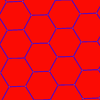 {6.3} 6.6.6  |  {7.3} 7.7.7  |  ∞.∞.∞  |
| Regular mosaics on the sphere {p, q}, the Euclidean plane and the hyperbolic plane with faces in the form of regular pentagons, hexagons, heptagons and infinite angles. | |||
 t {5,3} 10.10.3 | 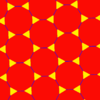 12.12.3 |  14.14.3 | 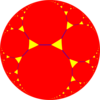 ∞.∞.3 |
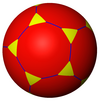
| Truncated mosaics have 2p.2p.q vertex shapes derived from regular {p, q} | |||
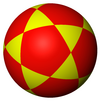 r {5,3} 3.5.3.5 |  r {6,3} 3.6.3.6 |  3.7.3.7 | 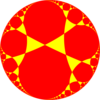 3.∞.3.∞ |
| Quasiregular mosaics are similar to regular mosaics, but they have two types of regular polygons, alternately following around each vertex. | |||
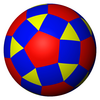 rr {5,3} 3.4.5.4 |  3.4.6.4 |  3.4.7.4 | 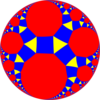 3.4.∞.4 |
| Semi-regular mosaics have more than one type of regular polygon. | |||
 tr {5,3} 4.6.10 |  4.6.12 |  4.6.14 | 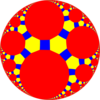 4.6.∞ |
| have three or more regular polygons with an even number of sides. | |||
In hyperbolic geometry, a homogeneous (regular, quasi-regular, or semi-regular) hyperbolic mosaic is filling an hyperbolic plane with regular edge-to-edge polygons with the property of vertex transitivity (this is a mosaic transitive with respect to vertices , isogonal, i.e. there is a movement that takes any vertex to any another). It follows that all the vertices are congruent and the mosaic has a high degree of rotational and translational symmetry .
Homogeneous mosaics are uniquely determined by their , a sequence of numbers representing the number of sides of the polygons around each vertex. For example, 7.7.7 represents a heptagonal mosaic having 3 heptagons around each vertex. It is correct because all polygons are of the same size. Thus, it can be set with the Shlefly symbol {7.3}.
Homogeneous mosaics can be regular (if they are also transitive along faces and edges), quasi-regular (if they are edge-transitive, but not transitive along faces) or semi-regular (if they are not transitive either along edges or along edges). For regular triangles ( p q 2), there are two regular mosaics with the Schlefli symbols { p , q } and { q , p }.
Content
Building Withoff
There are an infinite number of homogeneous mosaics based on Schwartz triangles ( p q r ), where 1 / p + 1 / q + 1 / r <1, where p , q , r are the orders of reflective symmetry at the three vertices of the fundamental triangle - the symmetry group is hyperbolic group of a triangle .
Each symmetry family contains 7 homogeneous mosaics defined or the Coxeter – Dynkin diagram , 7 combinations of three active mirrors. The 8th mosaic represents the operation of , removing half of the vertices from the higher form of active mirrors.
Families with r = 2 contain regular hyperbolic mosaics defined by Coxeter groups , such as [7,3], [8,3], [9,3], ... [5,4], [6,4],. ...
Hyperbolic families with r = 3 and higher are defined by the symbols ( p q r ) and include (4 3 3), (5 3 3), (6 3 3) ... (4 4 3), (5 4 3),. .. (4 4 4) ....
Hyperbolic families ( p q r ) define compact homogeneous hyperbolic mosaics. In the limit, any of the numbers p , q or r can be replaced by the symbol ∞, which gives a paracompact hyperbolic triangle and creates homogeneous mosaics that have either infinite faces (called apeirogons or infinite angles) that converge to one imaginary point, or infinite vertex figures with an infinite number edges coming from one imaginary point.
It is possible to construct additional families of symmetries from fundamental domains that are not triangular.
Some families of homogeneous mosaics are shown below (using the Poincare model for the hyperbolic plane). Three of them - (7 3 2), (5 4 2) and (4 3 3) - and no others, are minimal in the sense that if any of the defining numbers is replaced with a smaller integer value, we get either a Euclidean or a spherical mosaic rather than hyperbolic. And vice versa, any of the numbers can be increased (even replaced by infinity) to get another hyperbolic pattern.
Each homogeneous mosaic forms a dual homogeneous mosaic , and many of them are listed below as well.
Rectangular fundamental triangles
There are infinitely many families of triangle groups ( p q 2). The article shows the correct mosaics up to p , q = 8 and homogeneous mosaics of 12 families: (7 3 2), (8 3 2), (5 4 2), (6 4 2), (7 4 2), (8 4 2), (5 5 2), (6 5 2) (6 6 2), (7 7 2), (8 6 2) and (8 8 2).
Correct Hyperbolic Mosaics
The simplest set of hyperbolic mosaics are regular mosaics { p , q }. The regular mosaic { p , q } has the dual mosaic { q , p } (the diagonals of the table are symmetric). Self-dual mosaics {3,3} , {4,4} , , etc. are located on the diagonal of the table.
| Spherical (Platonic) / Euclidean / hyperbolic (Poincare disk: compact / paracompact / noncompact ) tilings with their symbols Shlefli | ||||||||||
|---|---|---|---|---|---|---|---|---|---|---|
| p \ q | 3 | four | five | 6 | 7 | eight | ... | ∞ | ... | iπ / λ |
| 3 | ( tetrahedron ) {3,3} | ( octahedron ) {3,4} | ( icosahedron ) {3,5} | ( delta tile ) {3,6} | {3,7} | {3.8} | {3, ∞} | {3, iπ / λ} | ||
| four | ( cube ) {4.3} | ( quadrille ) {4.4} | {4,5} | {4.6} | {4.7} | {4.8} | {4, ∞} | {4, iπ / λ} | ||
| five | ( dodecahedron ) {5,3} | {5,4} | {5.5} | {5,6} | {5.7} | {5.8} | {5, ∞} | {5, iπ / λ} | ||
| 6 | ( hexaplate ) {6.3} | {6.4} | {6.5} | {6.6} | {6.7} | {6.8} | {6, ∞} | {6, iπ / λ} | ||
| 7 | {7.3} | {7.4} | {7.5} | {7.6} | {7.7} | {7.8} | {7, ∞} | {7, iπ / λ} | ||
| eight | {8.3} | {8.4} | {8.5} | {8.6} | {8.7} | {8.8} | {8, ∞} | {8, iπ / λ} | ||
| ... | ||||||||||
| ∞ | {∞, 3} | {∞, 4} | {∞, 5} | {∞, 6} | {∞, 7} | {∞, 8} | {∞, ∞} | {∞, iπ / λ} | ||
| ... | ||||||||||
| iπ / λ | {iπ / λ, 3} | {iπ / λ, 4} | {iπ / λ, 5} | {iπ / λ, 6} | {iπ / λ, 7} | {iπ / λ, 8} | {iπ / λ, ∞} | {iπ / λ, iπ / λ} | ||
(7 3 2)
The triangle group , the Coxeter group [7.3], the (* 732) contain these homogeneous mosaics.
| Symmetry: | [7.3] + , (732) | |||||||||
|---|---|---|---|---|---|---|---|---|---|---|
| = t {3.7} | = {3.7} | |||||||||
| Homogeneous dual mosaics | ||||||||||
| V3.14.14 | V3.7.3.7 | V6.6.7 | V3.4.7.4 | V3.3.3.3.7 | ||||||
(8 3 2)
The triangle group , the Coxeter group [8.3], the (* 832) contain these homogeneous mosaics.
| Homogeneous octagonal / triangular mosaics | |||||||||||||
|---|---|---|---|---|---|---|---|---|---|---|---|---|---|
| Symmetry: [8.3], (* 832) | [8.3] + (832) | [1 + , 8.3] (* 443) | [8.3 + ] (3 * 4) | ||||||||||
| {8.3} | t {8.3} | r {8.3} | t {3,8} | {3.8} | rr {8.3} s 2 {3,8} | tr {8.3} | sr {8.3} | h {8.3} | h 2 {8,3} | s {3,8} | |||
| | | or | or | | |||||||||
| | | | |||||||||||
| Homogeneous dual | |||||||||||||
| V8 3 | V3.16.16 | V3.8.3.8 | V6.6.8 | V3 8 | V3.4.8.4 | V4.6.16 | V3 4 .8 | V (3.4) 3 | V8.6.6 | V3 5 .4 | |||
(5 4 2)
The triangle group , the Coxeter group [5,4], the (* 542) contain these homogeneous mosaics.
| Homogeneous pentagonal / square mosaics | |||||||||||
|---|---|---|---|---|---|---|---|---|---|---|---|
| Symmetry: [5.4], (* 542) | [5.4] + , (542) | [5 + , 4], (5 * 2) | [5,4,1 + ], (* 552) | ||||||||
| {5,4} | t {5,4} | r {5,4} | 2t {5,4} = t {4,5} | 2r {5,4} = {4,5} | rr {5,4} | tr {5,4} | sr {5,4} | s {5,4} | h {4,5} | ||
| Homogeneous dual | |||||||||||
| V5 4 | V4.10.10 | V4.5.4.5 | V5.8.8 | V4 5 | V4.4.5.4 | V4.8.10 | V3.3.4.3.5 | V3.3.5.3.5 | V5 5 | ||
(6 4 2)
The triangle group , the Coxeter group [6,4], the (* 642) contain these homogeneous mosaics. Since all elements are even, of the two dual homogeneous mosaics, one represents the fundamental region of mirror symmetry: * 3333, * 662, * 3232, * 443, * 222222, * 3222 and * 642, respectively. All seven mosaics can be alternated and there are dual ones for the resulting mosaics.
| Homogeneous quadrangular mosaics | |||||||||||
|---|---|---|---|---|---|---|---|---|---|---|---|
| Symmetry : [6.4], (* 642 ) ([6,6] (* 662), [(4,3,3)] (* 443), [∞, 3, ∞] (* 3222) index 2 subsymmetries) (and [(∞, 3, ∞, 3)] (* 3232) sub-symmetry) | |||||||||||
| = = = | = | = = = | = | = = = | = | ||||||
| {6.4} | t {6,4} | r {6,4} | t {4,6} | {4.6} | rr {6,4} | tr {6,4} | |||||
| Homogeneous dual duals | |||||||||||
| V6 4 | V4.12.12 | V (4.6) 2 | V6.8.8 | V4 6 | V4.4.4.6 | V4.8.12 | |||||
| Alternations | |||||||||||
| [1 + , 6.4] (* 443) | [6 + , 4] (6 * 2) | [6.1 + , 4] (* 3222) | [6.4 + ] (4 * 3) | [6.4.1 + ] (* 662) | [(6.4.2 + )] (2 * 32) | [6.4] + (642) | |||||
| = | = | = | = | = | = | ||||||
| h {6,4} | s {6,4} | hr {6,4} | s {4,6} | h {4,6} | hrr {6,4} | sr {6,4} | |||||
(7 4 2)
The triangle group , the Coxeter group [7.4], the (* 742) contain these homogeneous mosaics.
| Homogeneous heptagonal / square mosaics | |||||||||||
|---|---|---|---|---|---|---|---|---|---|---|---|
| Symmetry: [7.4], (* 742) | [7.4] + , (742) | [7 + , 4], (7 * 2) | [7.4.1 + ], (* 772) | ||||||||
| {7.4} | t {7.4} | r {7.4} | 2t {7.4} = t {4.7} | 2r {7.4} = {4.7} | rr {7.4} | tr {7.4} | sr {7,4} | s {7,4} | h {4.7} | ||
| Homogeneous dual | |||||||||||
| V7 4 | V4.14.14 | V4.7.4.7 | V7.8.8 | V4 7 | V4.4.7.4 | V4.8.14 | V3.3.4.3.7 | V3.3.7.3.7 | V7 7 | ||
(8 4 2)
The triangle group , the Coxeter group [8.4], the (* 842) contain these homogeneous mosaics. Since all elements are even, of the two dual homogeneous mosaics, one represents the fundamental region of mirror symmetry: * 4444, * 882, * 4242, * 444, * 22222222, * 4222 and * 842, respectively. All seven mosaics can be alternated and there are dual ones for the resulting mosaics.
| Homogeneous octagonal / square mosaics | |||||||||||
|---|---|---|---|---|---|---|---|---|---|---|---|
| [8.4], (* 842) (with [8,8] (* 882), [(4,4,4)] (* 444), [∞, 4, ∞] (* 4222) index 2 subsymmetries) (and the sub-symmetry [(∞, 4, ∞, 4)] (* 4242)) | |||||||||||
| = = = | = | = = = | = | = = | = | ||||||
| {8.4} | t {8,4} | r {8,4} | 2t {8.4} = t {4.8} | 2r {8.4} = {4.8} | rr {8.4} | tr {8,4} | |||||
| One -ordial dual | |||||||||||
| V8 4 | V4.16.16 | V (4.8) 2 | V8.8.8 | V4 8 | V4.4.4.8 | V4.8.16 | |||||
| Alternate | |||||||||||
| [1 + , 8.4] (* 444) | [8 + , 4] (8 * 2) | [8.1 + , 4] (* 4222) | [8.4 + ] (4 * 4) | [8.4.1 + ] (* 882) | [(8,4,2 + )] (2 * 42) | [8.4] + (842) | |||||
| = | = | = | = | = | = | ||||||
| h {8,4} | s {8,4} | hr {8,4} | s {4,8} | h {4.8} | hrr {8.4} | sr {8,4} | |||||
| Alternating dual | |||||||||||
| V (4.4) 4 | V3. (3.8) 2 | V (4.4.4) 2 | V (3.4) 3 | V8 8 | V4.4 4 | V3.3.4.3.8 | |||||
(5 5 2)
The triangle group , the Coxeter group [5.5], the (* 552) contain these homogeneous mosaics.
| Homogeneous five-pentagonal mosaics | |||||||||||
|---|---|---|---|---|---|---|---|---|---|---|---|
| Symmetry: [5.5], (* 552) | [5.5] + , (552) | ||||||||||
| = | = | = | = | = | = | = | = | ||||
| {5.5} | t {5,5} | r {5,5} | 2t {5.5} = t {5.5} | 2r {5.5} = {5.5} | rr {5,5} | tr {5,5} | sr {5,5} | ||||
| Homogeneous dual duals | |||||||||||
| V5.5.5.5.5 | V5.10.10 | V5.5.5.5 | V5.10.10 | V5.5.5.5.5 | V4.5.4.5 | V4.10.10 | V3.3.5.3.5 | ||||
(6 5 2)
The triangle group , the Coxeter group [6.5], the (* 652) contain these homogeneous mosaics.
| Homogeneous hexagonal / pentagonal mosaics | |||||||||||
|---|---|---|---|---|---|---|---|---|---|---|---|
| Symmetry: [6.5], (* 652) | [6.5] + , (652) | [6.5 + ], (5 * 3) | [1 + , 6.5], (* 553) | ||||||||
| {6.5} | t {6,5} | r {6,5} | 2t {6,5} = t {5,6} | 2r {6.5} = {5.6} | rr {6,5} | tr {6,5} | sr {6,5} | s {5,6} | h {6,5} | ||
| Homogeneous dual | |||||||||||
| V6 5 | V5.12.12 | V5.6.5.6 | V6.10.10 | V5 6 | V4.5.4.6 | V4.10.12 | V3.3.5.3.6 | V3.3.3.5.3.5 | V (3.5) 5 | ||
(6 6 2)
The triangle group , the Coxeter group [6,6], the (* 662) contain these homogeneous mosaics.
| Homogeneous hexagonal mosaics | ||||||
|---|---|---|---|---|---|---|
| Symmetry: [6.6], (* 662) | ||||||
| = = | = = | = = | = = | = = | = = | = = |
| {6.6} = h {4,6} | t {6,6} = h 2 {4,6} | r {6,6} {6.4} | t {6,6} = h 2 {4,6} | {6.6} = h {4,6} | rr {6,6} r {6,4} | tr {6,6} t {6,4} |
| Homogeneous dual | ||||||
| V6 6 | V6.12.12 | V6.6.6.6 | V6.12.12 | V6 6 | V4.6.4.6 | V4.12.12 |
| Alternate | ||||||
| [1 + , 6.6] (* 663) | [6 + , 6] (6 * 3) | [6.1 + , 6] (* 3232) | [6.6 + ] (6 * 3) | [6,6,1 + ] (* 663) | [(6,6,2 + )] (2 * 33) | [6.6] + (662) |
| = | = | = | ||||
| h {6,6} | s {6,6} | hr {6,6} | s {6,6} | h {6,6} | hrr {6,6} | sr {6,6} |
(8 6 2)
Triangle group , Coxeter group [8,6],