“Lady Lilith” is a painting by the English pre-Raphaelite artist Dante Gabriel Rossetti , originally painted between 1866 and 1878 with the model Fanny Kornfort , from 1872 to 1873 the artist rewrote the picture, then Alexa Wilding became the model [1] . The painting depicts Lilith , the first wife of Adam , “a powerful and evil temptress” [2] . There is an assumption that Rossetti rewrote the face of the model at the request of his customer, collector and art dealer Frederick Leyland [1] [3] . After the death of Leyland, the painting was bought by Samuel Bancroft, Jr., the owner of one of the largest collections of works of Pre-Raphaelites outside the UK. Bancroft in 1935 handed over the painting to the Delaware Museum of Art [4] .
| ||
| Dante Gabriel Rossetti | ||
| Lady Lilith . 1866–68, 1872–73 | ||
| Lady lilith | ||
| Canvas, oil. 96.5 × 81.1 cm | ||
| Delaware Museum of Art , Wilmington | ||
| ( inv. ) | ||

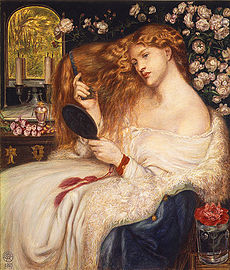

The picture is a diptych with the work of 1866–70 of Sibyl Palmifer : Lady Lilith represents the beauty of the body, and Sibyl Palmifer represents the beauty of the soul; on the frames of both paintings are painted sonnets by Rossetti.
Rosetti's 1867 watercolor, a copy of Lady Lilith, featuring Fanny Cornfort, is now in the Metropolitan Museum of Art [5] .
Information about the picture
In a letter to Frederick Leyland on April 9, 1866, Rossetti wrote that he began to write a new work, which will become one of his best works [6] . In 1866, Leyland bought Lady Lilith, and in 1869 became its owner; The price of the painting was 472.1 £. Two large-scale sketches of the 1866 painting and sketches that could have been created earlier than this date have been preserved. The picture depicts Lilith , a biblical character - the first wife of Adam , but this is a modern interpretation of the heroine. Girl admires herself in the mirror. Many artists depicted such narcissistic virgins with mirrors, but Lady Lilith is considered the personification and standard of this type of painting [7] .
Rossetti Assistant Henry Treffrey Dunn , said that the final stage of the painting was a floral background, for which they brought large baskets of roses from John Ruskin 's garden; it is assumed that it was Dunn, and not Rossetti, who later recreated the image of “Lady Lilith” on paper in colored pastel, which is now stored in the Metropolitan Museum of Art [8] [9] .
Historians disagree about who initiated the replacement of the model's faces - Leyland or Rossetti [10] [1] . In 1872, the painting returned to the artist, and by December of the following year he rewrote his face and sent the work back to Leyland [1] [11] . At the time of work, model sitter Alex Wilding was 27 years old, Rossetti paid her £ 1 per week for work. Previously, Rossetti also rewrote the picture “ Venus Verticordia ”, replacing the image of the face of the previous model with the face of Alexa Wilding [12] [11] .
Art historians note the use of symbolism of colors in the picture - white roses, symbolize sensual love, also reflects the tradition of painting, in which roses turned red when Eve appeared ; the poppy in the lower right corner represents sleep, oblivion, the languid and lazy nature of Lilith; Digitalis digitalis can symbolize insincerity [13] [1] .
The figure of Lilith is often seen as a symbol of the feminist movement, since she is a strong formidable woman dominating a man; in the picture, she is focused on her own beauty and is not dressed in a traditional Victorian corset, but in loose clothing [14] . A special symbolism in this regard is hair. In her book “The Power of Women's Hair in the Victorian Imagination”, Elizabeth Jitter writes that the more attention and space for the image of hair is given in the picture, the stronger the sexual subtext of the image; in folk traditions, literature and psychoanalysis, fluffy thick hair is a sign of powerful sexuality and even debauchery [7] . Also in the lines of the sonnet, Jitter sees a reference to castration :
| Lo! as that youth's eyes burned at thine, so went Thy spell through him, and left his straight neck bent |
.
Rossetti Sonnets
From 1865 to 1870, Dante Gabriel Rossetti worked on the painting " Sibyl Palmifer ", the model was also Alexa Wilding. The painting was sold to George Ray, Frederick Leyland also ordered a copy for himself, but it was not completed [16] . The word "Palmifera" means "bearing palm"; in the model’s hand is a palm leaf. By itself, palm trees and butterflies can symbolize the spiritual principle, and red roses and poppies carry flower symbolism in themselves [16] .
The sonnet of authorship of Rossetti himself was painted on the frame of the painting Beauty of the Soul [16] , on the frame “Lady Lilith” another sonnet was painted. Pairs of paintings and sonnets were first published together by Algernon Charles Swinburne in 1868. In 1870, poems were published in Rossetti's collection of “Sonnets for Pictures”. In 1881, Rossetti renamed the Lilith sonnet to Beauty of the Body and published two sonnets side by side in The House of Life, thereby directly combining a pair of contrasting works [16] [17] .
Exhibitions featuring paintings
After the purchase, Frederick Leyland kept the painting in his office, along with five other female portraits of the authorship of Rossetti [18] . May 28, 1892 at an auction at Christie's, American collector Samuel Bancroft Jr. bought “Lady Lilith” for £ 525, then he bought four more works of Dante Gabriel Rossetti, becoming the owner of one of the largest collections of Pre-Raphaelite works outside the UK. in 1935, Bancroft donated the painting and his entire collection to the Delaware Museum of Art [4] .
In 1883, the painting was exhibited in London, in 1892 - in Philadelphia. In the XX and XXI centuries, the painting visited American foreign exhibitions - in Richmond (1982), Tokyo (1990), Birmingham and Williamstown (2000), London, Liverpool and Amsterdam (2003) [6] . In 2012, the work was exhibited at the Tate Gallery , in 2013 - at the Washington National Gallery of Art .
Notes
- ↑ 1 2 3 4 5 McGann, Jerome (editor) Lady Lilith, Dante Gabriel Rossetti . Rossetti Archive . Institute for Advanced Technology in the Humanities, University of Virginia (2005). Date of treatment December 8, 2011.
- ↑ Lady Lilith . Delaware Art Museum.
- ↑ Waking Dreams , p. 58.
- ↑ 1 2 History . Delaware Art Museum. Date of treatment December 14, 2011. Archived March 17, 2013.
- ↑ "Dante Gabriel Rossetti: Lady Lilith (08.162.1) . " In Heilbrunn Timeline of Art History. New York: The Metropolitan Museum of Art, 2000-. (October 2006)
- ↑ 1 2 Waking Dreams , p.186.
- ↑ 1 2 Scerba, Amy Dante Gabriel Rossetti's painting “Lady Lilith” (1863: watercolor, 1864–1868 ?: oil) . Feminism and Women's Studies . EServer.org (2005). Date of treatment December 9, 2011.
- ↑ Henry Treffry Dunn - Past Auction Results . Artnet Date of treatment December 14, 2011.
- ↑ Thomas, David Wayne. Cultivating Victorians: liberal culture and the aesthetic p . 128 . - University of Pennsylvania Press, 2004 .-- P. 229.
- ↑ Waking Dreams , p. 188.
- ↑ 1 2 Lee, Jennifer J. VENUS IMAGINARIA: REFLECTIONS ON ALEXA WILDING, HER LIFE, AND HER ROLE AS MUSE IN THE WORKS OF DANTE GABRIEL ROSSETTI p. 26b and 31 // MA Dissertation: journal. - University of Maryland, 2006.
- ↑ Venus Verticordia, Dante Gabriel Rossetti, 1864-8 , Rossetti Archive, Retrieved December 18, 2011.
- ↑ Smith, Sarah Phelps. “Dante Gabriel Rossetti's 'Lady Lilith' and the Language of Flowers.” Arts Magazine 53 (1979): 142-145.
- ↑ Scerba, Amy Changing Literary Representations of Lilith and the Evolution of a Mythical Heroine (link unavailable) . Feminism and Women's Studies . EServer.org (1999). Date of treatment December 9, 2011. Archived December 21, 2011.
- ↑ Scerba, Amy Dante Gabriel Rossetti's Poem "Lilith," Later Published as "Body's Beauty" (1868) (Unreachable link) . Feminism and Women's Studies . EServer.org (1999). Date of treatment December 9, 2011. Archived November 3, 2013.
- ↑ 1 2 3 4 McGann, Jerome (editor) Sibylla Palmifera, Dante Gabriel Rossetti, 1866–70 . Rossetti Archive . Institute for Advanced Technology in the Humanities, University of Virginia (2005). Date of treatment December 12, 2011.
- ↑ Rossetti, Date Gabriel. The House of Life .
- ↑ Waking Dreams , p. 26 (figure 5).
Literature
- Wildman, Stephen. Waking Dreams, the Art of the Pre-Raphaelites from the Delaware Art Museum. - Art Services International, 2004 .-- P. 395.