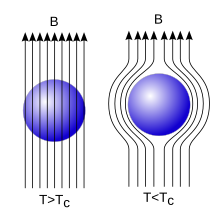
The Meissner effect , the Meissner effect (from German Meißner ) is the complete displacement of the magnetic field from the volume of the conductor when it enters the superconducting state . The phenomenon was first observed in 1933 by German physicists V. Meisner and R. Oksenfeld .
Content
- 1 Physical explanation
- 2 Type I and II superconductors
- 3 "Coffin of Mohammed"
- 3.1 Origin of the name
- 3.2 Statement of experience
- 3.3 Explanation
- 4 notes
- 5 Literature
- 6 References
Physical Explanation
When a superconductor located in an external constant magnetic field is cooled, at the moment of transition to a superconducting state, the magnetic field is completely displaced from its volume. This distinguishes a superconductor from an ideal conductor, in which, when the resistance drops to zero, the magnetic field induction in the volume must be preserved unchanged.
The absence of a magnetic field in the volume of the conductor allows us to conclude from the general laws of the magnetic field that only a surface current exists in it. It is physically real and therefore occupies a certain thin layer near the surface. The magnetic field of the current destroys the external magnetic field inside the superconductor. In this regard, the superconductor behaves formally as an ideal diamagnet . However, it is not a diamagnet, since the magnetization inside it is equal to zero.
The Meissner effect cannot be explained only by infinite conductivity. For the first time, the brothers Fritz and explained its nature using the equation of London . They showed that in a superconductor the field penetrates to a fixed depth from the surface - the London penetration depth of the magnetic field . For metals microns.
Type I and Type II Superconductors
Pure substances in which the phenomenon of superconductivity is observed are few. More often, superconductivity occurs in alloys. Pure substances have the full Meissner effect, while alloys do not completely eject the magnetic field from the volume (partial Meissner effect). Substances exhibiting the full Meissner effect are called superconductors of the first kind, and partial - superconductors of the second kind. However, it is worth noting that in low magnetic fields all types of superconductors have the full Meisner effect.
Superconductors of the second kind in the volume have circular currents that create a magnetic field, which, however, does not fill the entire volume, but is distributed in it in the form of separate filaments of Abrikosov vortices . As for the resistance, it is equal to zero, as in type I superconductors, although the movement of the vortices under the action of the current creates an effective resistance in the form of dissipative losses on the magnetic flux movement inside the superconductor, which is avoided by introducing defects into the structure of the superconductor - pinning centers, for which vortices “cling”.
The Coffin of Mohammed
“The coffin of Mohammed” is an experiment demonstrating the Meissner effect in superconductors [1] .
Name Origin
According to legend , the coffin with the body of the Prophet Mohammed hung in space without any support, so this experiment is called the "Coffin of Mohammed."
Learning Experience
Superconductivity exists only at low temperatures (in HTSC ceramics - at temperatures below 150 K ), therefore, the substance is preliminarily cooled, for example, using liquid nitrogen . Next, the magnet is placed on the surface of a plane superconductor. Even in fields whose magnetic induction is 0.001 T , a magnet shift upward by a distance of the order of a centimeter is noticeable. With increasing field up to the critical magnet rises higher.
Explanation
One of the properties of superconductors is the expulsion of a magnetic field from the region of the superconducting phase. Based on a stationary superconductor, the magnet “pops up” itself and continues to “float” until the external conditions remove the superconductor from the superconducting phase. As a result of this effect, a magnet approaching a superconductor “sees” a magnet of the same polarity and exactly the same size — which causes levitation.
Notes
- ↑ Yu. Martynenko On the problems of the levitation of bodies in force fields (1996). Date of treatment April 9, 2012. Archived August 16, 2010.
Literature
- de Genes P.-J. Superconductivity of metals and alloys. - M .: Mir , 1968 .-- 280 p.
- Martynenko Yu. G. On the problems of the levitation of bodies in force fields // Soros Educational Journal . - 1996. - No. 3 . - S. 82—86 . Archived on April 2, 2015.
- Matveev A.N. Electricity and magnetism. - M .: Higher School , 1983.- 463 p.
Links
- Meissner Effect (Hyperphysics)
- Yu. D. Tretyakov, E. A. Gudilin. Synthesis of “Levitating” HTSC Materials: From Fiction to Reality
- Meisner Effect Video ( YouTube )
- Another video demonstration of the effect ( YouTube )
- And another video demonstration of the effect ( YouTube )
- Superconducting levitation with strong pinning (demos)