Eugene Petrovich Goslavsky ( April 18 [30], 1861 [2] [3] , the village of Ostro-Plastikovo of the Ryazan province - December 2 [15] 1917 [2] [3] , Staraya Maina ) - Russian writer and playwright . Brother of the artist P.P. Goslavsky and critic V.P. Goslavsky , father of actress S.E. Goslavsky . Member of the Society of lovers of Russian literature [2] [3] , the Society of Russian dramatic writers and opera composers [3] , the literary circle " Wednesday " [2] . Valid state adviser [3] .
| Evgeny Petrovich Goslavsky | |
|---|---|
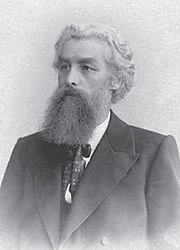 | |
| Aliases | Yarov, Eug. [one] |
| Date of Birth | April 18 (30), 1861 |
| Place of Birth | Ostro-Plastikovo , Russian Empire |
| Date of death | December 2 (15), 1917 (56 years old) |
| A place of death | Old Maina , Russian Empire |
| Occupation | novelist , playwright |
| Direction | realism |
| Genre | story , tale , play |
| Language of Works | Russian |
| Awards | Griboedov Prize |
Content
- 1 Biography
- 2 Literary activities
- 3 Relations with cultural figures
- 4 The image of Goslavsky in art
- 5 notes
- 5.1 Comments
- 5.2 Sources
- 6 Selected Bibliography
- 7 Literature
Biography
He was born in the family of P.V. Goslavsky , a hereditary nobleman, holder of the Order of St. Stanislav II degree with the imperial crown [3] , a real state adviser [3] . Brother had to artist P. P. Goslavsky and critic V. P. Goslavsky . Children: Alexander - officer of the White Army [4] ; Sergey - lawyer, official of the Kolchak Government [5] ; Sophia is an actress in theater and silent cinema.
He spent his childhood and youth mainly in the village of Ostro-Plastikovo, Sapozhkovsky district, Ryazan province [comm. 1] . Since 1884, he worked as a teacher in the local rural school, which was built and opened by I.V. Vernadsky (father of V.I. Vernadsky and brother-in-law S.N. Goslavskaya - mother of Evgeny Petrovich), and after his death, in 1885-1894 , contained mainly at the expense of P.V. Goslavsky. In 1886, he married A.V. Kark, a German-born woman whose father, Wilhelm Kark, lived in Russia and served as a wardrobe master at the court of Alexander III. Since that time, Goslavsky alternately lived in his estate near the village of Ostro-Plastikovo, in St. Petersburg and in Moscow (at the addresses: Trubnikovsky Lane , building 11 [6] ; Bolshaya Molchanovka , building 11 [7] ). Shortly before his death, the writer inherited an estate in the town of Staraya Maina and moved there for permanent residence. “ There he lived as a real recluse ,” recalled IA Belousov , “ for months he did not leave his room, whose walls were hung with plans and projects for new stories ” [8] .
Died on December 2 (15), 1917 .
Literary activity
E.P. Goslavsky began literary activity in 1882, but began to be published only from the late 1880s [2] . He collaborated with the magazines " Jester ", " Dragonfly ", " Observer ", " Artist " (it was here that many stories of Goslavsky, as well as his plays "Reckoning (Egoists)" and "Separated"), " Russian Thought ", " Theater "," Children's Rest "," Children's Reading "," Children's Friend ", etc. [2] . He showed great interest in Russian folklore, reflected in many works (the play "The Break-Grass", etc.). He recorded a number of folk songs [comm. 2] .
Goslavsky received the greatest recognition as a playwright. He penned the plays: “The Rich (Meekness is a White Dawn)” (1891), “Not to Anyone Like Jacob” (1891), “Reckoning (Egoists)” (1893, Griboedov Prize ), “ Separated ” (1894) , "Blizzard" (1894), "Plantain" (1897), "Ivanushka and the crane" (1898), "Rupture-grass" (1901), "Free artist" (1903), "Shoversha" (1904), etc. These works reflected the social processes of the 1890s: the ruin of "noble nests", the capitalization of the village, the stratification of the peasantry [2] . Goslawski’s Per also owns the play “Steam” (1899), commissioned by the Prince of Oldenburg and dedicated to the creation of Russia's first steam engine [9] .
Many of these plays were performed on the stages of the capital’s theaters, including the Maly (“Reckoning” [10] , “Separated” [10] ) and the New . Such outstanding masters of the stage as M. N. Ermolova (the first performer of the role of Berta Reiman in "Reckoning" [11] ), E. D. Turchaninova (the first performer of the role of Dunki in the comedy "In Separation", the role of Militris in the fantastic fairy tale “Break-Grass” [12] ) and others. The comedy “In Separation” was highly appreciated by A. P. Chekhov , who wrote to the author: “ I have not read such good plays for a long time. <...> Her literary merits are so attractive that I, without hesitation, ranked her among our best plays from folk life, and now, as you see, I could not resist and write to you. People are alive, written simply and brightly. <...> The language is magnificent. A sense of proportion and tact exemplary. <...> I sincerely wish you all the best, and most importantly - success and full prosperity. I sincerely wish you sincerely believe that you have real dramatic talent ” [13] . The fate of the play "Ivanushka and the Crane", created based on Russian folk tales, is noteworthy. Repeatedly published during the author’s lifetime, it was not forgotten in the following decades: in 1920, the Theater Department of the People’s Commissariat included Ivanushka and Crane in the list of plays recommended for production in children's theaters [14] , and in 1999 Ivanushka ... light ramp in the framework of the I All-Russian festival of school theaters "Russian Drama". This performance was very warmly received by both the public and metropolitan observers. So, the meeting magazine published by the Moscow Theological Academy wrote: “ “ Ivanushka and the crane ”gives the viewer sunny joy. Uncomplicated drama, a simple naive tale ... <...> It is gratifying that the Russian classics, imbued with spirituality and morality, are returning to the school scene ” [15] .
Goslavsky gained fame as the author of numerous stories. Their detailed analysis is devoted to an article by V. M. Shulyatikov, “Stories by Evgeny. Goslavsky ", which is a review of the collection" By the Road "(1902). As the critic noted, Goslawski turned in his little prose, as a rule, to a description of the life of the peasantry (“Rival”, “Apples”), “the life of rural teachers, their position among the provincial aristocracy” (“By chance”), “their relationship to the educational to the authorities ”(“ The Hare ”). Paying great attention to the inner world of his heroes, the writer with great skill depicted pathological conditions of the psyche. In this regard, the plot of “The Hare”, devoted to “the description of the consistent development of a mental illness”, is of particular interest. The main character of the story, teacher Terenty Zakharovich Mashin, was put by the reviewer on a par with Vasya Shumkov from the novel “ Weak Heart ” by F. M. Dostoevsky . In general, according to Shulyatikov, Goslawsky’s prose is marked by the “stamp of undoubted talent, a deeply realistic talent” [16] .
Shulyatikov’s article is partially supplemented by a review by M. A. Protopopov , which appeared in the journal Russian Thought (1903, No. 3). The author of this review noted that the "cold abstract truth of the depicted fact" was always warmed up by Goslavsky with the "warmth of subjective feeling", and emphasized the "restrained, decent literary manner", devoid of "deliberate eccentricities" and "ostentation" [17] . Goslavsky also received no less favorable reviews from Protopopov in personal correspondence: “In the letter he calls him“ chosen one ” [18] ,” said Yevgeny Petrovich Chekhov on January 4, 1903. Thus, both critics agreed on sympathies for the work of Goslavsky, which is especially significant taking into account their belonging to opposite camps of social thought: Shulyatikov was a Marxist , and Protopopov belonged to the Narodniks .
Relations with cultural figures
E.P. Goslavsky was in friendly relations with many figures of Russian culture of the late XIX - early XX centuries. He was one of the oldest members of the literary circle " Wednesday " [19] , which also included I. A. Bunin , Yu. A. Bunin , Maxim Gorky , L. N. Andreev , A. I. Kuprin , N. D. Teleshov , VV Veresaev , NI Timkovsky and others. Some meetings of the members of this circle were held in the apartment of Goslavsky on Bolshaya Molchanovka [20] .
A special place in the biography of Goslavsky is occupied by the period of communication with A.P. Chekhov [2] . Their acquaintance took place in 1880, but the correspondence materials were not preserved in full: only the corps of letters dating back to 1892-1903 survived [2] . The great Russian writer highly appreciated Goslavsky as a person and as a creative person, and gave him numerous practical advice. Support from Chekhov was very important for Yevgeny Petrovich: it was she, in particular, who helped him out of the creative crisis in the spring of 1899, when Goslavsky, by his own admission, was about to “give up on his writing” [21] .
Goslavsky’s circle of acquaintances included many other artists: E. D. Turchaninova , T. L. Shchepkina-Kupernik , S. P. Kuvshinnikova , A. I. Sumbatov-Yuzhin , Vl. I. Nemirovich-Danchenko , A. P. Lensky (Goslavsky dedicated the drama “Reckoning (Egoists)” to him) and other creative unions connected Goslavsky with A. F. Geltser (the author of the scenery for the premiere production of the comedy “In Separation” [22] ), K. F. Waltz (one of the authors of the scenery for the premiere production of “Rupture-Grass” [23] ). Part of the Goslawski archive, which is stored in the Russian State Archives of Arts [comm. 3] , includes letters from A. V. Amfiteatrov , P. P. Gnedich , V. S. Kalinnikov , V. G. Korolenko , F. A. Korsh , A. N. Plescheev , K. S. Stanislavsky [24] . There is reason to believe that Goslavsky was also acquainted with F. I. Chaliapin , who in the winter of 1902-1903 attended separate meetings of members of the “Environment” [25] .
Goslavsky's Image in Art
In 1892, the story of A.P. Chekhov's “The Jumpers ” was published on the pages of the Sever magazine, the first chapter of which mentions a "young but already well-known" writer who "wrote novels, plays and short stories" [26] . According to both the first readers of the story and researchers, Yevgeny Petrovich Goslavsky should be considered its prototype [27] [28] . In addition, the writer and playwright repeatedly appeared on the pages of memoirs: information about his life and work can be found in “Notes of the film actress” by S. E. Goslavskaya , “Conversations with memory” by V. N. Muromtseva-Bunina , and memoirs of I. A. Belousov, V.V. Veresaev, B.K. Zaitsev. Separate references to Goslavsky are in the Notes of the Writer by N. D. Teleshov . There is a portrait of Evgeny Petrovich, painted in the first quarter of the XX century by the artist V. I. Rossinsky [29] .
Notes
Comments
- ↑ In accordance with modern territorial division, this village is part of the Ostro-Plastikovsky rural settlement of the Chuchkovsky district of the Ryazan region .
- ↑ A notebook with drafts of short stories, recordings of songs, and other unpublished materials is stored in the RGALI (f. 150; 36 units of books; 1888-1967; op. 2).
- ↑ F. 150, op. 1 unit hr 36.
Sources
- ↑ Masanov I.F. Dictionary of pseudonyms of Russian writers, scientists and public figures : in 4 volumes / Masanov Yu.I. - M .: All-Union Book Chamber, 1956-1960. - T. 4. - P. 143. - 558 p. - 15,000 copies.
- ↑ 1 2 3 4 5 6 7 8 9 RP, 1989 , p. 658.
- ↑ 1 2 3 4 5 6 7 Potemkin, 2017 , p. 431.
- ↑ Semenov V. Supplement to the biographical reference book “Officer corps of the Orenburg Cossack army 1891-1945”. - Orenburg: Printing House "Dimur", 2009. - S. 21. - 72 p.
- ↑ Goslavsky Sergey Evgenievich . CenterAsia . Date of appeal September 20, 2017.
- ↑ Goslavsky, 2013 , Part 1, p. 28.
- ↑ Goslavsky, 2013 , Part 1, p. 57.
- ↑ Belousov, 1928 , p. 125.
- ↑ Goslavskaya, 1974 , p. eighteen.
- ↑ 1 2 Maly Theater, 1924 , p. 689.
- ↑ Ermolova, 1955 , p. 477.
- ↑ Turchaninova, 1974 , p. 411-412.
- ↑ Chekhov, 1974-1983 , Letters. T. 5, p. 33-34.
- ↑ Game: Non-periodical publication dedicated to education through play . - Pg. : State Publishing House, 1920. - T. 3. - S. 48. - 144 p.
- ↑ Beloselskaya, G. <About the play "Ivanushka and the Crane"> // Meeting. - 1999. - No. 8.
- ↑ Shulyatikov, V. M. Stories Eug. Goslavsky // Courier. - 1902. - No. 112.
- ↑ Protopopov, M. A. Simple Talents // Russian Thought. - 1903. - No. 3. - S. 174-190 (1st pagination).
- ↑ Chekhov, 1974-1983 , Letters. T. 11, p. 427.
- ↑ Belousov, 1928 , p. 122.
- ↑ Goslavsky, 2013 , Part 1, p. 29.
- ↑ Chekhov, 1974-1983 , Letters. T. 8, p. 486.
- ↑ Repertoire of the Maly Theater of 1890-1900 . Maly Theater . Date of appeal September 20, 2017.
- ↑ Repertoire of the Maly Theater 1900-1910 . Maly Theater . Date of appeal September 20, 2017.
- ↑ F. 150 Goslavsky Evgeny Petrovich (Unavailable link) . RGALI: Funds Guide . Date of treatment September 20, 2017. Archived September 12, 2017.
- ↑ Teleshov, 1958 , p. 48.
- ↑ Chekhov, 1974-1983 , Works. T. 8, p. 8.
- ↑ Sobolev, 1930 , p. 133.
- ↑ Chekhov, 1974-1983 , Works. T. 8, p. 430.
- ↑ Goslavsky O. V. Goslavsky: The connection of times and generations. - M. , 2017 .-- S. 38 .-- 212 p.
Selected Bibliography
- Eternal memory: Story // Artist. - 1893. - No. 26. - S. 110-124 (1st pagination).
- Hare: Short Story // Artist. - 1893. - No. 28. - S. 88-103 (1st pagination).
- Two nights: Story // Artist. - 1893. - No. 31. - S. 106-112 (1st pagination).
- Retribution (Egoists): Drama in 4 acts // Artist. - 1893. - No. 31. - S. 36–62 (2nd pagination).
- Error: Story // Artist. - 1894. - No. 35. - S. 93-117 (1st pagination).
- Separated: Comedy at 4 d. // Artist. - 1894. - No. 41. - S. 1-21 (2nd pagination).
- Indistinctness: Sketch // By the way: Sat. the stories of A.P. Chekhov, I.N. Potapenko , P.P. Gnedich and others. - M., 1894.
- Cow: Story // Russian Thought. - 1896. - Book. 2. - S. 179-206 (1st pagination).
- Ivanushka and the Crane: A Tale of 3 Maps. - SPb., 1898. - (Library of our children. Fairytale Theater).
- Peasant Conscience: A Story. // Russian thought. - 1900. - Book. 11. - S. 55-68 (1st pagination).
- Ivanushka and the Crane: A Tale of 3 Maps. - Ed. 2nd. - SPb., 1901. - (Fairytale Theater).
- Guardian: Story // Courier . - 1901. - Book. 3. - December 25th.
- The Way-The-Road: Stories. - [M.], 1902. Contents. : Our people; By chance; Rival Raspberry ringing; Resentment; Animal; To help; Velvet; Hare; Warning; Apples Sagebrush; The mercy of evil; Why not; Naked.
- Gap grass: Fantastic tale in 5 d. - M., 1902.
- A case came out: Story // Russian Thought. - 1903. - Prince. 3.
- Dreamer: Story // Russian Thought. - 1903. - Prince. 6.
- Reckoning (Egoists): Drama in 4 d. - M., 1903.
- Free artist: Comedy in 4 d. - M., 1903.
- Spring Thunderstorms: Stories. - M., 1903. Contents. : Gooseberry; Flooring; Red chicken; Mom's darling; Kennel; Sapling grass; Misha is a sin.
- Girls: Comedy in 1 day - M., 1904.
- Gorbach: A Tale // Russian Thought. - 1904. - Prince. 6.
- Among the fields: Sat stories for children. - M., 1905.
- In the village: Sat stories for children. - M., 1905.
- “Voivodsha the Frog” and other short stories and poems for young children. - M., 1908.
Literature
- Belousov I.A. Literary environment: Memoirs (1880-1928) . - M .: Nikitinsky Subbotniks, 1928 .-- 278 p. - 3,000 copies.
- Bunina V.N. Conversations with memory // Literary heritage . - M .: Nauka , 1973.- T. 84, Prince. 2. - S. 159—223. - 551 p. - 20,000 copies.
- Vengerov S. A. Sources of the dictionary of Russian writers . - SPb. : Type of. Imp. Academy of Sciences, 1910. - T. 2. - 598 p.
- Veresaev V.V. Cloud and Dawn // Memoirs. - Ed. 3rd, add. - M. - L .: Goslitizdat , 1946 .-- S. 472-483. - 508 s. - 65,000 copies.
- Vernadsky V.I. Diaries of 1935-1941 / V.P. Volkov. - M .: Nauka , 2006 .-- T. 1.
- Gavrilov I. Goslavsky Evgeny Petrovich // Literary Ryazan: Biobibliogr. dictionary. - Ryazan, 1979. - Part 1. - P. 12-13.
- Gilyarovsky V.A. Moscow newspaper // Works: In 4 vols. - M .: Pravda , 1989. - Vol. 3. - P. 4-266. - 432 s. - 500,000 copies.
- Goslavskaya S. E. Notes of the film actress . - M .: Art , 1974. - 197 p. - 30,000 copies.
- Goslavsky Evgeny Petrovich // Theatrical Encyclopedia . - M .: Soviet Encyclopedia , 1967. - T. VI (add.).
- Goslavsky, O. V. Goslavsky - the name of soldiers and creators // Monomakh. - 2009. - No. 1 (56).
- Goslavsky O. S. P. P. Kuvshinnikova and Goslavsky // Levitan readings: Materials of the scientific and practical conference, Plyos, October 3-4, 2011. - Ivanovo: Plesky state. historical-architectural and art museum-reserve, 2014. - P. 12-18. - 156 p.
- Goslavsky O. V. Goslavsky (materials on the pedigree). - M. , 2013.
- Doroshevich V. M. “Rupture-grass” [Review] // Russia. - 1901. - No. 863.
- Zaitsev B.K. Youth - Russia // Collected Works. - M .: Russian book , 2000.- T. 9 (add.). - S. 6-18. - 560 s. - 5,000 copies.
- Zaoksky S. Correspondence of A.P. Chekhov with E.P. Goslavsky // Stalin's banner. - 1954. - July 11.
- Ermolova M.N. Letters. From the literary heritage. Memoirs of contemporaries. - M .: Art , 1955. - 496 p. - 20,000 copies.
- L-ev [Andreev L.N.] New Theater: “Rift-Grass”: a fantastic tale: in 5th d., Op. E.P. Goslavsky. [Review] // Courier. - 1901. - No. 252.
- M. T. “Separated,” a comedy in the fourth episode of E. Goslavsky [Review] // Artist. - 1894. - No. 42. - C 216-221.
- Mikhailov O. N. I. A. Bunin: Essay on creativity. - M., 1967 .-- S. 47.
- Moscow Maly Theater. 1824-1924 . - M .: State Publishing House, 1924. - 710 p. - 2,200 copies.
- Nadson, S. Ya. Literary Essays (1883–1886). Journal Review, IV // Prose. Diaries. Letters. - SPb. : Type of. M.A. Aleksandrova, 1912 .-- S. 253-261. - 642 p.
- Novikova A. A. P. Chekhov - reader, editor and literary critic (from the epistolary heritage) // Scientific works of SWorld. - 2012. - T. 31. - No. 2. - S. 53–61.
- Polubedov, A.A., Levitan's Daughter // Moscow. - 2016. - No. 6.
- Potemkin E. L. Biographical Dictionary. The highest ranks of the Russian Empire . - M .: b. and., 2017 .-- T. I: A — Z. - 623 p.
- [Preobrazhensky V.] P. New Theater: “Rift-Grass”: a fantastic tale by E. P. Goslavsky. [Review] // News of the day. - 1901. - No. 6556.
- Protopopov M.A. Simple Talents // Russian Thought. - 1903. - Prince. 3. - S. 174-190 (1st pagination).
- R. Theaters // Moscow Leaf. - 1901. - No. 253.
- Wanderer S.G. River of Oblivion // Tales and Stories. Memories. - M .: Moscow Worker , 1960 .-- S. 186-200. - 510 s.
- Sobolev Yu. V. How the “Jumper” is made // Chekhov: Articles, materials, bibliography. - M .: Federation, 1930. - S. 132-144. - 345 p. - 4,000 copies.
- Sysoev N.A. Chekhov in the Crimea . - Ed. 3rd, fix and add. - Simferopol: Krimizdat, 1954. - 152 p.
- Teleshov N. D. Notes of the writer: Memoirs and stories of the past . - M .: Moscow Worker , 1958.- 384 p. - 85,000 copies.
- Telyatnik, M. A. Feuilleton-reviews of Leonid Andreyev about the Maly and New Theaters // Bulletin of the St. Petersburg State University of Culture and Arts. - 2015. - No. 1 (22).
- Time G. A. Goslavsky Evgeny Petrovich // Russian writers. 1800-1917: Biographical Dictionary . - M .: Soviet Encyclopedia , 1989. - T. 1: A — G. - S. 658. - 672 p. - 100,000 copies.
- Titov S. Rewriting the pages of old magazines // Ryazan Komsomolets. - 1969. - Sep 13.
- Turchaninova E. D. Letters, articles. Memoirs of contemporaries. - M .: All-Russian Theater Society, 1974. - S. 411-412. - 432 s. - 17,500 copies.
- Khodus V. Directorial intentions of A.P. Chekhov according to metapoetics // Science, Innovations, Technologies. - 2008. - No. 5.
- Chekhov A.P. Complete Works and Letters: 30 vol . - Academy of Sciences of the USSR. Institute of World Lite. them. A. M. Gorky. - M .: Science, 1974-1983. - 50,000 copies.
- Shulyatikov V. M. Stories Eug. Goslavsky // Courier. - 1902. - No. 112.