Egilops three-inch (also protruding aegilops, three-axis aegilops; Latin Aegilops triuncialis ) - an annual herbaceous plant ; a species of the genus Aegilops of the family Cereals ( Poaceae ) [2] .
| Aegilops three-inch |
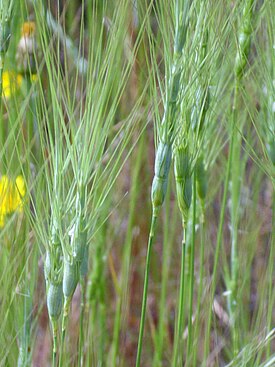
General view of the plant |
| Scientific classification |
|---|
| Grade: | Monocotyledonous [1] |
|
| International scientific name |
|---|
Aegilops triuncialis L. |
| Synonyms |
|---|
| See text |
|
Content
Aegilops triuncialis (drawing from the United States Grass Guide,
A.S. Hitchcock , 1950)
Thorny spikelets with a long spine are attached to animals and people, contributing to the spread of the plant.
An annual herbaceous plant 20-45 cm tall, the stems in most cases erect.
The leaves are linear, flat. The leaves, tongue and upper part of the sheaths of the leaf are ciliated.
Ears of 3.5-7 cm long (not counting the spines), with 4-5 (less often with 3 or 6) spikelets, narrow-lanceolate. At the base of the ear there are 2-3 rudimentary spikelets. Spikelet scales are oblong, ovate or obovate, less than 2 times shorter than the adjacent lower floral scales, cartilaginous, with 7-13 wide veins, rough or short-haired, at the apex with 2-3 a few slightly deviated awns from the spike axis. Spikelet scales of the upper spikelet 4.5-6 mm long. The ribs of the axis of the ears are often only with sharp tubercles, without longer spines. Grains do not grow together with flowering scales.
Wind and self-pollinating plant. Autochor. Propagated by seeds. It blooms in May, bears fruit in June. Ploidy 2n = 28 [3] .
According to The Plant List for 2010, the synonymy of the species includes [4] :
- Aegilopodes triuncialis ( L. ) Á.Löve
- Aegilopodes triuncialis subsp. persica ) Boiss. ) Á.Löve
- Aegilopodes triuncialis subsp. triuncialis
- Aegilops aristata Req. ex Bertol.
- Aegilops buschirica Roshev.
- Aegilops croatica gand.
- Aegilops echinata C.Presl
- Aegilops elongata Lam.
- Aegilops ovata var. triaristata (Willd.) Coss. & Durand
- Aegilops ovata var. triaristata (Willd.) Lindb.
- Aegilops ovata subsp. triaristata (Willd.) Jáv.
- Aegilops persica boiss.
- Aegilops squarrosa L.
- Aegilops squarrosa subsp. squarrosa (L.) Kihara & Tanaka
- Aegilops triaristata Req. ex Bertol.
- Triticum persicum (Boiss.) Aiton & Hemsl.
- Triticum squarrosum (L.) Raspail
- Triticum triunciale (L.) Raspail
- Triticum trunciale (L.) Raspail [5]
Crimea, the Caucasus (Dagestan, East and South Transcaucasia, Talysh), Central Asia (the valleys of the Syr Darya and Amu Darya rivers in their upper reaches, Kyzylkum, western Tien Shan, Gissaro-Darvaz, Kopet-Dag), the Mediterranean, Asia Minor, Iran. Alien in many other non-tropical countries [3] .
In the United States grows in the west (California, Nevada) and east (Maryland) of the country [6] .
Feed. It is well eaten by all types of farm animals until the fruiting phase. It can be used in breeding for hybridization with wheat [3] .
- Gandilyan P. A. On the taxonomy of the genus Aegilops L. and the determinant of its species. // Biol. Journal of Armenia, 1978.- T.31. - No. 3. - S.223-232.
- Zhukovsky P. M. Critical and systematic review of species of the genus Aegilops L. // Tr. by prikl. bot. gene. and Selk., 1928. - T. 18. - No. 1. - S.417-609.
- Tsvelev N.N. Grains of the USSR. - Leningrad: Science, 1976 .-- 788 p.
- Eig A. 1929. Monographisch-kritische Ubersicht der Gattung Aegilops. Feddes Repertorium Specierum novarum regni vegetabilis Beih, 55: 1-228.
- Slageren MW van. 1994. Wild wheats: a monograph of Aegilops L. and Amblyopyrum (Jaub. & Spach) Eig (Poaceae). Wageningen Agriculture University Papers 1994 (7). 513 pp.
