Batrachognath [1] ( lat. Batrachognathus ) is a genus of "ramforinhoid" pterosaurs from the Upper Jurassic Karabastau Formation ( Oxford - Kimmeridzhsky longlines).
| † Batrahognath |
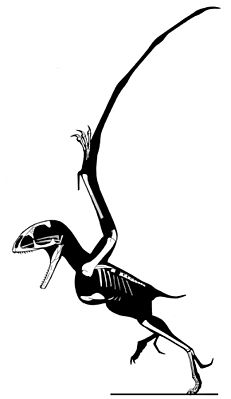
Reconstruction of the holotype skeleton |
| Scientific classification |
|---|
| No rank : | Bilateral symmetric |
| Infraclass : | Archosauromorphs |
| No rank : | Archosauriformes |
| Hoard : | † Pterosauromorphs ( Pterosauromorpha Padian, 1997 ) |
|
| International Scientific Name |
|---|
Batrachognathus Riabinin 1948 |
| Single species |
|---|
† Batrachognathus volans Riabinin, 1948 |
Geochronology161.2—150.8 Ma | million years | Period | Era | Eon |
|---|
| 2.588 | Even | | | Ka | F
but
n
e
R
about
s
about
th | | 23.03 | Neogene | | 66.0 | Paleogene | | 145.5 | a piece of chalk | M
e
s
about
s
about
th | | 199.6 | Yura | | 251 | Triassic | | 299 | Permian | P
but
l
e
about
s
about
th | | 359.2 | Carbon | | 416 | Devonian | | 443.7 | Silur | | 488.3 | Ordovician | | 542 | Cambrian | | 4570 | Precambrian |
◄ Nowadays◄ Cretaceous-Paleogene extinction◄ Triassic extinction◄ Perm mass extinction◄ Devonian extinction◄ Ordovician-Silurian extinction◄ Cambrian explosion |
|---|
|
The genus in 1948 was named and described by paleontologist Anatoly Nikolaevich Ryabinin [2] . The typical and only species is Batrachognathus volans . The name comes from the Greek. batrachos - frog and grech. The gnathos is the jaw pointing to the short, broad head of a flying lizard. Species name means "flying" in Latin .
Content
Three lake fossils were found in lake sediments, in the foothills of the northwestern Tien Shan , Karatau . During the Jurassic period, this area had a certain similarity of habitat to the ashstone lagoon deposits in modern Bavaria , Germany . The genus is based on the holotype PIN 52-2 , an incomplete and dissected skeleton, consisting of fragments of the skull, jaw, vertebrae, ribs, legs and bones of the wing. The tall, short and wide skull had a length of 48 millimeters. The upper jaws carried a total of 22 or 24 curved conical teeth; with the lower jaw, they made up a very large and wide mouth. The tail of the animal is not preserved. Whether there was a tail at all is a controversial issue; It is assumed that there was at least a short tail. Wingspan is estimated at 50 centimeters; David Unwin in 2000 gave a rating of 75 centimeters. Like all anurognathids, batrahognath was supposed to be insectivorous.
Batrahinogat was assigned to the anurognatid family as a relative of anurognath. In 2003, Alexander Kellner combined it with the Asian anurognathides Dendrorhynchoides and Jeholopterus in the Asiaticognathidae clade. In accordance with the analysis carried out by Lu Junchang, the batragnogat and Jeholopterus are sister taxa.
