Tajik Aluminum Plant (TadAZ) is an aluminum plant in Tursunzade . In 2007, the Tajik Aluminum Plant was officially renamed the State Unitary Enterprise Tajik Aluminum Company (TALCO). The main products are primary aluminum. Annually, about 98% of primary aluminum is exported. The plant is the main export producer in Tajikistan . Design capacity - 517,000 tons per year [2] . Does not disclose financial data. It provides up to 75% of all foreign exchange earnings to the budget of Tajikistan [1] and about 1/3 of the country's export [3] .
| SUE "TALCO" | |
|---|---|
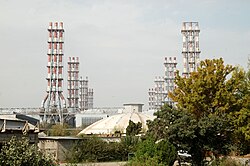 Factory view | |
| Type of | metallurgical plant |
| Year of foundation | 1975 |
| Former names | Tajik Aluminum Plant |
| Location |  Tajikistan : Tursunzade Tajikistan : Tursunzade |
| Industry | metallurgy ( ISIC :24 ) |
| Products | primary aluminum |
| Number of employees | 10 thousand [1] |
| Site | talco.com.tj |
Content
History
In the mid-1960s, under the project of the Leningrad Institute, construction work began on auxiliary facilities of the plant. The plant began to operate in 1975 and continued to operate continuously until now, despite the crisis after the collapse of the USSR , aggravated by the civil war in Tajikistan , but by the mid-1990s, production volumes fell from the projected 517,000 tons per year to less than 200,000 tons.
Until 1992, raw materials ( alumina ) were supplied to the plant by rail from Kazakhstan and other republics of the USSR . In 1996, a group of companies controlled by Tajik businessman Avaz Nazarov began large-scale supplies of alumina to the plant, and also began to finance the transportation of plant products to Russian or Estonian ports. Production volumes began to grow steadily. In 2000, the plant began to make a profit, and Nazarov agreed with Hydro, the aluminum division of the Norwegian concern Norsk Hydro , that it would become the largest buyer of the metal produced.
But in 2004, due to the threat of criminal prosecution, Nazarov and his loyal managers, led by the director of the plant Abdukadir Ermatov, fled to the UK , and Tajik President Emomali Rahmon agreed with RUSAL that this company would carry out export operations for the plant.
In May 2005, the plant filed a lawsuit in the High Court of London . It stated that a group of companies owned by Nazarov had bribed the management of the plant and sold him alumina at inflated prices, as a result of which the plant lost about 220 million dollars in profit. Nazarov and his companies filed a counterclaim, accusing the plant, Rahmon’s entourage and RUSAL of corruption, racketeering and fraud. In November 2005, the London International Arbitration Court ruled that the plant violated Hydro's aluminum supply contracts and was to pay Hydro $ 145 million, as well as legal costs and expenses. In April 2006, a judge of the High Court of London confirmed earlier decisions of the arbitration court, in which the plant was accused of conspiring with RUSAL to illegally expel Nazarov’s company from the plant, as well as concealing profits “in favor of unidentified persons”. In December 2006, the plant and Hydro publicly announced that they had resolved contentious issues. In January 2007, Talco Management Ltd., registered in the British Virgin Islands, became the winner of the tender for the conclusion of tolling agreements with the plant. Relations with RUSAL were severed and lawsuits were filed against him [4] .
A telegram dated February 16, 2010 from the US Embassy in Tajikistan, which became known due to the leak of US diplomatic telegrams from Wikileaks, states that most of the revenues of the state-owned TALCO company are deposited in an offshore company controlled by the president, while only a small part of the revenue goes to the state treasury [ 5] .
Current status
The Tajik Aluminum Plant is a city-forming enterprise in Tursunzade [1] . A program has been developed for transferring the plant to local raw materials, the commissioning of which is designed for 5 years, after which the plant will be provided with approximately 60% of the local alumina, aluminum fluoride , cryolite , graphite products, equipment and spare parts. It is carried out jointly with the Canadian engineering and construction company Hetch with the involvement of Tajik specialists and provides for the creation of the Tajik Chemical and Metallurgical Corporation (TCMC), which will include enterprises for the production of caustic soda , cryolite, alumina, aluminum fluoride, anthracite processing and a cement plant. As part of this project, two aluminum fluoride and cryolite plants are being constructed in Yavan in collaboration with the China National Heavy Machinery Corporation . According to preliminary estimates, the total cost of the project will be 1 billion 400 million dollars, an additional 10 thousand jobs should be created. It also envisages the construction of a sulfuric acid plant, the sale and financing of which in the amount of $ 50 million was undertaken by the Chinese company China Tianchen Engineering Corporation (TCC). The transfer of ownership of this plant to the State Unitary Enterprise “Talco” after 8 years of its activity is provided. [2]
From the beginning of the 1990s, a workshop for the production of aluminum profiles with a capacity of 10 thousand tons per year, a workshop for the assembly of metal structures were commissioned, where production was laid down from simple aluminum window and door blocks to complex rigid metal structures according to non-standard designs. In 1992, the production of teflon cookware with a capacity of up to 4 million items per year was launched. They also commissioned the production of aluminum wheels for automobile wheels, the production of detergents, and the art painting section of dishes. In 1999, in cooperation with Belarus , sites for the assembly of motorcycles and bicycles were created on the territory of the plant. In total, the nomenclature of consumer goods produced at the plant totals over 70 items.
The factory employs over twelve thousand people. Workers for the plant prepares SGPTU-59. To provide the plant with qualified personnel, there is a metallurgical college with full-time and part-time training. To improve the qualifications of workers and engineering staff, the plant has courses for training specialists at the training plant.
There is a sanatorium for workers at the plant, where more than two thousand workers and their families improve their health every year. For medical care of workers and members of their families, a factory clinic operates.
In June 2013, at the UN headquarters in New York , a letter was circulated by the Permanent Representative of Uzbekistan to the UN, Diller Hakimov, addressed to the UN Secretary General Ban Ki-moon , which draws attention to the environmental degradation in the northern regions of the Surkhandarya region of Uzbekistan as a result of pollution, caused by harmful industrial emissions of the Tajik aluminum company Talco. According to the document, this poses a threat to environmental safety, livelihoods and sustainable development in Uzbekistan, Tajikistan and other countries of Central Asia. According to observers, "the scale of the negative impact of Talco's industrial activity on the environment, health and gene pool of the local population and the irreparable damage to the region’s ecosystems has reached an unprecedented level." [6]
See also
- Regar-TadAZ - football club
Notes
- ↑ 1 2 3 Sarkorov, Anora . Tajikistan: aluminum plant awaits government assistance , BBC (December 24, 2013). Date of treatment July 8, 2016.
- ↑ 1 2 State Unitary Enterprise “Tajik Aluminum Company”: stages of formation and development prospects
- ↑ Tajik Aluminum Plant forced to lay off workers , Sputnik (April 21, 2016). Date of treatment July 8, 2016.
- ↑ Tajikistan mired in the "big game"
- ↑ Luke Harding: WikiLeaks cables paint bleak picture of Tajikistan, central Asia's poorest state , The Guardian , 12 Dec 2010.
- ↑ UN News Center - Uzbekistan sent a letter to the UN about the deterioration of the environmental situation in the northern regions of the Surkhandarya region
Links
- talco.com.tj - official site of SUE “TALCO”