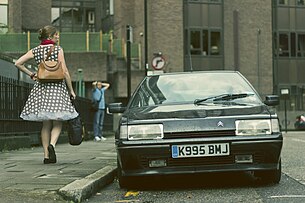
Citroën BX - a large car manufactured by the French company Citroen in 1982-1994. In total, 2,315,739 BXs were built over its 12-year history. [1] Hatchback production was discontinued in 1993 with the advent of the Xantia , but the station wagon continued to be produced for another year.
| Citroën BX | |
|---|---|
 | |
| general information | |
| Manufacturer | Citroën |
| Years of production | 1982 - 1994 |
| Assembly |  Rennes , France Rennes , France Vigo , Spain Vigo , Spain |
| Class | Big family car |
| Design | |
| Body type | 5-dv. hatchback 5-dv. station wagon |
| Layout | front-wheel drive , front -wheel drive , front-wheel drive, all-wheel drive |
| Wheel formula | 4 × 2, 4 × 4 |
| Engine | |
| 1124 cc XW , 1360 cc XY , 1360 cc TU3 1580 cc XU5 , 1905 cc XU9 , 1905 cc XU9 J4 16V 2142 cc N9TE 16V turbo ( BX 4TC ) 1769 cc XUD7 diesel, 1769 cc XUD7TE turbodiesel 1905 cc XUD9 diesel (all engines are in-line 4-cylinder) | |
| Characteristics | |
| Mass-dimensional | |
| Weight | 870-1220 kg |
| On the market | |
| Segment | D segment |
| Other | |
| Designer | Marcello Gandini |
Content
- 1 History
- 2 Versions
- 2.1 Sport
- 2.2 GT
- 2.3 4TC
- 2.4 GTi
- 2.5 16V
- 3 notes
- 4 References
History
Citroën BX was introduced in June 1982, [2] sales began this fall, [2] with a presentation in Paris on October 2, 1982 [3] under the Eiffel Tower . The BX was designed to replace the small family car Citroën GS / A , launched in 1970. The French advertising campaign used the slogan "J'aime, j'aime, j'aime" (I love, I love, I love) showing a car accompanied by music written specially by Julien Clerk . The UK ad campaign used the slogan “Loves Driving, Hates Garages” ( Citroën’s efforts to help lower BX maintenance costs).
The hatchback was developed by Marcello Gandini of Bertone , based on its unused design for the 1977 British concept car Reliant FW11 and its 1979 concept car Volvo Tundra . It was the second car after the merger of Peugeot and Citroën in 1976, the first of which, Citroën Visa , appeared in 1978. BX shared the platform with 405 , which appeared in 1987. Among the features that distinguish the car from its competitors were the traditional Citroën hydropneumatic self-leveling suspension, the widespread use of plastic body panels (hood, rear door, bumpers), as well as front and rear disc brakes.
The BX was equipped with in-line liquid-cooled four-cylinder engines from a GS car, and the new gasoline engines of the PSA group (XY, TU and XU series) with a capacity of 1360 cc, 1580 cc, and since 1984 1905 cc . The 1,124 cc engine, very unusual in a car of this size, was also available in countries where the transport tax is directly related to engine power, such as Italy, Portugal and Greece. 1.1 and 1.4 liter engines were used in the BX until 1988, previously installed in Peugeot 104 and Renault 14. [2] 1.6-liter (and, since 1984, 1.9-liter) versions used new engines XU-series, later installed on many Peugeot cars, and produced in a new engine plant built for this purpose. [2] The XUD diesel engine appeared in 1984, together with the turbodiesel they were supposed to be the most successful options, and were especially popular and sold diesel cars in the UK.
All gasoline engines were designated 11, 14, 16, 19, which indicated the size of the engine (in some countries, a less powerful, 80-horsepower (59 kW) version of the 1.6-liter engine was designated as BX15E instead of BX16). The 11TE was noted by the foreign automotive press as slow and uncomfortable.
The 1.1-liter H1A engine has been specially tuned for Italy, Greece and Portugal. It was installed on cars manufactured from 1988 to 1993 and had a power of 55 hp. (40 kW) at 5800 rpm.
A year later, a hatchback model was launched, a wagon version became available. In the late 1980s, an all-wheel drive system and turbodiesel engines appeared.
In 1986, the MK2 BX appeared. The interior and dashboard have changed to a more ordinary look. Early GT (and Sport) models already had a dial speedometer and tachometer. [4] The exterior has also been slightly updated, with new more rounded bumpers, wider tire wheel arches, new mirrors and direction indicators. The old Douvrin engine has been replaced with the newer TU-series engine.
In 1988, the BX Turbo Diesel was launched, which was praised in the automotive press. The diesel BX stood firm in the market, but diesel cars were slow and noisy. Diesel Car Magazine talked about the BX “we can't come up with any other car currently sold in the UK, close to the performance of the BX Turbo” [5] [6]
In 1989, minor changes and improvements took place among the BX models, including new wheel caps and interior fabrics.
The car has many awards, the BX was known as a tugboat (like the CX), especially diesel models, due to their power combined with a self-leveling suspension. [7]
The big problem with the BX was its varying build quality compared to its competitors. The latest BXs met in 1994, in parallel with their successors. It was partially replaced by a smaller ZX in early 1991, but its full replacement was the larger Xantia , which went on sale in March 1993.
Versions
Sport
Along with the regular BX, Citroën launched the BX Sport from 1985 to 1987. During this period, Citroën released 7,500 BX Sport units; 2500 in the first series, then an additional 5000 thanks to successful sales. Rated at 126 hp (93 kW) at 5,800 rpm and equipped with two dual-chamber carburetors, the BX Sport was the most powerful BX in production at the time. Engine modifications, including enlarged combustion chambers and valves, were developed by the famous French tuner Danielson. It also stood out for its unique body kit, alloy wheels later also used on the GTi, a unique dashboard and Pullman interior. The seat fabric was the same as that used on the CX Turbo at that time. The body kit included a rear wing, side skirts, as well as wing extensions that add 10 cm on each side of the car to install large wheels. The car was only available with left-hand drive, so it was not sold in the UK . Road tests showed good ride quality (as usual for the Citroën), but they weren’t enough for a sports car, even though the suspension was also changed.
GT
The BX GT was launched in 1985 and was powered by a Peugeot 1.9-liter engine, a generally sports engine. Maximum power 105 hp (77 kW). In the same year, Citroën released the Digit model, built on the basis of the BX GT. He had a digital dashboard and an on-board computer. Citroën released just 4,000 BX Digit units in 1985. [8]
4TC
Citroën entered Group B on a rally in the BX in the 1986 season. The specially designed rally BX was called the BX 4TC and looked a bit like a standard BX. She had a very long face, because the engine (turbo version of the Simca Type 180 engine from Chrysler Europe ) was installed longitudinally, unlike the usual BX. Engine capacity decreased to 2141.5 cm³ (from 2155 cc). The rally version of the BX also had a unique hydropneumatic suspension, and a five-speed manual transmission from Citroën SM . [9] Due to the rules of Group B, 200 4TC units also had to be built, with a 200 hp N9TE version of the engine. (147 kW) at 5250 rpm. [9]
4TC was not successful at the World Rally Championship ; its best result was sixth in 1986 at the Sweden Rally . 4TC took part in only three rallies before the Group B ban at the end of 1986, after the death of Henry Toivonen on his Lancia Delta S4 in the Tour de Corse rally. After poor results in Group B, Citroën was able to sell just 62 4TC cars; build quality and reliability issues forced Citroën to buy back many of these 4TCs. [10] Today, only a fraction of the first 200 copies remains, 4TC is very rare today.
GTi
Forced version of the BX GT, the BX19 GTi was equipped with a 1.9-liter eight-valve injection engine with 122 hp. (90 kW) (this engine is also mounted on the Peugeot 405 SRi, and be very similar to the 205 GTi engine, however the BX19 GTi and Peugeot 405 SRi used a different intake manifold and cylinder head), a spoiler, a stiffer suspension and anti-roll bar, difference from the standard model. The maximum speed is 198 km / h. [11] There was also a special export model, the BX16 GTi, with an XU5JA engine from the Peugeot 205 GTi 1.6 with 113 hp. (83 kW). Its maximum speed is 194 km / h. [12]
16V
In May 1987, the 16-valve version of the GTi was launched. It was the first production French car with a 16-valve engine. The DOHC cylinder head, based on the rally Peugeot 205 Turbo 16, was assembled with an updated 1905 cc version of the XU9 8-valve block. As a result, the XU9 J4 appeared; naturally aspirated 1.9-liter engine (also installed on the Peugeot 405 Mi16), with a capacity of 160 hp. (120 kW) and a torque of 177 Nm. More precisely, the power was 84 hp / l, which for a naturally-aspirated engine was pretty impressive at the time. This helped to show the BX acceleration to 100 km / h in 7.4 seconds, to 160 km / h in 19.9 seconds, the maximum speed was 220 km / h. Anti-lock braking system was installed as standard. The side skirts of the car made it easily distinguishable from all other BX models. In 1990, facelift 16V gave the car a new life. The new car has a new fiberglass bumper, anthracite wheels and a redesigned rear spoiler. These changes made the car even more distinctive from other BX. There were also a few small changes in the car's suspension, the most noticeable was the stiffer suspension and a thicker anti-roll bar. BX 16V was faster on the track of the "home" competitor Peugeot 405 Mi16 on the test of the Swedish magazine Teknikens Värld .
Notes
- ↑ “Dates” (Paris: Automobiles Citroën Corporate Communications Division, 1999), p. 76.
- ↑ 1 2 3 4 Automobilia (neopr.) // Toutes les voitures françaises 1982 (salon [Oct] 1981). - Paris: Histoire & collections, 2006 .-- T. Nr. 80s . - S. 16 .
- ↑ Citroen Bx () . Histomobile.com (October 2, 1982). Date of treatment April 28, 2016. Archived March 20, 2012.
- ↑ Bernardet, Alain. Place au sport? (Fr.) // Echappement. - Paris, France: Michael Hommell, 1985. - April. - S. 80-81 .
- ↑ Original: We can think of no other car currently on sale in the UK that comes anywhere near approaching the BX Turbo's combination of performance, accommodation and economy.
- ↑ Diesel Car , Future Publishing Limited, August-September 1998, p. 22
- ↑ Diesel Car , p. 96
- ↑ “Dates” (Paris: Automobiles Citroën Corporate Communications Division, 1999), p. 78.
- ↑ 1 2 Pierre, Jean-François BX 4TC Story . CITF.nl. Date of treatment April 29, 2016. Archived July 15, 2008.
- ↑ The BX 4TC
- ↑ Quattroruote: Tutte le Auto del Mondo 1990: [] / Mastrostefano, Raffaele. - Milan: Editoriale Domus SpA, 1990. - P. 144-145.
- ↑ Tutte le Auto del Mondo 1990 , p. 143
Links
- BX on Citroën World