Eosinopteryx (lat.) - a genus of dinosaurs - a theropod from the Paraves treasure, who lived in the late Jurassic on the territory of modern China . It includes a single species - Eosinopteryx brevipenna [1] .
| † Eosinopteryx |
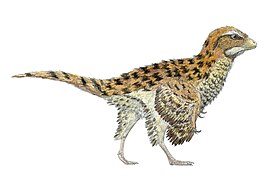
Restored Appearance |
| Scientific classification |
|---|
| No rank : | Bilateral symmetrical |
| Infraclass : | Archosauromorphs |
| No rank : | Archosauriformes |
|
| International scientific name |
|---|
Eosinopteryx Godefroit et al. , 2013 |
| Single view |
|---|
† Eosinopteryx brevipenna
Godefroit et al. , 2013 |
Geochronology167.7-150.8 Ma | million years | Period | Era | Aeon |
|---|
| 2,588 | Even | | | Ka | F
but
n
e
R
about
s
about
th | | 23.03 | Neogene | | 66.0 | Paleogen | | 145.5 | a piece of chalk | M
e
s
about
s
about
th | | 199.6 | Yura | | 251 | Triassic | | 299 | Permian | P
but
l
e
about
s
about
th | | 359.2 | Carbon | | 416 | Devonian | | 443.7 | Silur | | 488.3 | Ordovician | | 542 | Cambrian | | 4570 | Precambrian |
◄ Nowadays◄ Cretaceous-Paleogene extinction◄ Triassic extinction◄ Mass Permian Extinction◄ Devonian extinction◄ Ordovician-Silurian extinction◄ Cambrian explosion |
|---|
|
Eosinopteryx is described by a single fossil sample extracted from the Tiaojishan formation in the west of Liaoning , China, which dates from the Upper Jurassic ( Oxfordian , about 160 Ma ago) [2] [3] . The generic name comes from other Greek. ἑως - “early”, lat. Sinae - "China" and others. Greek. πτέρυξ - “wing”; species - from lat. brevis - “short” and penna - “feather” due to the remnants of the reduced plumage found in type sample YFGP-T5197 [1] .
Although the dinosaur was originally classified as a troodontid [1] , a later analysis showed a greater likelihood that Eosinopteryx was a primitive representative of the Paraves clade or the Avialae clade [4] .
Eosinopteryx brevipenna is known for a single fossil specimen consisting of an almost complete skeleton of a teenage or adult individual. The sample is very small for a dinosaur that does not belong to the Avialae clade, about 30 centimeters in size. Unlike most troodontids, its muzzle was very short, shorter than the diameter of the orbit . The wings were about the same size as those associated with anchornis animals, with the wing feathers being longer than the humerus . The unusual location of the wing bones could prevent any flapping movements. The tail was very short compared to most troodontids and dromaeosaurids , and, unlike the members of these groups, the legs and fingers of the Eosinopteryx were very thin, with no characteristic highly curved claws. It is also unusual that the tail of the only known fossil does not show signs of complex tail feathers, and the tarsels and feet, apparently, were devoid of feathers, unlike many related species [1] .
A researcher at the University of Southampton said that the discovery of Eosinopteryx suggests that “the origin of the flight is much more complex than previously thought” [5] .
