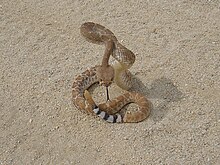
Red rattler [1] ( lat. Crotalus ruber ) is a species of venomous snakes of the viper family.
| Red rattler |
 |
| Scientific classification |
|---|
| No rank : | Bilateral symmetric |
| Infraclass : | Lepidozavromorfy |
| Infrastructure : | Caenophidia |
|
| International Scientific Name |
|---|
Crotalus ruber Cope , 1892 |
| Area |
|---|

|
|
The total length reaches 1-1.5 m. The head is wide, the body is slim. The color is brick red, pale reddish brown or orange. Large lozenges along the back are slightly darker than the general background of the body, bordered with pale scales, especially in the front half of the body. On the tail before the rattle, narrow black and white rings alternate.
Loves the desert, coast, mountainous areas. Occurs at an altitude of 1500 m above sea level. Active at night. It feeds on small mammals and birds.
Vivipara snake. The female gives birth to 3 to 20 cubs 30–34 cm long [2] .
The poison is quite strong, contains hemotoxins, proteolytic enzymes. The bite causes severe swelling, pain, bruising, necrosis, nausea, vomiting, clinical bleeding and hemolysis . The poison is used in medicine, at one time take up to 364 mg of poison (in dry weight).
However, this snake is quite peaceful, its bites are extremely rare.
The species is common in southern California (USA) and Baja California (Mexico).

Coyote bit into flight in flight of a red rattle who attacked him
- Subspecies
- C. r. lorenzoensis is an endemic of the island of San Lorenzo Sur. This subspecies is smaller than the snakes on the continent with a tendency to reduce rattle due to the loss of the last segments;
- C. r. lucasensis in the lower California coastal region south of Loreto . Color from brown to olive green;
- C. r. ruber in southern California and most of Baja California, with the exception of the coast.