Clever Geek Handbook
📜 ⬆️ ⬇️

Atrociraptor

Atrociraptor ( Latin , literally - the wild robber [1] ) is a genus of dinosaurs from the dromaeosaurid family that lived during the Cretaceous period (Upper Maastricht , 70.6–66.0 Ma ago [2] ) in the territory of the modern province of Alberta ( Canada )

† Atrociraptor
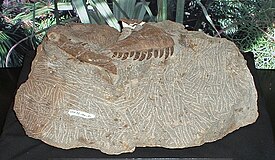
Atrociraptor royal tyrrell.jpg
Fossil specimen
Scientific classification
{{{{{{{{{{{{{{{{{{{{{{{{{{{{{{{{{{{{{{{{{{{| 1}} | 1}} | 1}} | 1}} | 1}} | 1}} | 1}} | 1}} | 1}} | 1}} | 1}} | 1}} | 1}} | 1}} | 1 }} | 1}} | 1}} | 1}} | 1}} | 1}} | 4}} :Eukaryotes
Kingdom:Animals
Kingdom :Eumetazoi
No rank :Bilateral symmetrical
No rank :Secondary
Type of:Chordate
Subtype :Vertebrates
Infratype :Maxillary
Overclass :Tetrapods
Grade:Reptiles
Subclass :Diapsids
Infraclass :Archosauromorphs
No rank :Archosauriformes
No rank :Archosaurs
Treasure :† Ornithodirs
Squadron :† Dinosaurs
Squad:† Lizophrenic
Suborder :† Theropods
Group :† Tetanura
Group :† Coelurosaurs
Group :† Maniraptoriformes
Family:† Dromaeosaurids
Gender:† Atrociraptor
International scientific name

Atrociraptor Currie & Varricchio, 2004

Single view
† Atrociraptor marshalli
Currie & Varricchio, 2004
Geochronology
70.6–66.0 Ma
million yearsPeriodEraAeon
2,588Even
KaF
but
n
e
R
about
s
about
th
23.03Neogene
66.0Paleogen
145.5a piece of chalkM
e
s
about
s
about
th
199.6Yura
251Triassic
299PermianP
but
l
e
about
s
about
th
359.2Carbon
416Devonian
443.7Silur
488.3Ordovician
542Cambrian
4570Precambrian
◄
Nowadays
◄
Cretaceous-Paleogene extinction
◄
Triassic extinction
◄
Mass Permian Extinction
◄
Devonian extinction
◄
Ordovician-Silurian extinction
◄
Cambrian explosion

Wayne Marshall discovered the typical and only specimen holotype RTMP 95.166.1 in 1995, in the layers of the Formation, also containing fossils of the Albertosaurus . Fossil deposits are located in the upper part of the 4th block of the formation [3] , which dates back to 68.5 million years ago [4] . The holotype consists of fragments of the jaws (both premaxillary bones , the right upper jaw , both halves of the lower jaw ), teeth and numerous small fragments. The skull was unusually short and tall. The teeth are relatively straight, but come out of the hole at an angle to the jaw line, as a result of which they look very inclined. A number of scattered teeth (previously assigned to Saurornitholestes ) were also extracted in the Horschu formation [5] ; these fossils were recognized by the unusually large teeth of Atrociraptor .
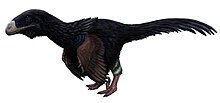
Appearance of Atrociraptor

In 2004, Philip Curry and David Varricchio named and described the type species Atrociraptor marshalli . The generic name comes from lat. atrox is the savage, and raptor is the robber. The species name is given in honor of the discoverer of the find Wayne Marshall [1] .

In 2010, Gregory S. Paul estimated the length of the animal at 2 meters and weight at 15 kilograms [6] . Atrociraptor differs from Bambiraptor and other dromaeosaurids in its teeth (the teeth were of different lengths but of the same shape) and have a short and blunt muzzle. One of the windows of the skull, the maxillary opening, was relatively large, and located directly above the other window, the premaxillary opening, which is unknown in other species.

Researchers assigned Atrociraptor to the Velociraptorin subfamily within the dromaeosaurid family. However, in 2009, Curry published a cladistic analysis showing Atrociraptor as a representative of the subfamily Saurornitholestinae [7] .
Notes

  1. ↑ 1 2 Currie, PJ and DJ Varricchio (2004). A new dromaeosaurid from the Horseshoe Canyon Formation (Upper Cretaceous) of Alberta, Canada. Pp. 112-132 in PJ Currie, EB Koppelhus, MA Shugar and JL Wright. (eds.) Feathered Dragons. Indianapolis: Indiana University Press. [one]
  2. ↑ Atrociraptor . Paleobiology Database . (Retrieved December 28, 2016) .
  3. ↑ Larson, DW, Brinkman, DB, & Bell, PR (2010). Faunal assemblages from the upper Horseshoe Canyon Formation, an early Maastrichtian cool-climate assemblage from Alberta, with special reference to the Albertosaurus sarcophagus bonebed This article is one of a series of papers published in this Special Issue on the theme Albertosaurus . Canadian Journal of Earth Sciences 47 (9): 1159-1181.
  4. ↑ Arbor, Victoria. A Cretaceous armory: Multiple ankylosaurid taxa in the Late Cretaceous of Alberta, Canada and Montana, USA // Journal of Vertebrate Paleontology : journal. - Society of Vertebrate Paleontology 2010. - Vol. 30 , no. Supplement 2 . - P. 55A . - DOI : 10.1080 / 02724634.2010.10411819 .
  5. ↑ Ryan, MJ, PJ Currie, et al. (1998). Baby hadrosaurid material associated with an unusually high abundance of Troodon teeth from the Horseshoe Canyon Formation, Upper Cretaceous, Alberta, Canada. Gaia 16 : 123-133.
  6. ↑ Paul, GS (2010). The Princeton Field Guide to Dinosaurs , Princeton University Press p. 136
  7. ↑ Longrich NR and Currie PJ (2009). A microraptorine (Dinosauria-Dromaeosauridae) from the Late Cretaceous of North America. Proceedings of the National Academy of Sciences 106 : 5002-5007.
Source - https://ru.wikipedia.org/w/index.php?title=Atrociraptor&oldid=100677621


More articles:

  • Maryinsky (Moscow Region)
  • Thorium Selenide
  • Fredrickson Stig
  • NBA Playoffs 2016
  • Januh Jat
  • Bali, Beckim
  • Daisy: Democracy is Freedom
  • Vygladovo
  • Achilles-Andreas, Prince of Greece and Denmark
  • Shelogino

All articles

Clever Geek | 2019