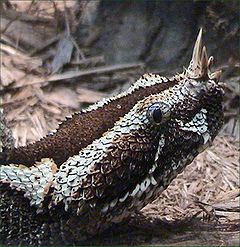
Rhino Viper [1] ( lat. Bitis nasicornis ) is a poisonous snake from the genus of African vipers .
| Rhino viper |
 |
| Scientific classification |
|---|
| No rank : | Bilateral symmetrical |
| Infraclass : | Lepidosauromorphs |
| Infrastructure : | Caenophidia |
|
| International scientific name |
|---|
Bitis nasicornis ( Shaw , 1802) |
|
The total length varies from 60 cm to 1.2 m. Sexual dimorphism is observed - females are larger than males. The head is flat, triangular. The tip of the muzzle is decorated with 2-3 long pointed scales that protrude vertically above the nostrils. A thick, short body is covered with a beautiful pattern. The black arrow-shaped pattern on the head is bordered by a light yellow stripe, and the sides of the head are bright blue. Along the back there are double blue trapezoids bordered with yellow, which are connected by black rhombs. On the sides, black triangles alternate with large green rhombuses bordered by a narrow red stripe. Variegated coloring well hides this snake among the bright greenery of vegetation against the background of red-brown soil and fallen leaves.
He loves moist tropical forests, marshy places, banks of forest rivers and streams, willingly goes into the water. Swims well. Active at night. It feeds on small mammals, frogs, toads, fish.
The poison is strong enough, can be dangerous to humans.
Oviparous snake. The female gives birth to 38 cubs 18-25 cm long.
The species is common in Equatorial Africa - from western Kenya to Guinea, Sudan and Zambia.