The kingdom of Eswatini [6] [7] ( Swati Umbuso weSwatini ), until 2018 - the kingdom of Swaziland ( English Kingdom of Swaziland ) - a state in South Africa . In the south, southeast, west and north it borders with South Africa (border length - 430 km), in the east - with Mozambique (105 km). The total length of the border is 535 km. The total area of the country is 17 363 km² (land area is 17 200 km²). The country lies on the Weld Plateau , which is led down by steppes from west to east. The highest point is Mount Eemlembe (1862 m) [8] . There are several gentle plains in Eswatini. The main rivers are the Umpilusi (Great Usutu), Komati , and Umbeluzi . The main natural resources: coal , wood , hydropower potential, forests , there are small deposits of gold and diamonds . About 11% of the territory is occupied by arable land , meadows and pastures - 62%.
| Kingdom of Eswatini | |||||
|---|---|---|---|---|---|
| Umbuso weSwatini | |||||
| |||||
| Motto : “We are a fortress ( matchmaking Siyinqaba ) " | |||||
| Anthem : "Nkulunkulu Mnikati wetibusiso temaSwati" | |||||
 | |||||
| Date of independence | September 6, 1968 (from Great Britain ) | ||||
| official languages | English Swati | ||||
| Capital | Mbabane ( official) Lobamba (royal and parliamentary) | ||||
| The largest city | Manzini | ||||
| Form of government | dual monarchy [1] | ||||
| King | Mswati III | ||||
| Prime Minister | Ambroz Mandvulo Dlamini | ||||
| Territory | 153rd in the world | ||||
| • Total | 17 363 km² | ||||
| •% water surface | 0.9 | ||||
| Population | |||||
| • Evaluation (2009) | 1,185,000 [2] people ( 154th ) | ||||
| • Density | 68.4 persons / km² | ||||
| GDP | |||||
| • Total (2011) | 4.1 billion (nominal) dollars | ||||
| • Per capita | 3400 [3] dollars | ||||
| HDI (2018) | ▲ 0.588 [4] ( medium ; 144th place ) | ||||
| Currency | lilageni (SZL, code 748) | ||||
| Internet domain | .sz | ||||
| ISO code | |||||
| IOC Code | |||||
| Telephone code | +268 | ||||
| Time Zones | +2 | ||||
| Car traffic | |||||

Content
Symbols
Flag
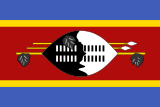
There are three horizontal stripes on the national flag: upper and lower blue, medium, 3 times wider - red; the red bar above and below has an orange border; In the center of the red stripe there is a large black and white shield, two spears and a staff decorated with tassels of feathers.
Coat of arms
In the center of the emblem there is a shield supported by a lion, symbolizing the king, and an elephant, symbolizing the queen mother. Above the shield is a headdress that the king wears during the Incwal feast. Below is the tape with the national motto [9] .
Geography
Eswatini provides a wide variety of natural landscapes, from mountainous areas along the border with Mozambique to savannas in the east and moist forests in the north-west. Several rivers flow through the country, including the largest river Eswatini - the Lusutfu river.
The official capital of the country is Mbabane (67,200 inhabitants in 2004 ), the historical capital and the seat of the Queen Mother and Parliament is Lobamba . The largest city and economic “capital” is Manzini (73,000 inhabitants in 2004 ).
Climate
The three-step relief of the country correspond to three main climatic zones. The moderately warm mountain-type climate gives way to lower subtropical and, finally, tropical in the Lower Velde. More precipitation falls in summer in the temperate zone. The average July temperature is + 12 ° С, February is + 23 ° С. Precipitations range from 500–700 mm per year in the east to 1200–1400 mm in the west.
Plant World
Eswatini's vegetation is represented by typical savanna in the west; thickets of xerophytic shrubs are common in the east. The flora is rich: about 2400 species are known - from lichens and ferns to magnolias and ficuses. One aloe - 25 species, 12 species of orchids, 10 - lilies.
Animal World
Of the large mammals, there are "blue" buffalo, horned antelope, zebras, hippos. Crocodiles are found in the rivers.
History
The ancestors of the Swazi people came to southern Africa in the Middle Ages, from the central part of the continent. At first they settled on the coast of the Indian Ocean , but in the XVIII century, Swazis were pushed aside by other tribes to the north - to the territory of present-day Esvatini. At the beginning of the 19th century, the Swazis waged bloody wars against the Zulu and other neighboring tribes who raided the Swazi lands.
In 1836, the leader of the Swazi Sobhuza (now called the king ) won a decisive victory over the Zulu, introduced a centralized system of his power, subjugating other leaders, and in fact created the state of Swazi.
The next Swazi king, Mswati I , joined the new lands in the north of the country at the end of the 1830s and created a state whose territory more than doubled the area of modern Esvatini.
From the middle of the XIX century, the Boers came to Swaziland. They bought large land plots from the leaders of the Swazi. On February 21, 1895 , Swaziland was declared a protectorate of the Transvaal , after the second Anglo-Boer War, which had passed under the protectorate (actually into colonial administration) of Great Britain . April 15, 1926 , his status was close to the status of the crown colony .
In 1964, the first local elections were held in Swaziland. The majority of deputy seats was received by the party created by the then king Sobhuz II and bore the name “Imbokodvo National Movement”. On April 25, 1967 , the protectorate was granted autonomy, and on September 6, 1968 , full independence was granted to them.
In the parliamentary elections of May 16-17, 1972, the monarchist National Imbodokwo movement received 78% of the votes and 15 of the 30 seats, left-wing National Congress Liberation Party Ngwana received about 20% of the votes (and 3 seats in parliament), and as a result the king abolished the constitution, dissolved parliament and outlawed the activities of all political parties, trade unions and public organizations.
In April 2011, many thousands of opposition rallies were held in the country with the demands of the abdication of King Mswati III . The opposition accuses the monarch of plundering the state treasury for the sake of ensuring a luxurious life for himself and his 15 wives. On April 12, the police, using special means, broke up a rally in the capital of Eswatini and arrested its organizers.
On April 19, 2018, King Mswati III renamed the country to the Kingdom of eSwatini [10] .
Political structure
The head of state is the king, since 1986, Mswati III . The executive is concentrated in the king’s hands. He has the right to appoint the prime minister and his representatives in each of the chambers of parliament ( Libandla ).
The country's highest legislative body is a bicameral parliament, consisting of the National Assembly (65 seats) and the Senate (30 seats). The term of the parliament is 5 years.
Elections to the National Assembly are two-level (in the second round, 55 deputies are elected by the electors and 10 are appointed by the king). 10 senators are appointed by the National Assembly, 20 by the king.
Parliament does not have real legislative power and is in fact an advisory body to the king. Candidates for candidates are nominated by local councils, elections are always held in two rounds - in the second round are three candidates who received the largest number of votes in the first. At least 30% of the seats in the assembly house should be occupied by women.
The first local legislative assembly (Swaziland was then a British protectorate) was held in 1964.
In 1968, the independence of the country was proclaimed.
In 1977, the parliamentary system was destroyed, political parties were banned.
In 1979, indirect parliamentary elections were restored.
In 1994, partial direct parliamentary elections were allowed.
The activities of political parties are still (2017) prohibited.
Chairman of the Senate (2017) - Princess Gelane Swami.
Chairman of the National Assembly (2017) - Prince Gooduz Dlamini.
Foreign Policy
Eswatini is a member of the Commonwealth of Nations , the United Nations (UN), the African Union , the Common Market for Eastern and Southern Africa and the Southern African Development Community . Eswatini is one of the founding states of the South African Customs Union , the oldest existing customs union in the world, established in 1910 [11] .
Armed Forces
The country's armed forces consist of the Eswatini Defense Force and the Royal Swaziland Police . The Eswatini Army has never participated in external conflicts and is mainly engaged in maintaining order inside the country and guarding the borders. The supreme commander is King Eswatini [12] . In fact, the daily leadership of the army is provided by the government of Eswatini . The Defense Council is an advisory body that advises the king on issues related to the army [13] .
Administrative divisions
Esvatini is divided into 4 districts:
| No | District (Russian name) | District (English name) | District (Title on matchmaker ) | Adm Centre | Population, people (2010) | Square, km² | Density, person / km² |
|---|---|---|---|---|---|---|---|
| one | Hoho | Hhohho District | siGodzi wa Hhohho | Mbabane | 267 397 | 3569 | 74.92 |
| 2 | Lubombo | Lubombo district | siGodzi wa Lubombo | CITES | 194,217 | 5945 | 32.67 |
| 3 | Manzini | Manzini District | siGodzi wa Manzini | Manzini | 298 378 | 4070 | 73.31 |
| four | Shisselveni | Shiselweni District | siGodzi wa Shiselweni | Nhlangano | 201 346 | 3779 | 53.28 |
| Total | 961 338 | 17 363 | 55.28 |
Population
In July 2010, the population of Eswatini was estimated at 1.35 million, but this estimate may be inaccurate due to the high level of infection with the immunodeficiency virus ( HIV ) - 26.1% of the adult population according to UN estimates for 2007 (the highest level among ).
Annual population growth is 1.2%.
The birth rate is 27 per 1000 (fertility rate is 3.2 births per woman, infant mortality is 67 per 1000).
Mortality - 15 per 1000.
The average life expectancy for 2011 is 48 years [14] .
The main part of the population is Swazi , as well as a small number of Zulus , Europeans and immigrants from Mozambique .
The official languages are English and Swazi .
Urban population - 25%.
The literacy of the population is 82% (2003 estimate).
Age categories:
- 0-14 years old - 46% (men 245,626; women 247,825)
- 15-64 years old - 52% (men 270 308; women 291 884)
- 65 years and older - 2% (men 11 357; women 16 289)
The main religion in Eswatini is Christianity (82.7% of the population), in which the majority of various Protestant and local African churches, including African Zionists , constitute, also have a significant number of Catholics.
Other religions include Islam (0.95%), Baha'ism (0.5%), Hinduism (0.15%), and traditional beliefs, such as animalism, fetishism, the cult of ancestors, the forces of nature, etc.
As of May 2010, Swaziland is the country with the highest percentage of people infected with the human immunodeficiency virus ( HIV ). [15] Every fourth adult resident is a carrier of the virus.
Economy
GDP per capita for 2011, face value - 3.4 thousand dollars (150th place in the world, 8th place in Black Africa ). Below the poverty level - 69% of the population (in 2006). The unemployment rate is 40% (in 2006).
75% of the country's labor force is employed in agriculture (8% of GDP). They grow sugar cane , cotton , corn , tobacco , rice , citrus fruits , pineapples , sorghum , peanuts , and also engage in cattle breeding (cows, goats, sheep).
In the industrial sector of the economy (45% of GDP) - sugar production from cane , coal mining , timber production, production of fruit juice concentrates, textile production.
Budget deficit - 16% of GDP. The negative trade balance increased from $ 153 million (2008) to $ 194 million. The inflation rate was 7.8%. Unemployment - 40.6%. The country's foreign exchange reserves are estimated at $ 920 million (January 2010). The volume of external debt is $ 367 million. [sixteen]
Exports - $ 1.8 billion (in 2008) - juice concentrates, sugar , wood , cotton , citrus fruits, canned fruits.
The main foreign trade partners are South Africa (60% of exports and more than 80% of the country's imports).
Imports - 1.9 billion dollars (in 2008) - industrial goods, vehicles, food, petroleum products.
The main supplier is South Africa (90%).
Included in the international organization of the AKT countries .
The main sector of the economy is agriculture (about 8%), in which a large part of the working-age population is employed. The main crops are sugarcane, corn, cotton, tobacco, rice, citrus fruits, pineapples. In addition to the production of processing agricultural products developed mining industry (coal and asbestos), pulp production. GDP in 1994 was $ 3.3 billion (per capita GDP is $ 3,490). Monetary unit - lilageni (1 lilageni (E) is equal to 100 cents). Main trading partners: South Africa, Japan, Belgium, UK, Canada.
The total length of railways is 297 km, of roads — 2853 km (510 km of paved roads).
Culture
The tourist attraction is the traditional Reed Dance (Umhlanga) - the annual mass celebration in Eswatini.
Hymn Eswatini in Swazi :
Nkulunkulu Mnikati wetibusiso temaSwati;
Siyatibonga tonkhe tinhlanhla,
Sibonga iNgwenyama yetfu,
Live netintsaba nemifula.Busisa tiphatsimandla takaNgwane
Nguwe wedvwa Somandla wetfu;
Sinike kuhlakanipha lokungenabucili
Simise usicinise, Simakadze.
Media
Swazi TV State Broadcasting Company ( Swaziland Television Broadcasting Authority - “Swaziland Television Broadcasting Administration”), until 1983 - STBC ( Swaziland Television Broadcasting Corporation - “Swaziland Television Broadcasting Corporation”) includes the same-name television channel, the state radio station - Radio Swaziland in the same radio station.
See also
- Islam in Eswatini
- Music by Eswatini
- Eswatini University
- The border between Esvatini and Mozambique
Notes
- ↑ Atlas of the World: The most detailed information / Project leaders: A. N. Bushnev, A. P. Pritvorov. - Moscow: AST, 2017. - p. 74. - 96 p. - ISBN 978-5-17-10261-4.
- ↑ Department of Economic and Social Affairs Population Division. World Population Prospects, Table A.1 (Undefected) . - United Nations, 2009. - T. 2008 revision .
- ↑ Gross Domestic Product (GDP) Eswatini, 1970–2011
- ↑ Human Development Indices and Indicators (English) . United Nations Development Program (2018). - Human Development Report on the UN Development Program website. The appeal date is September 14, 2018.
- ↑ http://chartsbin.com/view/edr
- ↑ Reuters: King of Swaziland changed TASS country name
- ↑ King of Swaziland renamed the state to the Kingdom of Eswatini Interfax
- ↑ Map sheet G-36-XIV (Yu. P.) .
- ↑ National Arms of Swaziland - Heraldry of the World (English) (inaccessible link) . The appeal date is December 25, 2012. Archived May 14, 2012.
- ↑ Swaziland king changes the country's name (English) . BBC News (19 April 2018). The appeal date is April 19, 2018.
- ↑ Swaziland - Foreign Relations
- ↑ Crash diminishes Swaziland's air force , Independent Online (November 23, 2004). The appeal date is October 19, 2009.
- ↑ Security in Swaziland, Swaziland Security, Ministry of Defense, Swaziland welcome, Commonwealth (not available link) . Commonwealth-of-nations.org. The appeal date was July 6, 2012. Archived September 18, 2011.
- ↑ World Development Indicators
- ↑ Swasiland: Die höchste HIV-Rate der Welt (German)
- ↑ Ministry of Foreign Affairs of Russia & 124; 10/17/2011 & 124; Kingdom of Swaziland (reference information)
Links
- - the official website of Esvatini
- The smallest country in the southern hemisphere