

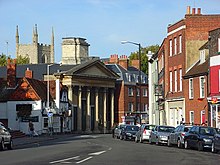


A small town (town) is a settlement that is larger than a rural settlement , but smaller than a large city . The size and definition of what constitutes a small city varies greatly in different parts of the world .
Content
- 1 Origin and use
- 2 Worldwide
- 2.1 Australia
- 2.2 India
- 2.3 USA
- 2.4 Japan
- 2.5 Russia
- 3 notes
- 4 References
- 5 Links
Origin and use
In some cases, a town is a different name for a city or rural locality (especially a large village or town). In general, today small towns can be differentiated from towns, villages or farms on the basis of their economic nature, in that the majority of the population of a small town, as a rule, receives income from manufacturing, trade and public services, rather than primary sectors of the economy, such as agriculture and related activities.
The population is an unreliable marker of the urban character of the settlement. In many parts of the world, as in India , at least until recently, a large village can be inhabited by several times more people than a small city. In the United Kingdom , there are historic cities with city status that are much smaller than small towns.
The current trend is the spread of suburbs and suburbanization, the development of satellite cities and the migration of urban residents to the suburbs, which further complicate the definition of cities, the creation of city communities with respect to their economic and cultural features, but in the absence of other characteristics of urban settlements.
Some forms of non-rural settlements, such as temporary mining villages, including urban ones, may be clearly not rural, but it is only doubtful to claim the right to be called a city.
The difference between a small city and a large city depends on the approach: a large city can be strictly an administrative entity, which was provided to it by law, but in informal speech, this term is also used to denote an urban area of a certain size or importance: while a large medieval the city may have been inhabited by only 10,000 inhabitants, today cities with a population of more than 100,000 inhabitants are referred to large cities.
Australia
In Australia , cities or “human settlements - urban centers” are usually understood as those communities that are not officially declared city and have a population of over 200 people. [1] Too small to be called cities, settlements are, as a rule, settlements with the status of a village.
In addition, some local governments, officially registered as settlements in Queensland , Western Australia and the Northern Territory , and in front of state associations of the 1990s in Victoria, some local governments, were formalized as cities, but now cities are not only settlements, which contain cities with populations exceeding 200 people.
India
In 2011, the census of India took into account small towns of two types - the charter city and the census city. A registered city is defined as any city with the status of a municipality , corporation , etc. The census city must satisfy the following criteria:
- minimum population - 5000 people;
- at least 75 percent of male workers are engaged in non-agricultural production;
- population density of at least 400 people / km 2 . (1000 people / sq. Mile).
USA
Town - (small) city, urban type settlement.
City - (large) city. Legally, a municipal corporation with its charter (charter) registered by the state authorities is usually larger than an urban-type village, a village ( English village ) or county ( born borough ). Typically, city status is based on population, but is specifically determined by the laws of each state. In the USA there are about 19 thousand large cities.
- The English-Russian linguistic and regional dictionary “Americana II” / Ed. Doctors of Philology, Professor G.V. Chernov. © M. V. Vasyanin, O. N. Grishina, I. V. Zubanova, A. N. Natarov, E. B. Sannikova, O. A. Tarkhanova, G. V. Chernov, S. G. Chernov; 2005. Built into the ABBYY Lingvo program
Japan
In Japan, the status of a city ( si ) was intended only for a few particularly large settlements. Over time, however, the necessary conditions for the city were softened, and today the only rule for obtaining the status of a large city is a population of more than 50,000 people and more than 60% of the population is concentrated in the central part of the city. Recently, many small villages, towns, and small towns have merged to form a status city, despite the appearance of a cluster of villages.
The difference between small towns ( mothers ) and villages ( mura ) is largely unwritten and is determined solely by the population: less than 10,000 people live in mura, and from 10,000 to 50,000 people in small towns / villages of mothers.
Russia
Unlike English , the Russian language does not distinguish between the English terms “city” and “town” - both translate as a city . Sometimes the term small town or town is used for urban-type settlements , although, of course, the town is not legally a city, even if the population of the town is considered urban. A significant part of the town appeared due to some local industrial enterprises. The main type of small cities in Russia are district centers [2] .
In Russia, the criteria of a settlement with which it must meet in order to obtain the status of a city vary depending on the subject . For example, the smallest and youngest city in Russia Innopolis in Tatarstan received the status of a city when 10 people lived in it. In general, in order to qualify for this status, a settlement must have more than 12,000 inhabitants, and at least 85% of the population should not be in agriculture. However, settlements that were previously granted city status and which no longer meet these criteria can still maintain their status for historical reasons.
Notes
- ↑ “The Australian”, December 13, 2012
- ↑ A.G. Nazarov SMALL CITIES OF RUSSIA: FORMATION, DEVELOPMENT, HISTORICAL DESTINY
References
Links
- Open-Site Regional - Contains information about cities in many countries.
- Geopolis : research team, University of Paris-Diderot, France - access to the Geopolis database