Cockatoo Inca [1] ( lat. Lophochroa leadbeateri ) is a bird of the cockatoo family. The only kind of genus. Some taxonomists refer the species to the genus Kakadu ( Cacatua )
| Inca Cockatoo |
 |
| Scientific classification |
|---|
| No rank : | Bilateral symmetric |
| Subfamily : | White Cockatoo ( Cacatuinae Gray , 1840 ) |
| Rod: | Lophochroa Bonaparte , 1857 |
|
| International Scientific Name |
|---|
Lophochroa leadbeateri ( Vigors , 1831 ) |
| Synonyms |
|---|
- Cacatua leadbeateri (Vigors, 1831)
|
| Area |
|---|
|
| Security status |
|---|
Least concernIUCN 3.1 Least Concern : 22684767 |
|
Content
The length of the body is 35–40 cm, the weight of the male is 300–425 g, the females are 375–435 g. Very elegant, extraordinarily beautiful parrots. Plumage of their pinkish-white color. The wings are white, belly, breast, neck and cheeks pinkish-red. At the base of the beak there is a narrow red stripe. The length of the crest feathers reaches 18 cm. The front feathers of the crest are white, the inner ones are bright red with yellow areas in their lower part, and their upper ends are white. The color of the males and females is the same. The male's iris is dark brown, almost black, the female is red-brown.
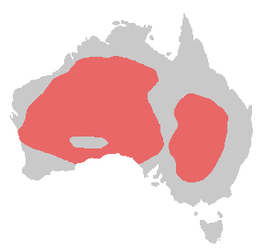
It lives in the west and south of Australia .
They are inhabited by light forests, in most cases live in areas with a very arid climate, not far from water bodies. Prefer eucalyptus forests , shrubs, undersized Australian eucalyptus and adjacent cultivated land. Dense forests do not suit them. Hold in pairs and small flocks. They feed on tree seeds ( acacia , eucalyptus, pine cones), shrubs and grasses, nuts ( pecans , almonds ), fruits (wild figs and melons ), berries, roots, insect larvae, grains ( wheat , corn ), flowers. In search of food can migrate over long distances. Most of the day is spent in search of food (on the ground or trees). Most active early in the morning and late in the afternoon. They drink water twice a day: in the morning and in the evening (before sunset). In hot weather, they rest in the crown of tall trees. Fly badly, avoid flying through open spaces. With an abundance of food and water are sedentary. Damage to grain crops (wheat, almonds). When a parrot is alarmed, it squeals loudly.
A pair is formed for life. Each pair has its own territory (about 500 hectares), which the birds jealously protect. They nest in hollow old trees (eucalyptus, red rubber, cypress), at a height of 3—9 m. The bottom is lined with branches and bark. In laying 4 eggs . Hatching lasts 23-25 days. Eggs hatch both parents: the female at night, and the male during the day. In case of death of the masonry nest only in the next year. The young ones leave the nest by the 3rd month, but their parents take care of them for several more weeks.
A rare species, in some places supplanted by a pink cockatoo ( Eolophus roseicapillus ). Populations have also decreased due to clearing of traditional habitats for agricultural needs. It is protected in all states.
Currently, these parrots in the home content are rare. In Europe, they are not imported, and very few chicks bred by amateurs. Catching and selling this parrot is prohibited. In Australia itself it is kept only with the permission of the authorities. Life expectancy from 40 to 80 years.
The species includes 2 subspecies, differing in the intensity of pink plumage color on the abdomen and chest:
- Lophocroa leadbeateri leadbeateri (Vigors, 1831) - nominative subspecies. Body length about 38 cm. Distributed in the eastern part of the range.
- Lophocroa leadbeateri mollis ( Mathews , 1912) - differs from the nominative subspecies by its smaller size, darker red on the tuft; the yellow strip is almost absent or very thin. Distributed in central and western Australia.
- ↑ Boehme RL , Flint V. Ye. The five-language dictionary of animal names. Birds. Latin, Russian, English, German, French / Under total. ed. Acad. V.E. Sokolova . - M .: Rus. lang, "RUSSO", 1994. - p. 116. - 2030 copies. - ISBN 5-200-00643-0 .