
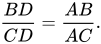
The bisector theorem is a classical triangle geometry theorem.
Content
- 1 Formulation
- 1.1 Notes
- 2 History
- 3 Variations and generalizations
- 4 See also
- 5 notes
- 6 Literature
Wording
The bisector at the apex of the triangle divides the opposite side into parts proportional to the adjacent sides. That is, if the bisector at the top the triangle crosses the side at the point then
Remarks
- The same equality holds for the point lying at the intersection of the external bisector and the continuation of the side .
History
The bisectrix theorem is formulated in the sixth book “The Beginning of Euclid ” (Proposition III) [1] , in particular, in Greek in the Byzantine manuscript [2] . An early Euclidean quote of this theorem in Russian-language sources is contained in one of the first Russian geometry textbooks - the manuscript of the beginning of the 17th century “ Synodal No. 42 ” (book 1, part 2, chapter 21).
Variations and generalizations
- If D is an arbitrary point on the side BC of triangle ABC , then
- In the case when AD is a bisector, .
- The bisector plane of the dihedral angle in the tetrahedron (that is, the plane dividing the dihedral angle in half) divides its opposite edge into parts proportional to the areas of the faces of the tetrahedron that are the faces of this dihedral angle [3] .
- Steiner theorem .
See also
- Anti-bisectrix
- Bisector
- Height (geometry)
- Triangle height
- Center
- Triangle Med
- Simediana
- Axis of external bisectors or anti-aortic axis
- Triangle
- Triangle of three external bisectors
- Axis of external bisectors or anti-aortic axis
- Centroid
- Cheviana
Notes
- ↑ The Euclidean began eight books, namely: the first six, 11th and 12th, containing the foundations of geometry. / Per. F. Petrushevsky. - SPb. , 1819. - S. 205. - 480 p.
- ↑ Bisectrix theorem in the Byzantine manuscript
- ↑ Gusyatnikov P.B., Reznichenko S.V. Vector algebra in examples and problems . - M .: Higher school , 1985 .-- 232 p.
Literature
- Ponarin I.P. Elementary geometry. In 2 vols. - M .: ICMMO , 2004 .-- S. 18-19.