The Battle of Ulm ( October 16-19 , 1805 ) - a series of clashes between the army of Napoleon and the Austrian army under the command of Field Marshal Lieutenant Mack . Mac’s army was surrounded and capitulated [Note. 1] .
| Battle of Ulm | |||
|---|---|---|---|
| Main Conflict: Napoleonic Wars Third Coalition War Ulm Campaign | |||
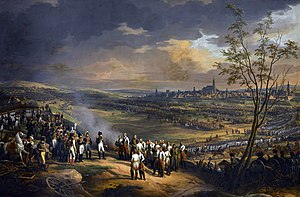 The surrender of Ulm, October 20, 1805, Napoleon I accepts the surrender of General Mack Charles Tevenen , 1815 | |||
| date | October 16-19 , 1805 | ||
| A place | Ulm , Elector of Bavaria | ||
| Total | French victory | ||
| Opponents | |||
| |||
| Commanders | |||
| |||
| Forces of the parties | |||
| |||
| Losses | |||
| |||


Content
Previous Events
In 1805, Britain, Austria, Sweden and Russia formed the Third Coalition against Napoleon. After Bavaria entered into an alliance with Napoleon, Austria moved against it a 70,000-strong army under the command of General Mack. The Russian army came from Poland to join with the Austrians. The allies assumed that the clash with Napoleon would not happen in Germany, but in northern Italy, and their goal was to protect the Alps.
Ulm maneuver
Starting the campaign of 1805 , Napoleon managed to achieve the effect of surprise. “Napoleon made unusually fast transitions,” wrote the famous Russian historian E.V. Tarle , “making a detour from the north to the location of Austrian troops on the Danube , whose left flank was the Ulm fortress.” Describing preparations for the 1805 campaign, the English historian R. Delderfield notes: “In the middle of the autumn of 1805, the French army rushed to the Danube Valley, and General Mack knew about its appearance only when the French cavalry turned into a giant arc through which they could not his scouts would break through, and the French infantry cut him off from all sources of supply and reinforcements. ”
Napoleon's plan before Ulm
September 24, Napoleon deployed his troops opposite the Ulm Mac located between Strasbourg and Weissenburg . He intended to bypass the right flank of Mac and thereby cut off the Austrian army from the Russian army, which had reached Vienna by then. Upon learning about this, Mac on October 7 changed the disposition, placing his left flank in the Ulm region, and the right one at Rain .
However, the French, continuing their movement, crossed the Danube at Neuburg . In an effort to get out of the predicament, Mack tried to cross the Danube in the area of Gunzburg , but ran into the 6th Corps of the French and, having lost two thousand people in battle, retreated to Ulm.
Austrian disaster in Ulm
By October 16, Napoleon managed to surround the entire Austrian army near Ulm. The shocked Austrian general asked the chief of staff of Marshal Ney , General Dutaya , for an 8-day truce, promising to surrender if the Russian army did not fit in during this time. In fact, Mack received no more than 3-5 days of truce, after which he surrendered with a 30,000th army; about 20 thousand fled, 10 thousand were killed or wounded, the rest were captured. The loss of the French amounted to 6 thousand dead and wounded. A month later, Napoleon’s troops entered Vienna, which was left unprotected.
Napoleon's Proclamation
Soldiers of the Great Army , I promised you a great battle. However, thanks to the evil actions of the enemy, I was able to achieve the same success without any risk ... In fifteen days we completed the campaign.
Original text (Fr.)Soldats de la Grande Armée, je vous ai annoncé une grande bataille. Mais grâce aux mauvaises combinaisons de l'ennemi, j'ai pu obtenir les mêmes succès sans courir aucun risque ... En quinze jours, nous avons fait une campagne
- Bulletin of the Great Army of October 21, 1805
See also
- Ulm Campaign
Notes
- ↑ A part of the Austrian cavalry fought out of encirclement
Literature
- Delderfield R. Marshals of Napoleon. M.: Tsentropoligraf, 2001 . S.159.
- Tarle E.V. Napoleon. M .: Publishing. USSR Academy of Sciences, 1941 . S.158.159.
- Harbotl T. Battles of World History. M .: Vneshsigma, 1993 . S.466.