The Ministry of Public Education (MNE) is the central state institution in the Russian Empire , which led the institutions of public education and science. It existed in 1802 - 1817 and 1824 - 1917 .
| Ministry of Education | |
|---|---|
| (MNP) | |
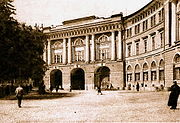 The building of the Ministry of Education in St. Petersburg on Lomonosov Square (former Chernysheva Square) Architect K. I. Rossi . | |
| general information | |
| A country | Russian empire |
| date of creation | 1811 |
| Date of Abolition | 1917 |
| Replaced by | People's Commissariat of Education of the RSFSR |
| Parent agency | Committee of Ministers |
| Headquarters | St. Petersburg |
In the years 1817 - 1824 it was part of the Ministry of Spiritual Affairs and Public Education in the form of a department.
The history of the ministry in 1802-1863
The first institution to manage education in the Russian Empire was the Commission on the Establishment of Public Schools , formed in 1782 and twenty years later becoming part of the Ministry of Public Education, formed by the manifesto of Emperor Alexander I of September 8 (20), 1802 “On the establishment of ministries” with the aim of “ education of youth and dissemination of sciences ” [1] . The following were assigned to him by the manifesto:
private and state-owned printing houses, publication of bulletins and all kinds of periodicals, public libraries, rarities , natural offices, museums and schools of all types
The Ministry led the drafting of charters and rules for imperial universities, secondary and lower educational institutions; was in charge of the appointment and relocation of faculty; engaged in supplying educational institutions with books and teaching aids. Since 1803, the Ministry was in charge of the Imperial Academy of Sciences .
According to the Manifesto "On the division of state affairs into special administrations" of July 25 ( August 6 ), 1810 , the MNP transferred control of all academies and educational institutions except military and religious ones. The manifesto on the “General Establishment of Ministries” of June 25 ( July 7 ), 1811 , so designated the scope of the MNE:
§ 11. The Ministry of Public Education is in charge of all learned societies, academies, universities, all general educational institutions, with the exception of religious, military, and those schools, which are specially established for the education of youth as a separate part of the administration, such as: the Mountain Corps and others To this, such establishments, which, being in a special department, retain, however, in matters of general affairs, the necessary connection and intercourse with the Minister of Education. [2]
The main objectives of the MNE in the early years of its existence was the creation of a system of educational districts : the opening of new universities and their transformation into governing bodies of the educational system, as well as the compilation and approval of charters of educational institutions on the basis of autonomy in matters of internal administration and the court. On November 5 (17), 1804 , the “Charter of educational institutions subordinate to universities” was approved, according to which a network of local educational institutions was established, which had an omniscient character. Along with them, a number of privileged educational institutions were opened - lyceums .
In 1804-1826, the MNP censored print media through special censorship committees established at universities. In 1826, a special General Directorate of Censorship was created for this purpose (see below).
In 1817, the Ministry of Public Education was merged with the Main Directorates of Spiritual Affairs of the Orthodox and Foreign Confessions into a single Ministry of Spiritual Affairs and Public Education , the creation and existence of which is closely related to the activities of the Minister of Prince A.N. Golitsyn . After the ministry was disbanded in 1824, the administration of the Orthodox clergy was transferred to the Synod , but the affairs of foreign confessions remained under the jurisdiction of the MNP until 1832, when they were transferred to the Ministry of the Interior .
In 1834, the MNE was entrusted with the duty of collecting and publishing sources of Russian history, for which a special Archaeographic Commission was formed under it (see below).
The history of the ministry in 1863-1904
In 1863, a reorganization of the Ministry of Education was carried out, enshrined in the adopted "June 18 (30), 1863 " Institution of the Ministry of Education. According to him, the central apparatus of the ministry consisted of the Council of the Minister , the Department of Public Education and the Scientific Committee .
The ministry was in charge of the Imperial St. Petersburg Academy of Sciences , the Nikolaev Main Observatory , the Imperial Public Library , and the Rumyantsev Museum .
During the reforms of Alexander II, the Ministry of Education prepared the University Charter on June 18 (30), 1863 and the Charter of the gymnasiums on November 19 ( December 1 ), 1864 , which were distinguished by their liberal orientation. Somewhat later, the Charter of the schools was also prepared on May 15 (27), 1872 . These regulatory documents have created a new legislative framework for the activities of educational institutions. To improve the management of educational institutions in 1864, the ministry formed provincial and district school councils, and in 1869 the posts of inspectors of public schools were created.
In 1874 and 1875, the St. Petersburg Vedomosti and St. Petersburger Zeitung ”, formerly academic.
In 1881, the majority of educational institutions under the Ministry of Finance were transferred to the Ministry of Education, as well as a number of educational institutions in Finland, Transcaucasia, etc.
In the 1880s, state policy in the field of higher education was adjusted towards tightening control, which was reflected in the new University charter on August 23 ( September 4 ), 1884 .
History of the Ministry in 1904-1917
On May 31 ( June 13 ), 1904 , another reorganization of the Ministry of Education was carried out. Its headquarters now included the Ministerial Council , the Department of Public Education , the Department of General Affairs , the Academic Committee , as well as the Office of the Pension Office of People's Teachers and Teachers , the Legal Counsel, the Standing Committee on Public Reading and other institutions.
The rapid growth in the number of educational institutions required the ministry to be active. A number of reformist steps were taken in the ministry of Count P.N. Ignatiev . In order to cope with the management of the higher education system, in March 1916 the Council for Higher Education and the Interdepartmental Council for Vocational Education were established in the MNP.
In October 1917, the MNP ceased to exist, its functions were transferred to the People's Commissariat for Education of the RSFSR .
Main departments of the ministry
Main board of schools (1802-1863)
Initially, according to the manifesto “On the Establishment of Ministries”, a commission on schools was called. Since January 24 ( February 5 ), 1803 was called the Main Board of Schools . It consisted of trustees of universities and educational districts , as well as members specially appointed by the emperor; it was chaired by the Minister of Education. The office of the Main Board of the schools and the office of the Main Board of the schools were established, which were engaged in managing the income of the main board. In 1807, on the basis of one of the expeditions of the office and the chancellery, an economic committee was formed. In 1817, the decree on the establishment of the Ministry of Spiritual Affairs and Public Education specified the subjects of government studies, the most important of which were: 1) new decrees on various subjects of colleges; 2) the establishment of educational institutions and scientific societies, and 3) the supply of training manuals. In 1856, the transformation of the Main Board took place; members of the main board were assigned a salary and were obliged to review the reports of educational institutions and attend the latest [3] .
After concentrating the main administrative functions in the Department of Public Education in 1835, the Main Board acted as a council under the minister, resolving matters previously reviewed in the department and was renamed the Council of the Minister of Public Education on June 18 (30), 1863 .
Council of the Minister of Education (1863-1917)
Replaced the main board of schools . According to the "Establishment of the Ministry of Public Education" (1863), he was responsible for the consideration of general issues in the development of education and science in Russia.
Department of Public Education (1803-1917)
Created on January 7 (19), 1803 . He was the highest deliberative body in the MNP, was endowed mainly with administrative and administrative functions. Since September 1831, statistical work has been concentrated in the department, and since June 1835, the economic affairs of the MNP, the management of the archive and bookstore, as well as the Journal of the Ministry of Public Education .
According to the "Establishment of the Ministry of Public Education" (1863), the department was in charge of: personnel of educational institutions, inspectorial, accounting, economic, and judicial issues. Since 1883, a special department was opened in the department, which was engaged in industrial schools.
Some of the issues subsequently went into the newly created Department of General Affairs in the MNE.
Department of General Affairs (1904-1917)
It was created in 1904 . He was engaged in affairs on personnel, drawing up financial estimates, statistical issues and others.
Scientific Committee (1817-1831, 1856-1917)
It was created as part of the Ministry of Spiritual Affairs and Public Education on March 27 ( April 8 ), 1817 . He was in charge of general issues of an educational nature and considered draft teaching aids. It was dissolved on September 10 (22), 1831 . It was re-created on May 5 (17), 1856 .
According to the “Establishment of the Ministry of Public Education” (1863), the Scientific Committee was responsible for reviewing curricula, evaluating the content of textbooks, draft charters of learned societies, and reports of persons who had special assignments for MNE. A special department under the committee was in charge of reviewing books recommended for popular reading.
In 1884 , a technical and vocational education department was established under the committee. In 1900 , a special department for female vocational education was allocated as part of the latter.
See a separate article for details.
Office of the Minister of Education (1825-1917)
It began work on January 20 ( February 1 ), 1825 . The office kept secret affairs, private correspondence of the minister, was engaged in translations from foreign languages and the like secretarial work.
General Directorate of Censorship (1828-1863)
Knew censorship in the Russian Empire. Established in accordance with the "Censorship Charter" of 1828 . It existed from April 22 ( May 4 ), 1828 to March 10 (22), 1863 . Disbanded in connection with the transfer of censorship issues to the Ministry of the Interior .
See a separate article for details.
Council for Higher Education (1916-1917)
It was created in March 1916 for the development and preliminary discussion of bills, rules, instructions, general events in the ministry with the aim of uniting the management of subordinate higher educational institutions. He was engaged in the evacuation of higher schools, the study of the financial situation of universities and institutes, the opening of new universities, the development of admission rules, etc.
Council for Vocational Education (1916-1917)
It was created at the Ministry of Education on March 11 (24), 1916 , with the aim of coordinating the management of higher educational institutions of various departmental subordination. The Council was the last resort in addressing issues of higher specialized education, such as the publication of the statute on special higher schools, planning their development, coordinating their activities, as well as harmonizing systems of special and general higher education. Monitoring the state of local education was supposed to be carried out by the provincial councils for vocational education, subordinate to the imperial. However, the council almost did not have time to start work; it only met twice for meetings.
Main committees and commissions that existed under the ministry
Educational Institutions Committee (1826-1850)
Interdepartmental Committee, led by the Minister of Education. Its main task was to review the charters of educational institutions.
See a separate article for details.
Archaeographic Commission (1834-1837)
It was established by decree of Nicholas I of December 24, 1834 ( January 5, 1835 ) for the publication of materials collected by the archaeographic expedition of P. M. Stroyev . According to the highest approved “Rules” of February 18 ( March 2 ), 1837 became an independently functioning state institution.
See a separate article for details.
Commission on the Organization of Archives (1871, 1873-1885)
It was established at the initiative of N.V. Kalachov to prepare a question on the principles of the reorganization of archiving in the country and discuss the problems of organizing archives in Russia and the rules for storing documents in them. In 1871, it acted as a commission of the Second Archaeological Congress, since 1873 it existed as an interdepartmental commission established in accordance with the decision of the Committee of Ministers of February 27 ( March 11 ), 1873 . Its activity ceased with the death of the chairman - N.V. Kalachov.
Permanent Commission of Public Readings (1872-1917)
Commission on the International Exchange of Publications in the Field of Sciences and Arts (1877-1917)
It was created on April 22 ( May 4 ), 1877 .
Education ministers and ministry managers
- Count Zavadovsky, Peter Vasilievich ( September 2 [14], 1802 - April 11 [23], 1810 )
- Count Razumovsky, Alexei Kirillovich ( April 11 [23], 1810 - August 10 [22], 1816 )
- Prince Golitsyn, Alexander Nikolaevich ( August 10 [22], 1816 - May 15 [27], 1824 )
- Shishkov, Alexander Semenovich ( May 15 [27], 1824 - April 25 [ May 7 ], 1828 )
- Prince Liven, Karl Andreevich ( April 25 [ May 7 ] 1828 - March 18 [30], 1833 )
- Count Uvarov, Sergey Semenovich ( March 21 [ April 3 ] 1833 - October 20 [ November 2 ] 1849 )
- Prince Shirinsky-Shikhmatov, Platon Aleksandrovich ( October 20 [ November 2 ] 1849 - April 7 [19], 1853 )
- Norov, Avraam Sergeevich ( April 7 [19], 1853 - March 23 [ April 4 ], 1858 )
- Kovalevsky, Evgraf Petrovich ( March 23 [ April 4 ] 1858 - June 28 [ July 10 ] 1861 )
- Count Putyatin, Evfimiy Vasilievich ( June 28 [ July 10 ] 1861 - December 25, 1861 [ January 6, 1862 ])
- Golovnin, Alexander Vasilievich ( December 25, 1861 [ January 6, 1862 ] - April 14 [26], 1866 )
- Count Tolstoy, Dmitry Andreevich ( April 14 [26], 1866 - April 24 [ May 6 ], 1880 )
- Saburov, Andrey Alexandrovich ( April 24 [ May 6 ] 1880 - March 24 [ April 5 ] 1881 )
- Baron Nikolai, Alexander Pavlovich ( March 24 [ April 5 ] 1881 - March 16 [28], 1882 )
- Count Delyanov, Ivan Davydovich ( March 16 [28], 1882 - December 29, 1897 [ January 10, 1898 ])
- Bogolepov, Nikolai Pavlovich ( February 12 [24], 1898 - March 2 [15], 1901 )
- Vannovsky, Pyotr Semyonovich ( March 24 [ April 6 ] 1901 - April 11 [24], 1902 )
- Zenger, Grigory Eduardovich ( April 11 [24], 1902 - January 23 [ February 5 ], 1904 )
- Glazov, Vladimir Gavrilovich ( April 10 [23] 1904 - October 18 [31] 1905 )
- Count Tolstoy, Ivan Ivanovich ( October 18 [31], 1905 - April 24 [ May 7 ], 1906 )
- Kaufman, Pyotr Mikhailovich ( April 24 [ May 7 ] 1906 - January 1 [14] 1908 )
- Schwartz, Alexander Nikolaevich ( January 1 [14], 1908 - September 25 [ October 8 ], 1910 )
- Kasso, Lev Aristidovich (the head of the ministry from September 25 ( October 8 ) 1910 , the minister from February 2 [15] 1911 to November 26 [ December 9 ] 1914 )
- Count Ignatiev, Pavel Nikolaevich ( January 9 [22], 1915 - December 27, 1916 [ January 9, 1917 ])
- Kulchitsky, Nikolai Konstantinovich ( December 27, 1916 [ January 9, 1917 ] - February 28 [ March 13 ] 1917 )
Members of the Provisional Government
- Manuilov, Alexander Apollonovich ( March 2 [15], 1917 - June 4 [17], 1917 )
- Oldenburg, Sergey Fedorovich ( July 25 [ August 7 ] 1917 - August 31 [ September 13 ] 1917 )
- Salazkin, Sergey Sergeevich (Minister of the Ministry from September 4 [17], 1917 , Minister from September 8 [21], 1917 to October 25 [ November 7 ], 1917 )
See also
- Ministry of Spiritual Affairs and Public Education of the Russian Empire
- Departmental districts of the Russian Empire
Literature (in chronological order)
- Rozhdestvensky S.V. Historical review of the activities of the Ministry of Education 1802-1902 . - SPb., 1902.
- Eroshkin N.P. of the Ministry of Russia of the first half of the 19th century - the founders of the central state archives of the USSR. - M., 1980.
- Eroshkin N.P. History of state institutions of pre-revolutionary Russia. - M., 1981.
- Eroshkin N.P. The feudal autocracy and its political institutions (1st half of the 19th century). - M., 1981.
- Ivanov A.E. Higher School of Russia in the late XIX - early XX centuries. - M., 1991.
- Statehood of Russia: Dictionary. Prince 3. - M., 2001 .-- S. 87-89.
- Alekseeva S.I. The Holy Synod in the system of higher and central state institutions of post-reform Russia, 1856-1904. St. Petersburg: Science, 2003; 2nd ed., Erased. St. Petersburg: Nauka, 2006.276 s.
- Alekseeva S.I. The main stages of development of the apparatus of public administration in Russia // Alekseeva S.I. Political history of Russia. Part 1. IX - beginning of XX centuries. / S. I. Alekseeva, O. V. Egorenkova, T. N. Zakharova. St. Petersburg: BSTU, 2005.S. 182-281.
School Directories
- Lists of educational institutions of the Ministry of Education (except primary) for cities and villages: A reference book compiled according to official information for ... [1883/84, 1890/91] year. - SPb., 1883, 1890.
- Educational institutions of the Ministry of Public Education: A reference book compiled according to official information for ... [1895, 1898, 1905, 1907-1909, 1911-1916]. - SPb., 1883-1916.
- Memorial book of the Ministry of Education for 1865. SPb, 1865
Statistical Guides
- A detailed list of educational institutions established during the reign of Emperor Nikolai Pavlovich (from 1825 to 1836). // Journal of the Ministry of Education. 1836. Part 9. No. 3. - S. 594-608.
- Tables of educational institutions of all departments of the Russian Empire, showing the ratio of the number of students to the number of residents. - SPb., 1838. - V, 109 p .; 1 liter kart.
- Chronological list of higher and secondary educational institutions of the Ministry of Education, founded or transformed from 1855 to 1880 - SPb., 1880. - 36 p.
- Dubrovsky A. V. Information on statistics of public education in European Russia. 1872-1874. - SPb., 1879. - [4], XXVI, 136 pp .; 1 liter kart. - (Statistical temporary of the Russian Empire. Ser. 2. Issue 16).
- Dubrovsky A.V. Universities and secondary schools of 50 provinces of European Russia and 10 provinces of the Privislyansky census on March 20, 1880 - St. Petersburg, 1888. - XIX, 454 p. - (Statistics of the Russian Empire. Issue 3).
- Dubrovsky A.V. Universities and secondary schools for men and women in 50 provinces of European Russia and 10 provinces of Privislyansky according to the census on March 20, 1880 - St. Petersburg, 1888. - VIII, PO, 35 pp. - (Temporary Central Statistical Committee. Issue 1).
- Dubrovsky A.V. Special educational institutions for men and women in 50 provinces of European Russia and 10 provinces of Privislyansky according to the census of March 20, 1880. - SPb., 1890. - 248 p. - (Statistics of the Russian Empire. Issue 8).
- Historical and statistical essay on general and special education in Russia. - St. Petersburg, 1883 (region: 1884). - 11, 257 p.
Notes
- ↑ There is a version that the initiator of the Ministry of Education was V.N. Karazin , who proposed this idea to Emperor Alexander I. (See: In memory of Vasily Nazarievich Karazin // Historical Bulletin, 1892. - T. 50. - No. 12. - P. 756.)
- ↑ Russian legislation of the 10th-20th centuries In 9 vol. T. 6. Legislation of the first half of the XIX century. M., 1988.
- ↑ Main board of schools // Brockhaus and Efron Encyclopedic Dictionary : in 86 volumes (82 volumes and 4 additional). - SPb. , 1890-1907.
Literature
- Ministry of Public Education // Brockhaus and Efron Encyclopedic Dictionary : in 86 volumes (82 volumes and 4 additional). - SPb. , 1890-1907.
- Ministry of Spiritual Affairs and Public Education // Brockhaus and Efron Encyclopedic Dictionary : in 86 volumes (82 volumes and 4 additional). - SPb. , 1890-1907.