Ghost in the Shell (from the English. - "Ghost in the Shell") - a computer game in the genre of third-person shooter cyberpunk theme. The game was developed by Exact and Production IG exclusively for the PlayStation . Ghost in the Shell is part of the Ghost in the Shell media franchise ; the main roles are voiced by the same actors as in the 1995 film of the same name , despite the fact that they are not directly connected by the plot. The release of the game took place on July 17, 1997, along with the soundtrack, art and guidebook.
| Ghost in the shell | |
|---|---|
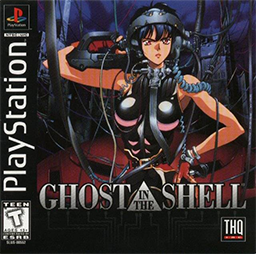 North American Cover | |
| Developer | Exact, Production IG |
| Publisher | Sony Computer Entertainment |
| Part of a series | Ghost in armor |
| Date of issue | July 17, 1997 |
| Genre | Action , TPS |
| Creators | |
| Supervisor | Kenji Sakaguchi |
| Producer | |
| Game designer | |
| Technical details | |
| Platform | Playstation |
| Game mode | single user |
| Carrier | |
| Control | gamepad |
The game's plot and decoration were written and created by Masamune Shiro , the creator of the original manga . The plot of Ghost in the Shell revolves around the actions of members of the ninth division of the PSIA , their investigation and the battle against the "Front for the Liberation of Humanity." The player controls the tatikoma - a mobile combat robot.
The game received mostly positive reviews. Particularly highlighted were graphics, animation and music, as well as unusual mechanics of movement on the walls. However, tedious and monotonous gameplay and low complexity have been criticized enough. Fifteen years after the release of Game Informer , Ghost in the Shell was added to the list of the best games based on manga or anime.
Content
Gameplay
In Ghost in the Shell, the player takes control of a spider-like wedge called tatikoma (from the English - “Fuchikoma”), which is capable of jumping, abrupt jumps, using strafe , moving along walls, and also hanging down from the ceiling using ropes [1 ] [2] . While moving along the walls and ceiling, the camera automatically adjusts to the current position in space, which allows free maneuvering [1] . If there is a barrier to the view, the camera automatically switches from a third person to a first one, although you can switch to this mode yourself at any time [3] .
Tatikoma is equipped with double machine guns and homing missiles [4] . Both weapons have unlimited ammunition, but at the same time no more than six missiles can be launched, after which time is required for reloading [1] . You can also use grenades, which can be found as you progress through the game, stored in no more than three pieces at a time. Enemies range from humanoid robots to helicopters armed with various firearms and explosives [4] . Some stages of the game have a time limit. During the game, up to seventeen cut scenes can be unlocked, the number of which depends on the player’s score in training mode [2] . After opening the cut-scene can be reviewed in a special menu item.
The training mode consists of six levels that teach the basic mechanics of the game. The first five stages teach the player to achieve goals in various ways and effectively use the control system, while the last stage is a battle with another tatikoma. Twelve story missions take the player to different locations with different environments, for example, storage rooms, sewers, city highways, enemy bases inside skyscrapers [2] . Missions have various goals: raiding an enemy base, clearing bombs, chasing at sea, finding a hiding target in thermo-optical camouflage .
Story
Ghost in the Shell tells of the Ninth Division , which includes: Major Motoko Kusanagi , responsible for the department of Daisuke Aramaki, Bato, Ishikawa, Saito, Togusa and the nameless Rookie, controlled by the player. The plot information is provided in the form of short briefings before assignments and in cut scenes.
The story of the game begins with the fact that a terrorist organization called the "Liberation Front of Humanity" ( Eng. - "Human Liberation Front"), takes responsibility for undermining the building of Megatech Body Corporation. The ninth department is appointed to resolve the situation. The department manages to track the communications of the terrorists and determine their location in a certain coastal area, but this place is a trap. Aramaki reports that the leader of the Liberation Front is a mercenary under the pseudonym Zebra 27. Then Ishikawa finds out that the Ministry of Energy is interested in documents related to Zebra. Aramaki orders further investigation.
Having tracked the organization’s supply lines, the department finds the Front’s secret base in the Aeropolis II tower. It turns out that the terrorists intend to use a nuclear reactor. Ishikawa reports to Aramaki that a large official named Savamura was in contact with Zebra and is related to Megatech Body Corporation. When a raid on an enemy base begins, the nuclear reactor is overloaded. To disable it, the team reaches the nearest control points and removes the installed protective barriers. After that, Kusanagi finds the terrorist leader at the very top of the tower. Bato and Togusa are cut off from the major, so only the Rookie comes to her aid. The battle with Zebra occurs in free fall from the tower.
After the mission, the truth is revealed that Savamura planned to take Megatech in exchange for concealing information about defects in a nuclear reactor, which was planned to be undermined for the purpose of a terrorist attack. However, Zebra captured the reactor to force Savamura to pay him.
Development
The idea of tatik originates from the scene of the final battle in the 1995 film - the battle between Major Kusanagi and a large arachnid tank in the Museum of Paleontology. On its basis, Shoji Kawamori and Atsushi Takiutsi created a small-sized single fur , armed with the police. It is the pilot of one of these machines becomes the player [5] .
Notes
- ↑ 1 2 3 Fielder, Joe Ghost in the Shell Review . GameSpot (December 10, 1997). Date of treatment September 3, 2013. Archived December 29, 2009.
- ↑ 1 2 3 Ghost in the Shell Preview // GameFan. - T. 5, No. 9. - S. 35. - ISSN 1092-7212 .
- ↑ Steve Key. Ghost in the Shell // Computer and Video Games. - No. 201. - S. 59. - ISSN 0261-3697 .
- ↑ 1 2 Nicholson, Gray Ghost in the Shell . Imagine Publishing (July 1, 1998). Date of treatment September 3, 2013. Archived November 12, 2013.
- ↑ Valery Korneev. PlayStation - Ghost in the Shell // Great Dragon . - No. 35. - S. 10-11. - ISSN 0868-5967 .
Links
- Official website (Japanese) .