Carl Friedrich von Weizsäcker ( German: Carl Friedrich von Weizsäcker ; June 28, 1912 , Kiel - April 28, 2007 ) is a German physicist and philosopher . Honorary Member of Leopoldina (1992).
| Karl Friedrich von Weizsacker | |
|---|---|
| Carl Friedrich von Weizsäcker | |
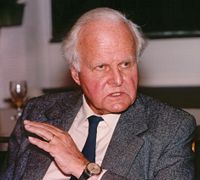 Karl Friedrich von Weizsacker | |
| Date of Birth | June 28, 1912 |
| Place of Birth | Keel |
| Date of death | April 28, 2007 (aged 94) |
| Place of death | Zöking |
| A country | Germany |
| Scientific field | physics |
| Place of work | |
| Alma mater | |
| supervisor | W. Heisenberg |
| Known as | author of the Weizsacker formula |
| Awards and prizes | Max Planck Medal (1957) Goethe Prize (1958) German Booksellers Peace Prize (1963) Erasmus Prize (1969) Messenger Lectures (1987) Sigmund Freud Prize for Scientific Prose (1988) Templeton Prize (1989) |
Content
Biography
Weizsacker comes from a Swabian family that has given many famous theologians , scholars, and the military. His grandfather was the Prime Minister of Württemberg , his father was a diplomat of the Nazi period Ernst von Weizsacker , his brother was the President of Germany in 1984 - 1994 Richard von Weizsacker . Already in the early years, Weizsacker showed interest in astronomy and physics. In 1929-1933 he studied physics in Berlin , Göttingen , Copenhagen (with N. Bohr ) and Leipzig (with W. Heisenberg ). As a young scientist, he first received a semi-empirical formula for the binding energy of the atomic nucleus , which was named in his honor by the Weizsacker formula . In 1942-1944 he was a professor of theoretical physics in Strassburg.
During the Second World War, together with V. Heisenberg and other German scientists, he worked on the creation of nuclear technologies for the Third Reich (“ Uranium Project ”).
In 1946-1957, Weizsäcker headed the department at the Institute for Physics of the Max Planck Society (Göttingen).
In 1956, Weizsacker, worried about the problem of nuclear weapons, together with other German nuclear scientists, spoke with the so-called. The Göttingen Declaration on the refusal to participate in the manufacture, testing or use of nuclear weapons. Since then, the problem of the scientist’s political responsibility for the social consequences of his discoveries has become one of the main topics of his thoughts.
- In 1957-1969 - professor of philosophy in Hamburg;
- Since 1970 - Director of the Institute for Physics of the Max Planck Society in Starnberg .
Philosophical Views
According to Weizsacker, philosophy should create an a priori foundation of private sciences , as well as verify the validity of the principles underlying them. The main task of philosophy, he believes, is to achieve a new understanding of the unity of nature, which is possible on the basis of a synthesis of philosophy and private sciences. It is here that the philosophical significance of fundamental physics is discovered (by which Weizsacker refers to quantum physics ). Only its axioms can be the basis of knowledge, since only they describe the conditions for the possibility of experience and represent the world as a whole. Weizsacker's attention is drawn to the dialogue of Plato " Parmenides ", which allows us to understand the conditions of the possibility of rationality itself and the scope of its applicability.
According to Weizsacker, a temporary structure is a condition for all experience. At the same time, the past is interpreted in the categories of really factual, and the future in the categories of opportunity. Statements about future events can only be made in the form of probabilistic judgments. The experience of quantum physics shows that judgments about the future in a strict form (the ideal of classical physics) are impossible. This fundamental difference between the past and the future is expressed by the 2nd law of thermodynamics . Weizsacker does not deduce from this law the traditional consequence of increasing entropy: if we abandon the causal interpretation of the future, then this consequence ceases to be necessary. On the basis of the 2nd law, one should rather conclude on the growth of the wealth of forms (as potential information). Such a view should correspond not to classical Aristotelian logic , but to “quantum”, endowing statements with the meaning of “true” / “false”, but “necessary”, “possible” or “impossible”.
Weizsacker is the author of a large number of articles on the problems of the modern world and culture. He sees one of the causes of the current crisis in the particularities of the development of “big” cultures, in which relations are built not on the basis of personal acquaintance, as in archaic antiquity, but on the processes of abstracting and quantifying mutual rights and obligations in the form of power and money.
Rewards
In 1989, he was awarded the Templeton Prize .
Major works
- Radiation emitted in collisions of very fast electrons (Ausstrahlung bei Stößen sehr schneller Elektronen), Z. Phys., 1934, 88, 612-625;
- Zum Weltbild der Physik, 1943; Die Geschichte der Natur, 1948;
- Die Verantwortung der Wissenschaft im Atomenzeitalter, 1957;
- Die Einheit der Natur, 1971; Wege in der Gefahr, 1977;
- Wahrnehmung der Neuzeit, 1983;
- Aufbau der Physik, 198S;
- Weizsacker K.F. Physics and Philosophy = Weizsacker CF von. Physics and philosophy // The Physicists Conception of Nature. Ed. J. Mehra. Dordrecht - Boston. 1973. P. 736-749. // Questions of Philosophy Year = 1993 / Translation by K. A. Tomilin. - No. 1 . - S. 115-125 .
Notes
Literature
- in Russian
- Weizsacker / I.A. Mikhailov // New Philosophical Encyclopedia : in 4 volumes / prev. scientific ed. Council V. S. Styopin . - 2nd ed., Rev. and add. - M .: Thought , 2010 .-- 2816 p.
- Garaja V.I. Weizsacker, Karl Friedrich von // Orthodox Encyclopedia . - M .: Church Scientific Center "Orthodox Encyclopedia" , 2003. - V. VI. - S. 500-501. - 752 s. - 39,000 copies. - ISBN 5-89572-010-2 .
- Hramov Yu. A. Weizsacker (Weizsacker) Karl Friedrich von // Physicists: Biographical Reference / Ed. A.I. Akhiezer . - Ed. 2nd, rev. and add. - M .: Nauka , 1983 .-- S. 59 .-- 400 p. - 200,000 copies. (in per.)
- in other languages
- Physik, Philosophie und Politik. Fur Carl Friedrich von Weizsacker zurn 60. Geburtstag. Munch., 1982;
- SchutzM, JC Einheit des Wirklichen. Carl Friedrich von Weizsackers Denkweg, 1986.
Links
- Weizsacker, Karl Friedrich von . Online encyclopedia " Krugosvet " (krugosvet.ru) . Date of treatment December 30, 2012. Archived December 30, 2012.