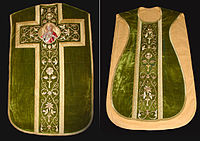
Kazula , or ornate ( lat. Casula - “cloak”) - an element of the liturgical vestments of the Catholic or Lutheran cleric . The main liturgical vestment of the bishop and priest . In Orthodoxy, it is similar to felony , in particular Greek, which, unlike the Russian one, does not have a high portal-like uplift.
Embroidered robe, similar to the Dalmatian , but without sleeves. It is worn on top of albums and tables . Color varies depending on the holiday.
There are two cuts of the Kazul: Romanesque and Gothic.
Romanesque cut involves the use of stiff fabric. Kazula in this case covers the body of the cleric in front and behind, leaving the sides and neck open. The cross and initials of the Savior are embroidered on the chapel - IHS ("Jesus Christ the Savior").
The gothic-style casula is more ancient in origin and almost analogous to the Orthodox felony (especially the Greek version). Covers the body of the cleric on all sides and has a neckline. Front and back on Kazulu, an ornate is sewn - a strip with embroidered crosses.
The Second Vatican Council practically abolished the use of Romanesque cut and prescribed the manufacture of a Gothic casula from light fabrics.

Romanesque Kazula
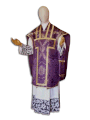
Kazula traditional cut, the beginning of the XVII century

Modern gothic kazul

Links
- Thurston, Herbert. "Chasuble." // The Catholic Encyclopedia . Vol. 3. New York: Robert Appleton Company, 1908.
- The development (and future?) Of vestments in the Roman rite