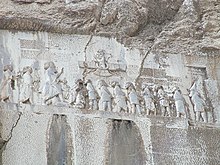
The Behistun inscription is a trilingual ( ancient Persian , Elamite and Akkadian ) cuneiform text on the Behistun rock (Bisutun), southwest of Ecbatan between Kermanshah and Hamadan in Iran , carved by order of King Darius I about the events of 523-521. BC e. The most important from the inscriptions of the Achaemenid kings and one of the largest epigraphic monuments of antiquity. Read (mostly) in the 30-40s. XIX century English scientist Henry Rawlinson , which marked the beginning of the decryption of cuneiform writing of many peoples of the ancient East .
Appearance

The Persian king tramples the defeated Gaumat with his foot, in front of him nine conquered leaders of the rebels ask for mercy, behind the king - a bodyguard and a warrior from the " immortal " detachment.
The inscription is carved on the territory of ancient Media at an altitude of 105 meters from the road connecting Babylon and Ecbatany [1] . The dimensions of the inscription are about 7 meters in height and 22 meters in width. The bas-relief depicts Darius under the auspices of the god Ahuramazda , meeting his defeated enemies. The rock below the inscriptions was chopped off vertically and made almost inaccessible for safety reasons.
The text consists of 4 columns written in three languages (Old Persian, Elamite and Babylonian) and dated 521-520. BC e., and 5 columns, written only in the ancient Persian language and which is the latest addition. The Behistun inscription includes the first (by dating of the preserved original) mention of Ahur Mazda (ancient Persian Auramazda) and the earliest known image of this god. The information about the coup of the “magician of Gaumata ” and the overthrow of Gaumata by Darius I, contained in the inscription, substantially supplement Herodotus’s story about the same events.
A relief is placed above the texts: the god Ahura-Mazda , stretching out his left hand to Darius, symbolically gives him royal power, and with his raised right hand he blesses the king. Darius is depicted in full size in the royal crown. His right hand in a prayer gesture is stretched out to Ahura Mazda, with his left he rests on a bow. With his left foot, Darius tramples on the defeated magician Gaumatu, who seized the throne during the life of Cambyses. Behind Gaumata, eight more insurgents are depicted, who rebelled during the ascension of Darius to the throne, and the rebellious leader of the Saka tribe of the tigrahaud. The hands of the prisoners are tied behind their backs, they are chained in one long chain. Behind Darius - his two soldiers, the spear-bearer Gobriy and the archer Aspatin. Columns of text stretch along the sides of the relief.
Today you can see inscriptions and reliefs only from afar - it is impossible to examine them from a close distance. More than 2500 years ago, the ancient sculptors, having finished their work, went downstairs and destroyed the stone steps behind them in order to exclude any opportunity to rise again to the monument. Perhaps that is why the Behistun inscription has been preserved relatively well to this day: no one's hand touched it. The same circumstance had a different turn: after a relatively short time, people forgot what, in fact, is depicted here. Already an ancient Greek physician and geographer Ctesias , at the turn of the 5th and 4th centuries. BC e. who lived in the Persian court, called the Behistun relief a monument to the Babylonian queen Semiramis [1] .
Label content
The Behistun inscription tells about the campaign of Cambyses in Egypt and the subsequent events. According to the inscription, Cambyses, before going against the Egyptians, ordered to secretly kill his brother Bardia . Then a certain magician (priest) Gaumata began to impersonate Bardia and seized the throne. Cambyses, who moved to Persia, died under mysterious circumstances, and the power of Gaumata was recognized in all countries of a huge Persian power. But seven months later, on September 29, 522 BC. e., noble Persian men secretly entered the palace where Gaumata was, and killed him. One of the conspirators, a distant relative of Cambyses, 28-year-old Darius, became king.
Herodotus and other ancient Greek historians tell about these events, but their stories are significantly different from the version presented in the Behistun inscription. Some modern historians believe that in fact, Darius killed Bardia, declaring him the magician Gaumata, in order to become king himself. However, it is unlikely that we will ever be able to clarify this issue exactly. In any case, the peoples of the Persian state were convinced that Bardia, son of Cyrus, reigned over them.
Copies of the inscription
The text of the inscription is presented in the three main languages of the state: ancient Persian, that is, the native language of Darius, Akkadian - the language of the Babylonians and Assyrians, as well as Elam, which was spoken by the Elamites , one of the most ancient cultural peoples inhabiting the southwestern regions of Iran. The inscription was also translated into many other languages, its text was sent to all areas of the state. One of these specimens has been preserved on papyrus from Egypt. It is written in Aramaic, the official clerical language of the entire Persian state. In the ruins of Babylon, a large stone block was also found with the Akkadian text of the Behistun inscription carved on it.
Darius, who launched a large propaganda activity in the main languages of the Persian Empire, in all likelihood, ordered the Behistun inscription to be translated into Greek, as well as to distribute it among the Greek population of Asia Minor cities. The Aramaic and Akkadian versions of this inscription and the direct indication of § 70 of the inscription that Darius ordered to distribute his version of the events of 523-521 that have survived to our time in Elephantine , in Egypt on the border with Nubia, and in Babylon. in all countries of the Persian Empire, there is no doubt that the Behistun inscription was translated into many languages and distributed throughout the state. Biblical sources also confirm that the Achaemenids wrote "to each region with its letters" and "to every people in their language" [2] .
Filmography
- The History of Writing ( The Written Word ) is a popular science film shot in 2005.
Notes
- ↑ 1 2 Nizovsky, Andrey. Henry Rawlinson and the Behistun Inscription // 100 Great Archaeological Discoveries. - M .: Veche, 2002 .-- 544 p. - (100 great). - ISBN 5-94538-116-0 .
- ↑ Dandamaev M.A. Reflection of the content of the Behistun inscription in the work of Herodotus // Brief Communications of the Institute of Asian Peoples. Iranian philology. - M. , 1963 .-- T. 67 . - S. 190—192 .
Literature
| UNESCO World Heritage Site No. 1222 Russian • English • fr. |
- Dandamaev M.A. Reflection of the content of the Behistun inscription in the work of Herodotus // Brief Communications of the Institute of Asian Peoples. Iranian philology. - M. , 1963 .-- T. 67 . - S. 190—192 .
- Dandamaev M.A. Uvāmaršiyuš amariyatā of the Behistun inscription // Ancient World: Collection of articles: [Dedicated to] acad. V.V. Struve / Acad. sciences of the USSR. Institute of Asian Peoples; Ed. Collegium: Corr. Acad. Sciences of the USSR N.V. Pigulevskaya et al. - M .: Publishing House of Oriental Literature, 1962. - S. 371-376. - 658 p.
- Struve V.V.Dating of the Behistun inscription // Bulletin of Ancient History . - 1952. - No. 1 . - S. 26-48 .
Links
- Behistun inscription of Darius I . rec.gerodot.ru. Date of treatment June 20, 2018.