Pavoraja nitida (lat.) Is a species of cartilaginous fish of the genus Arhynchobatidae of the stingrays . They live in temperate waters of the Indo-Pacific region between 32 ° S. w. and 44 ° S w. They are found at a depth of up to 450 m. Their large, flattened pectoral fins form a rounded disk with a triangular snout. The maximum recorded length is 36.8 cm. Eggs are laid. They are not the target fishing target [1] [2] [3] .
| Pavoraja nitida |
 |
| Scientific classification |
|---|
| No rank : | Bilateral symmetrical |
| Subfamily : | One-Feathered Rays |
|
| International scientific name |
|---|
Pavoraja nitida ( Günther , 1880) |
| Synonyms |
|---|
- Raja nitida Günther, 1880
|
| Security status |
|---|
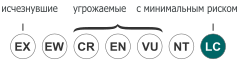
Least ConcernedIUCN 3.1 Least Concern : 161370 |
|
Content
The new species was first scientifically described in 1880 as Raja nitida [4] . Species epithet comes from the word lat. nitidus . - "bright." The holotype is a male 20.9 cm long, caught in the waters of New South Wales [5] .
These rays are endemic to the southeast coast of Australia. They are found on the continental shelf and in the upper part of the continental slope at a depth of 75 to 450 m [2] .
The broad and flat pectoral fins of these slopes form a rhombic disk with a wide triangular snout and rounded edges. On the ventral side of the disc are 5 gill slits, nostrils and mouth. The tail is longer than the disk. There are lateral folds on the tail. These skates have 2 reduced dorsal fins and a reduced caudal fin [1] .
The maximum recorded length is 36.8 cm [3] .
These stingrays lay eggs enclosed in a horn capsule with "horns" in the corners. The capsule is 5.7 cm long and 3.8-4.4 cm wide [3] . Males reach puberty with a length of 30.7 cm [2] .
These ramps are not the target fishing target. Caught in by- catch . The annual catch of this species in 2000-2006 is estimated at 70 tons. The International Union for Conservation of Nature has rated the conservation status of the species as “Least Concerned” [2] .
- ↑ 1 2 Froese, Rainer, and Daniel Pauly, eds. Family Anacanthobatidae - Smooth skates (neopr.) . FishBase (2014).
- ↑ 1 2 3 4 Pavoraja nitida . The IUCN Red List of Threatened Species .
- ↑ 1 2 3 Pavoraja nitida in the FishBase database.
- ↑ Günther A. Report on the shore fishes procured during the voyage of HMS Challenger in the years 1873-1876 // Report on the shore fishes procured during the voyage of HMS Challenger in the years 1873-1876. - 1880. - Vol. 1, no. (6) . - P. 1-82, Pls. 1-32.
- ↑ Pavoraja nitida (neopr.) . Shark-References. Date of treatment March 18, 2016.
- Species of Pavoraja nitida (English) in the World Register of Marine Species .