Dejo (Dezho) Szabo ( Hungarian. Dezső Szabó ; June 10, 1879, Klausenburg , Austria-Hungary - January 5, 1945, Budapest ) - Hungarian linguist and writer, known for nationalist and anti-Semitic views. Szabo was one of the first "pioneers of the Magyar populist literature" [3] . In 1935 he was one of the nominees for the Nobel Prize in literature .
| Dejo Szabo | |
|---|---|
| Hungarian Dezső Szabó | |
| Date of Birth | |
| Place of Birth | Clausenburg , Austria-Hungary |
| Date of death | |
| Place of death | |
| Citizenship (citizenship) | |
| Occupation | prose writer |
| Language of Works | |

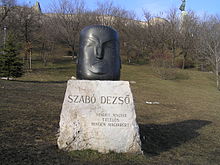
Biography
Sabo moved to Budapest in 1918. He began to publish short essays in the literary revue of Nyugat . Initially supported the 1918 Hungarian Revolution . Arthur Köstler , who was in high school at that time, recalled Szabo as one of the new teachers assigned to his school by the revolutionary regime: “a shy, quiet, somewhat distracted person, he told us about something more distant than the Moon: everyday the life of hired agricultural workers in rural areas ” [4] .
The support of the revolution was, however, brief, and soon Szabo became an outspoken and fierce opponent of the short-lived Hungarian Soviet Republic , proclaimed White Kun .
Szabo quickly gained fame and notable influence and established himself as a fruitful writer. For the first time, he earned the attention of the general public with his three-volume novel 1919 “Az elsodort falu” (“The Ruined Village”), an expressionist work that promotes the idea that the origins of the Hungarian revival should be sought in the peasantry, and not in the middle class, which Szabo considered “a tainted mentality assimilated Germans and Jews ” [5] This book enjoyed considerable influence during the“ white terror ”after the suppression of the communist revolution. Although he later published many more books, the first was considered the peak of his literary achievements [6] .
Szabo is called the first “intellectual anti-Semite among Hungarian writers” [3] . He was a regular contributor to Virradat , one of the most radical anti-Semitic periodicals of the interwar period, in which he published at least 44 articles in three years. These articles painted a very apocalyptic picture and were sustained in alarmist tones, reprimanding the Hungarian people for their "weakness".
There is ongoing discussion about whether Szabo called for the physical extermination of Hungarian Jews. According to Yehuda Marton, an Israeli-Hungarian scholar who authored an article on Szabo in the Jewish Encyclopedia , the writer explicitly called for destruction at a public meeting in 1921 [7] . On the other hand, the writers’ apologists note that in the Ruined Village Miklos (a key figure in this work) says to the old Jew: “If you only knew that all my anger stems from the fact that I understand how we depend on each other friend, from my love for you. " Such a statement is incompatible with the statement that the author wants to kill all Jews. There is no doubt that Szabo in his writings harshly attacked the Jews. This undermined their position in Hungarian society and, it could be said, contributed to the extermination of Jews in 1944 - regardless of whether Szabo himself demanded it.
At the same time, Szabo shared anti-German sentiment, and in 1923 launched a campaign to eradicate German influence in Hungary. After 1932, he was also openly against the Crossed Arrows , the party of Hungarian fascists, without giving up his anti-Semitic views.
This combination of ideas was connected with his own specific racism, which Szabo called the “apotheosis of the Hungarian race”.
Its influence, significant in the 1920s, waned in the next decade. In 1935, he was nominated for a Nobel Prize in literature , but the committee did not award it to anyone this year.
Szabo died in January 1945, during the siege of Budapest by the Soviet Army .
Works
- Az Elsodort Falu (1918)
- Csodálatos élet (1920)
- Jaj! (1925)
- Feltámadás Makucskán´ (1925)
- Karácsony Kolozsvárt (1931)
Notes
- ↑ 1 2 3 German National Library , Berlin State Library , Bavarian State Library , etc. Record # 119041669 // General regulatory control (GND) - 2012—2016.
- ↑ 1 2 3 BNF identifier : Open Data Platform 2011.
- ↑ 1 2 Lukacs, John. Budapest 1900 . Grove Press, 1994. p.168
- ↑ Arthur Koestler, “Arrow in the Blue - An Autobiography”, London, 1953, Ch. eight
- ↑ Held, Joseph. Columbia History of Eastern Europe in the Twentieth Century . Columbia University Press, 1993. p. 196
- ↑ Joseph Varga, “GUILTY NATION or UNWILLING ALLY? A short history of Hungary and the Danubian basin 1918-1939 »
- ↑ Dr. Yehuda Marton, Hebrew Encyclopedia, Jerusalem, 1974, Volume 25 p. 422 (Hebrew)