Vialie is a lake in the Gatchina and Luga regions of the Leningrad Region .
| Lake | |
| Vialier | |
|---|---|
 | |
| Morphometry | |
| Absolute height | 70 m |
| Dimensions | 8.3 × 3.5 km |
| Deepest | 9 m |
| Location | |
| A country |
|
| The subject of the Russian Federation | Leningrad region |
| Identifiers | |
| HWR : | |

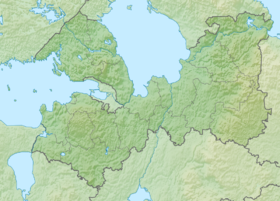


The lake is of glacial origin, located in the integrated federal reserve " Mshinsky swamp ."
Content
- 1 Description
- 2 Fauna and Flora
- 2.1 Birds
- 2.2 Animals
- 2.3 Fish
- 2.4 plants
- 3 History
- 4 notes
- 5 Links
Description
The length of the lake is 8.3 km , width - 3.5 km , the greatest depth - 9 m .
The lake is stretched from north to south and is connected to the neighboring Strachno Strait Lake, so that the lakes form a single body of water with an area of 35.8 km².
The shores of the lake are low, swampy, indented by bays and bays; the bottom is flat, peaty , covered with silt. The coastal vegetation is sparse; pine , spruce , birch , alder , silver willow , and the bank are overgrown with reeds , horsetail, and sedge . In some places, the coast smoothly turns into a swamp .
The lake is hard to reach, you can only get along the paths through the nearby swamps.
Fauna and Flora
Birds
Many types of ducks nest on the lake: gogol , mallard duck, teepee , teal , pintail , broad-nosed , etc. In addition, geese and black loons are found .
Beasts
Beavers are found on the lake, and in 1950, 53 black-brown muskrats were released into the lake (the birthplace of the animals is North America ). Here they took root and multiplied. Muskrats are under special protection of the reserve.
Fish
There are perch , pike , and ruff in the lake .
Plants
There are up to 90 species of plants on the lake and its shores. These are sphagnum mosses , sedges , cotton grass , cloudberries , cranberries , blueberries , heather , low marsh pine , etc. In some places you can see water lilies .
A peculiarity of the lake flora is water citrate sown here in 1912 by the Russian scientist V. Ya. Generozov, also known as “wild rice” or tuscarora [2] . It forms a kind of ring thickets that occupy a significant area and is readily eaten by waterfowl.
History
During the war , a partisan base was located in the area of the lake, from where attacks were made at the nearest railway station, where fascist depots with ammunition were located. The Germans' attempts to liquidate the base failed.
Notes
- ↑ Surface Water Resources of the USSR: Hydrological Understanding. T. 2. Karelia and the North-West / ed. E.N. Tarakanova. - L .: Gidrometeoizdat, 1965 .-- 700 p.
- ↑ Generozov V. Ya. Spring Hunting and Planned Hunting // Hunter and Fisherman, 1926, No. 5, pp. 106-108 (inaccessible link) . www.ptushki.org . Date of treatment August 3, 2016. Archived on August 3, 2016.
Links
- Lakes of the right tributaries of the Luga (Inaccessible link - history ) . web.archive.org . Date of treatment January 17, 2019.