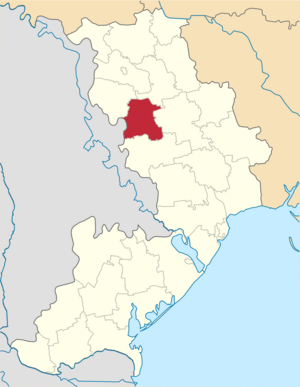
Zakharyevsky district ( Ukrainian Zakharivsky district , until 2016 - Frunzovsky district , Ukrainian Ukrainian Frunzivsky district [2] ) - an administrative unit in the north-west of Odessa region of Ukraine . The administrative center is the village of Zakharyevka .
| area | |||||
| Zakharyevsky district | |||||
|---|---|---|---|---|---|
| Zakharivskyi district | |||||
| |||||
| A country | Ukraine | ||||
| Included in | Odessa region | ||||
| Adm. Centre | Zakharyevka | ||||
| History and Geography | |||||
| Date of formation | 1927 | ||||
| Square | 956 km² | ||||
| Timezone | EET ( UTC + 2 , summer UTC + 3 ) | ||||
| Population | |||||
| Population | 20 034 [1] people ( 2017 ) | ||||
| Nationalities | Ukrainians , Moldavians , Russians , Belarusians [1] | ||||
| Official language | Ukrainian | ||||
| Digital identifiers | |||||
| Postal codes | |||||
 | |||||
![Flag [d]](http://upload.wikimedia.org/wikipedia/commons/thumb/0/04/Zakharivka_Raion_Flag.svg/160px-Zakharivka_Raion_Flag.svg.png)
![Coat of arms [d]](http://upload.wikimedia.org/wikipedia/commons/thumb/6/6f/Zakharivka_Raion_COA.png/90px-Zakharivka_Raion_COA.png)
Content
Geography
The Kuchurgan River flows through the territory of the district. In the northwest it borders on Oknyansky , in the north with Podolsky , northeast Ananyevsky , east Shiryaevsky , in the south with Velikomikhaylovsky areas. In the west, the state border with Moldova ( Grigoropol district of Transdniestria ).
History
Traces of a settlement of the Mesolithic era (13 thousand years ago) and a large burial ground of Chernyakhov culture of the 3rd – 6th centuries AD were found in the area. The district center and the district were named after the Soviet commander M.V. Frunze , whose father was born and lived here for a long time, until Prince Argutinsky-Dolgorukov gave him soldiers.
In 2016, the district center changed its name to Zakharyevka, and the district was called Zakharyevsky.
Civil War. Events at Zatishye Station in the Fall of 1919
Before the onset of the “ whites ” from the south and the Petliurists from the north, the area was under the control of the “ reds ”.
Approaching the Odessa direction, units of the UNR army reached the station. Birzula (today the city of Podolsk ). In this area, the Volyn group of Petliurists is located. Its basis was: 1st Northern Division and 4th Division of Greyhounds . According to rumors, a white landing was expected in the Odessa region, and the group was supposed to be a barrier against volunteer units . The 2nd Pereyaslavsky cavalry regiment under the command of Colonel Nikolai Arkas was advanced to Perekrestovo station (the closest north of Lull ). The number of the regiment exceeded 300 people, but hardly one third of them were armed. There were three machine guns in the regiment, and one was faulty.
The 3rd Consolidated-Dragoon Novorossiysk Regiment, after taking Odessa (together with officer organizations) moved north and reached the Zatishye station.
Arkas, in a personal meeting with Lyashkov, assured the latter that he and his fighters, having the same goal of fighting the Bolsheviks, are allies of the Good Army. Lyashkov believed Arkas - and calmed down on that, fully confident that he was standing side by side with the Allies.
The first contacts between the representatives of the two armies were quite peaceful. This went on for several days until the dragoons were suddenly attacked and disarmed by the Petliurists.
On September 24, 1919, the centurion horseman of the Maxim Zaliznyak regiment, Alexei Tsarenko, with his 50th Cossacks attacked the 3rd Dragoon Novorossiysk regiment located near the Zatishye station in the echelon. 50 Ukrainian Cossacks captured 326 well-armed people. It was also captured: 2 guns, 16 machine guns, 380 horses, a train with 29 wagons.
The commander of the Novorossiysk, captain Lyashkov, convinced of the peace of Arkas and therefore not taking security measures, shot himself.
Later, already in exile, Colonel Arkas described this episode in detail. He said that the inhabitants of Lull informed him that the “whites” were going somewhere, but there was no connection with the station. Then Arkas sent his horsemen for reconnaissance , but the whites, having noticed them, opened fire, after which they were attacked and disarmed. For reconnaissance, the Petlyura commander used almost all the armed men in the regiment.
It is unclear whether Arkas was afraid that he would be really attacked, and the message about the training camp in Lull confirmed him in this thought, or, taking advantage of the moment, he decided to seize the white battery . But there was a clash, and then Arkas had to reject the accusations of starting a war between the Petliurists and the whites.
For some time, both the “whites” and their own accused Colonel Nikolai Arkas of causing a war between the UNR and the Volunteer Army of General Anton Denikin . It was believed that the outbreak of war was more beneficial to the White Army.
On December 15, 1919, by order of the UPR army, Arkas was declared a traitor. Most of the regiment soon returned to the UPR army.
Alternative Opinions
- Hetman Pavel Skoropadsky was personally acquainted with Arkas, since the latter was his personal guard (in November 1918 he was arrested by hetman intelligence agencies for participating in the preparation of the uprising against the hetman). In his memoirs about this incident, Skoropadsky writes the following: “Nikolai Arkas divided his regiment in two - 45 soldiers each - and sent them to the flanks of the dragoons. And he, with a dozen staff officers, captured an enemy battery. After that, he invited Denikin to lay down his arms, because otherwise he would introduce the “second regiment” into the battle. The one that he really didn’t have. The Denikinites laid down their arms, the barefoot Makhnovists jumped out of hiding and armed themselves. Only then did the dragoons realize how shamefully they lost the battle. Their commander shot himself. Arkas ordered him buried with all honors. The station where this happened was called Calm. ”
- According to one opinion, the Ukrainian cavalrymen surrounded at night and then calmly disarmed caught by surprise, sleepy dragoons (presumably, according to the memoirs of officers of the Combined Dragoon Regiment).
Population
The population of the district is 21,029 people, of which the urban population is 8,653, and the rural population is 12,376.
Administrative device
Number of Tips:
- settlement - 2
- rural - 11
Number of settlements:
- urban-type villages - 2
- village - 51
Economics
The economy of the district is agricultural. In recent years, many enterprises have closed. Among them are Zatishansky: oil depot, asphalt plant, mezhraybaz, raisnab; Frunzovsky: feed mills and brick factories, Neptune plant, KSP Vesna and Frunze, as well as others. As a result, the unemployment rate exceeds 10 percent. Small business continues to develop, mainly in the field of trade. Of the ten industrial enterprises operating in the region, the largest are represented by Zatishanske KhPP OJSC (including an elevator), Frunzovsky Distribution Zone, Frunzovsky Telecommunication Shop No. 14. Of the agricultural enterprises, OOO-16, SFG-92, LLC Pravda , SFG "Olga", SFG "Crane". Objects of public services: two dormitories, three hairdressers, nineteen clubs, twelve libraries, one hotel.
Medicine
Medical assistance to the population is provided by 26 medical institutions (CRH, three family medicine outpatient clinics, sixteen FAPs, eight pharmacies).
Education
There are 21 educational institutions in the district, among them: an agricultural lyceum, a sports school, a music school, five kindergartens, and a children's creativity house.
Transport
The main line of the Odessa railway passes through the district. Railway stations: Lull, Ivanovka, Perekrestovo. Stopping platforms: Torosovo, Victory and the First of May. From the Zatishye station, you can directly transfer to the following regional centers: Odessa, Kharkov, Lviv, Vinnitsa, Khmelnitsky, Ternopol, Ivano-Frankivsk, Chernivtsi, Cherkasy, Poltava, Kropyvnytsky, Rivne, Lutsk. Regular bus service on the routes: Calm - Zagorye - Zakharyevka - Osipovka - Pavlovka; and Glubokoyar - Mayorskoye - Zakharyevka - Novaya Shibka - Novonikolaevka - Karabanovo - Kosharka, it’s quite well established.
Famous Natives
- In 1854, Vasily Mikhailovich Frunze, the father of the Soviet statesman and military leader Mikhail Frunze, was born in Zakharyevka
- In 1896, a lieutenant colonel of the UPR army (in exile, Coronet-General ) Pavel Bazilevsky was born in Lull .
- In 1899, in the village of Torosovo (then the German colony Hoffnungsfeld), the statesman and politician of the Third Reich, George Leibrandt, was born.
- In 1921, in the village of Novonikolaevka , Hero of the Soviet Union Nina Onilova was born.
Notes
- ↑ Number of population (per estimate) for 1 grass 2017 year // Head of Statistics Department in Odessa Oblast
- ↑ Resolution of the Verkhovna Rada of Ukraine “On the change of the population of the towns and districts” No. 1377-VIII of 05/19/2016 (Ukrainian)
Links
- The district registration card on the website of the Verkhovna Rada of Ukraine (in Ukrainian)
- List of settlements of Kherson province. Tiraspol County.
- Історія міст і іл Ukrainian RSR: В 26 t. Odessa region (Ukrainian) (unavailable link)
- Official website of the National Civil Service of Ukraine (P. Gai-Nizhnik “Hetman Pavel Skoropadsky Headquarters”) (in Ukrainian) (inaccessible link)